By Mohammad Ali Haqshenas
Long before modern humans existed, another kind of human was already living in a cave west of Qazvin, and the tools and teeth they left behind are now rewriting Iran’s human story.
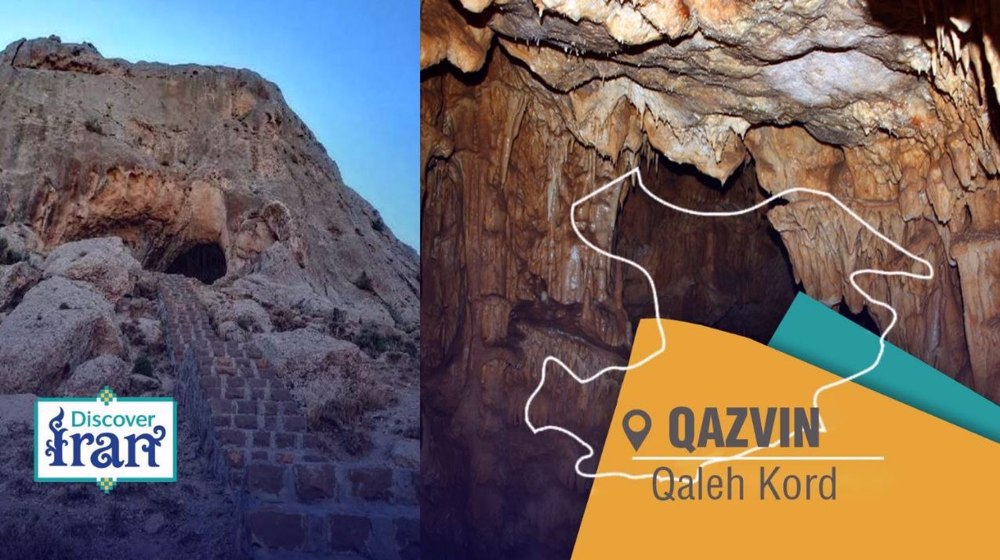
In the hills southwest of Qazvin, a mountain hides a passage straight into deep time; Qale Kord Cave. Walk through its wide entrance, and you find yourself in the cave whose floor holds thousands of years of buried history.
Deeper inside, the cave drops into a vertical shaft that leads to a stone hall the size of a football field. And according to the archaeologists who have spent years digging through it, it holds the oldest evidence of human life ever found in Iran.
Qale Kord sits about 20 kilometers from the twin towers of Kharaqan, in a small village called Hesar in Aavaj county. It lies more than 2,000 meters above sea level, tucked between the Alborz mountains and the vast Iranian plateau.
The cave itself is far older than anything found inside it. Geologists trace its rock back tens of millions of years, to an era long before humans existed. But it is what happened much more recently — over the last several hundred thousand years — that has made Qale Kord famous.
The cave has two very different parts. Near the entrance, ancient humans appear to have camped and worked, leaving behind the layers of soil that archaeologists have been excavating season after season.
Deeper inside, the cave floor opens into a 12-meter vertical shaft, which drops into a hidden hall roughly 50 by 20 meters, with a ceiling towering 20 meters overhead. Bats live down there in damp, cool air that hovers between 15 and 20 degrees Celsius. Nobody should descend the shaft without proper caving training and equipment.
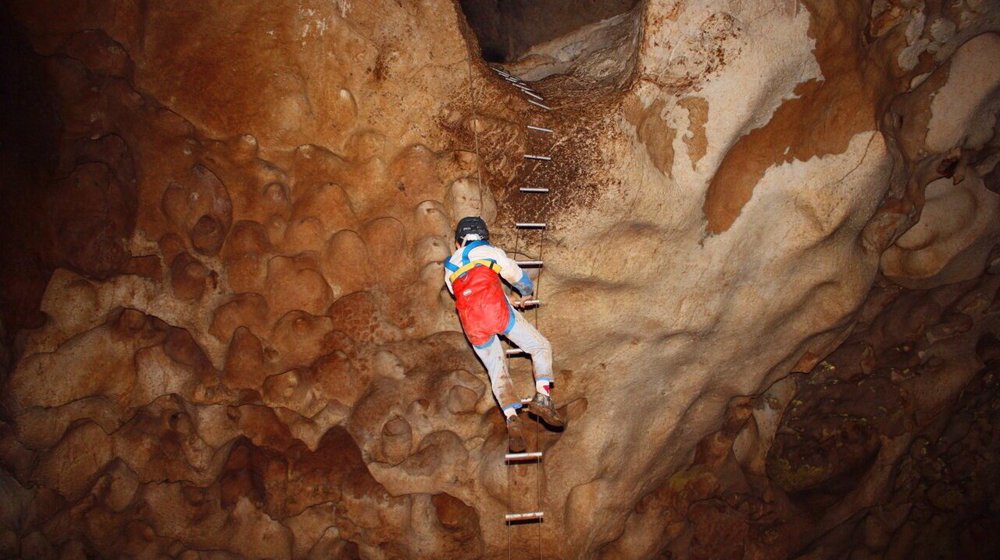
That inner shaft, researchers say, is likely why the cave survived so well. It kept looters and antiquities smugglers from reaching the deepest chamber for centuries.
But most of what archaeologists have actually found — the stone tools, animal bones, and human teeth that have made Qale Kord famous — has come not from that hidden hall, but from the entrance area itself, where excavation is still ongoing.
Teeth from nearly 180,000 years ago
The cave’s connection to ancient humans first drew wide attention when a joint Iranian-French team, led by Hamed Vahdati Nasab of Tarbiat Modares University and Gilles Berillon of the French National Center for Scientific Research in Paris, began publishing their findings in leading archaeology journals.
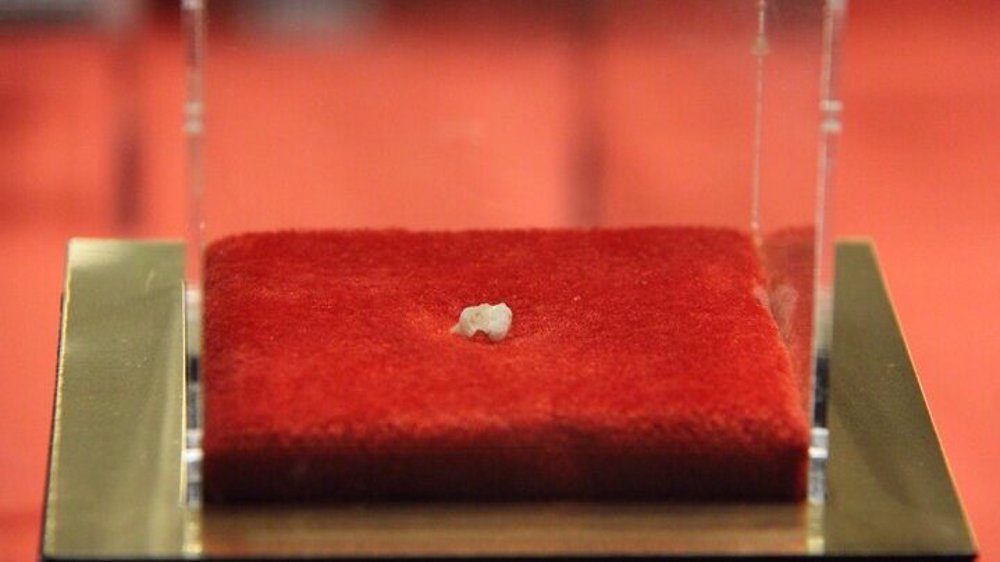
Their most striking discovery: two Neanderthal teeth, dated to roughly 175,000 and 180,000 years ago. It was the first such find in Iran, and the dating was confirmed by a university laboratory in France. Alongside the teeth, the team has recovered a large number of stone tools and animal bones.
Dating remains at Qale Kord relies on techniques that measure natural radiation trapped in buried material — methods scientists call electron spin resonance and uranium-thorium dating. In plain terms, these tests estimate how long a sample has been sealed underground, based on how radiation has slowly built up inside it over time.
The results have been striking. Cultural deposits — the layers of soil where ancient tools and remains are found — have been dated to more than 452,000 years old. That makes Qale Kord the oldest known site of human presence on the Iranian plateau, and one of the oldest in the wider West Asian region.
“We are talking about a type of human that, based on the latest dating at Qale Kord Cave, goes back about 455,000 years,” Vahdati Nasab said in an interview with Asriran website in June 2025. “This age is not final. In the most conservative scenario, we estimate these findings could reach 650,000 to 700,000 years.”
He explained who might have lived there before the Neanderthals. “Modern humans appeared on Earth only 50,000 to 60,000 years ago,” he said. “Before us, other kinds of humans existed. In Iran, Neanderthals occupied this land between roughly 40,000 and 400,000 years ago. Go back further than that, and other human types lived on the Iranian plateau — ones we no longer call Neanderthals. We call them Homo heidelbergensis, or possibly Homo erectus.”
No bones from those earlier humans have turned up yet at Qale Kord. But the team has found indirect clues: stone tools and broken animal bones, evidence of hunting, in layers that date to before the Neanderthal era.
A careful excavation
Working at Qale Kord’s entrance has taken patience. Some ground near the surface had been disturbed by unauthorized digging in years past, long before the scientific team arrived, which made mapping the site an early challenge.
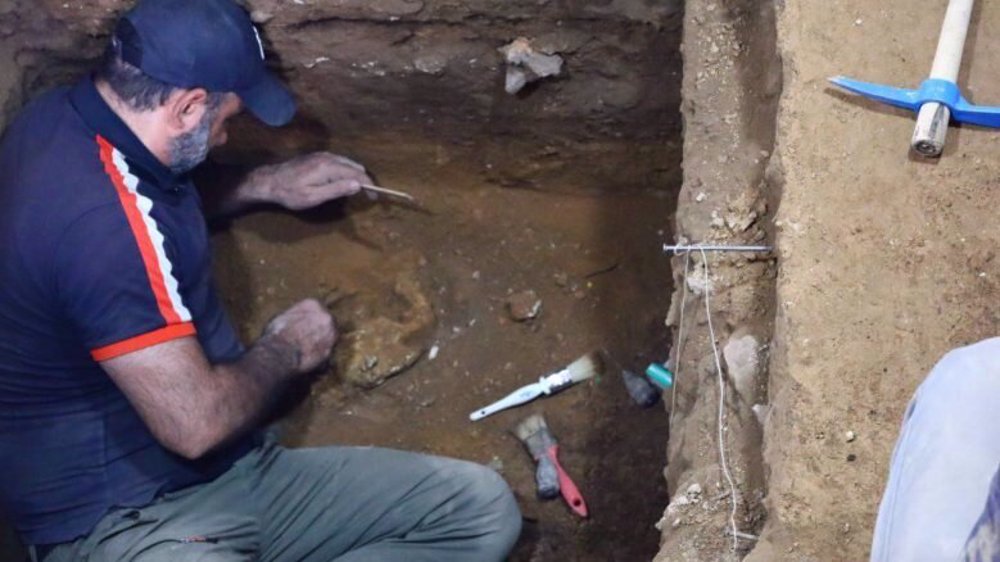
“We had two choices: open a new trench, or carefully work through the disturbed ground that was already there,” Vahdati Nasab said. “We sieved through it by hand. A good deal of context was lost, but tens of thousands of bone fragments and stone tools still came out of that soil.”
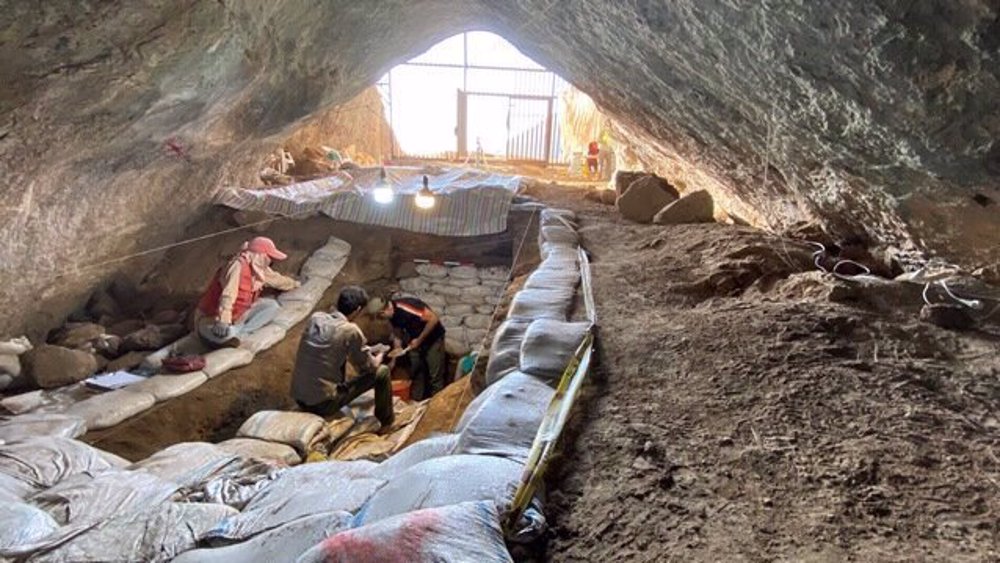
The first excavation season, in 2018, was largely spent salvaging material this way. A second season followed in 2019, when the team found the baby tooth of a young Neanderthal child, dated to about 155,000 years old. It is now on display at the Qazvin Museum.
The COVID-19 pandemic then forced a three-year pause, which researchers used to run detailed dating studies on what they had already collected. Digging resumed with a third season in 2021, followed by a fourth in 2022 and a fifth in the summer of 2023.
Even after three more seasons of careful excavation at the entrance, the team has yet to reach the bottom of the disturbed ground. “We are now seven meters down and still haven’t hit the bottom,” Vahdati Nasab said. “Those seven meters represent an enormous amount of information that can never be fully recovered.”
Despite the losses, the scientifically excavated layers have yielded remains of an extinct cave hyena — two to three times the size of hyenas alive today — along with an extinct cave bear, a woolly two-horned rhinoceros, and several species of prehistoric horse.
Who lived here before the Neanderthals?
The deeper the team digs, the older — and stranger — the picture becomes. A newly found human tooth, dated to about 180,000 years, was unveiled at a National Museum exhibition last year. Layers from the third and fourth seasons, several meters below the 455,000-year mark, are still awaiting lab results.
“Finding fossils of extinct humans is like winning the lottery,” Vahdati Nasab said, describing an old saying among his colleagues.
Preserved human remains that survive hundreds of thousands of years underground are exceptionally rare — which is why the team leans heavily on indirect evidence, like tools and butchered animal bones, to reconstruct who was living in the cave and when.
He believes Qale Kord may eventually prove older than any confirmed Neanderthal site in the region, including Shanidar Cave in Iraqi Kurdistan, sometimes called the “Neanderthal paradise” for its eleven sets of remains.
He also points to Dmanisi in Georgia, where 1.77-million-year-old skulls were found, as a hint that early human ancestors may have passed through Iran on their way across Asia — something Qale Kord could eventually help confirm.
A site still full of secrets
Piecing together daily life at Qale Kord has led to some vivid theories. The valley in front of the cave holds a stream, and researchers suspect Neanderthals may have driven herds of wild horses into it, ambushing them from both sides — a coordinated hunt for an animal too fast to catch any other way.
Skeletal evidence from Neanderthal sites elsewhere shows old fractures in arms, collarbones, and ribs that healed over time, suggesting both men and women took part in dangerous hunts and had a high tolerance for pain.
Vahdati Nasab estimates the site will need at least another decade of steady excavation as the seventh season started in mid-August this year.
For now, each new season adds another layer — sometimes literally — to a story that keeps pushing the record of human life in Iran further into the past.