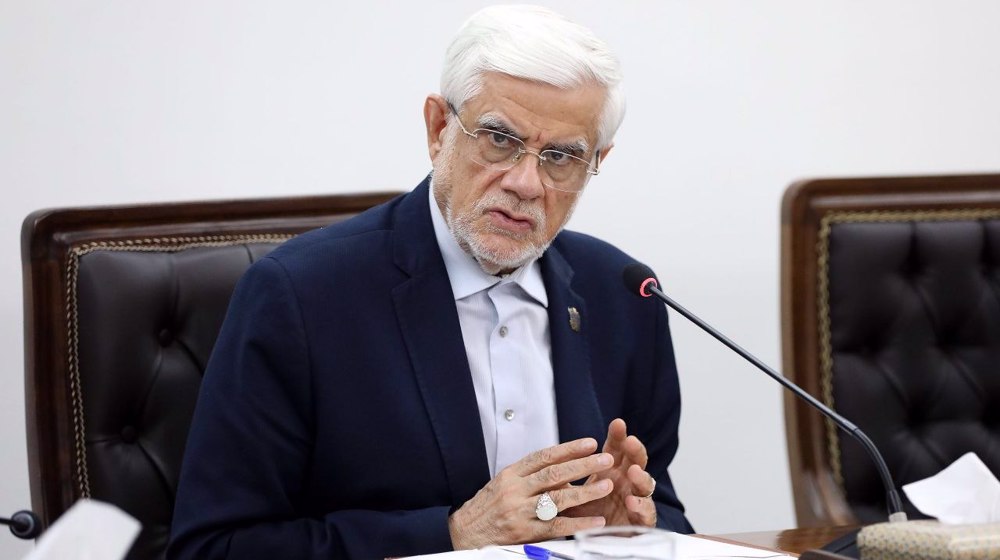
First Vice President Mohammad Reza Aref has announced a fundamental shift in Iran’s defense doctrine, warning that future responses to US aggression will be “asymmetric” and “multi-layered,” while cautioning American citizens to prepare for severe economic disruptions.
In a message posted on X, Aref declared that the recent wave of US military attacks on Iranian soil has permanently altered Tehran’s security equations.
“The new crimes committed by the United States against the Iranian nation have changed our security equations and defense doctrine,” Aref wrote. “From now on, our response will be ‘asymmetric,’ ‘multi-layered,’ and ‘security-depriving for the aggressor.'”
The first vice president issued a warning directed at the American public and the broader US economy.
“Americans should start thinking about stockpiling gasoline and fuel,” Aref stated. “Dark months await the American economy.”
The shift in Iran’s defense strategy comes in the wake of a series of US airstrikes late Tuesday night that targeted civilian areas and non-military infrastructure across several Iranian provinces, including Hormozgan, Khuzestan, Sistan-Baluchestan, and Kerman.
The most horrific incident occurred in the village of Kouhestak in Sirik County, Hormozgan Province, where a US missile struck a wedding celebration.
The massacre martyred and wounded more than 70 people, the vast majority of whom were women and children.
Aref’s warning arrives as the US and its allies are already reeling from a severe energy crisis triggered by the very war Washington initiated.
Since Iran imposed wartime restrictions on the Strait of Hormuz in late February, the American public has endured skyrocketing gasoline prices.
However, a more crippling “diesel shock” is now threatening the US supply chain.
According to energy analysts, the spread between diesel and crude oil prices in the United States has now surpassed $100.
Strangled West Asian oil exports, compounded by declining global refinery capacities, have created a deepening diesel supply crunch that threatens to disproportionately devastate the economies and agricultural sectors of several US states.
The economic blowback is also severely impacting Washington’s European allies. As the US escalates its strikes against Iran, European benchmark natural gas futures have surged to their highest levels since January 2023.
Dutch front-month futures recently jumped nearly 6 percent to €73.95 ($85.62) per megawatt-hour, surpassing earlier wartime peaks.
Traders are now pricing in a prolonged disruption to liquefied natural gas (LNG) shipping from West Asia, sparking panic over severe energy shortages just ahead of the critical European winter heating season.