
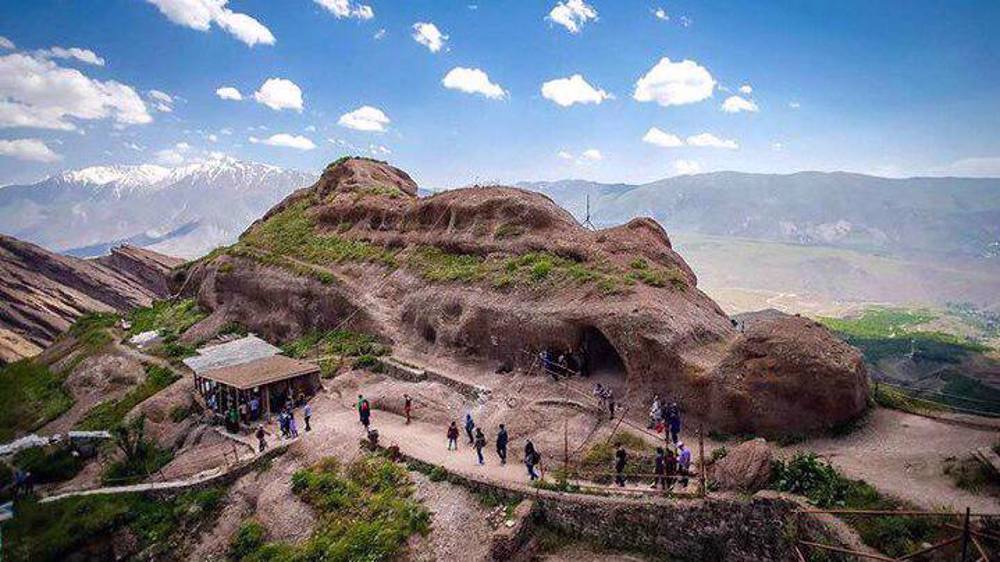
Iran’s 1,100-year-old Alamut Castle and its associated military fortifications have been inscribed on the UNESCO World Heritage List, bringing the country’s total number of World Heritage sites to 30.
The decision was approved on Sunday during the 48th session of the UNESCO World Heritage Committee in Busan, South Korea.
The successful nomination, titled “Alamut Castle and Its Associated Fortifications,” was confirmed by UNESCO’s evaluators, according to Alireza Izadi, director general for the registration, preservation, and restoration of Iran’s cultural and natural heritage.
The newly inscribed property comprises a chain of seven medieval fortresses: Alamut, Lambsar, Novizar Shah, Shams Kalayeh, Qostin Lar, Shirkuh, and Ilan.
Located near the village of Gazor Khan in Iran’s Qazvin province, around 200 kilometers northwest of Tehran, Alamut Castle is perched atop a rugged rocky peak overlooking the Alamut Valley.
Rising about 220 meters above the surrounding landscape at an elevation of 2,163 meters, the fortress dominates the southwestern foothills of the Alborz Mountains.
The interconnected defensive network dates from the 11th to the 13th centuries.
The fortress is built with a sophisticated understanding of mountainous terrain, water management, communication routes, defensive architecture, and spatial planning.
Alamut Castle was the headquarters of the Nizari Ismaili state and gained fame as one of the most impregnable fortresses in Iranian history.
Surrounded by deep ravines, it withstood military assaults for nearly 200 years, remaining unconquered by force.
The castle has long held strategic importance, serving as a gateway to the regions of Daylam and Gilan and playing a key role in the political and military history of northern Iran for centuries.
Historical accounts suggest that the fortress ultimately fell not through direct military victory but because of psychological warfare and internal divisions among its defenders.
The fortresses served not only as military strongholds but also as important political and intellectual centers. The renowned Persian scholar Nasir al-Din al-Tusi is among the historical figures closely associated with the Alamut complex.
Today, it stands as one of the country’s most distinctive historical landmarks and tourist attractions.
Iranian cultural heritage officials say Alamut has undergone extensive conservation and restoration projects in recent years to preserve its exceptional historical value.
They note that UNESCO inscription leads to increased global recognition and a rise in international tourism, making the designation a significant milestone for both heritage preservation and Iran’s cultural tourism sector.