
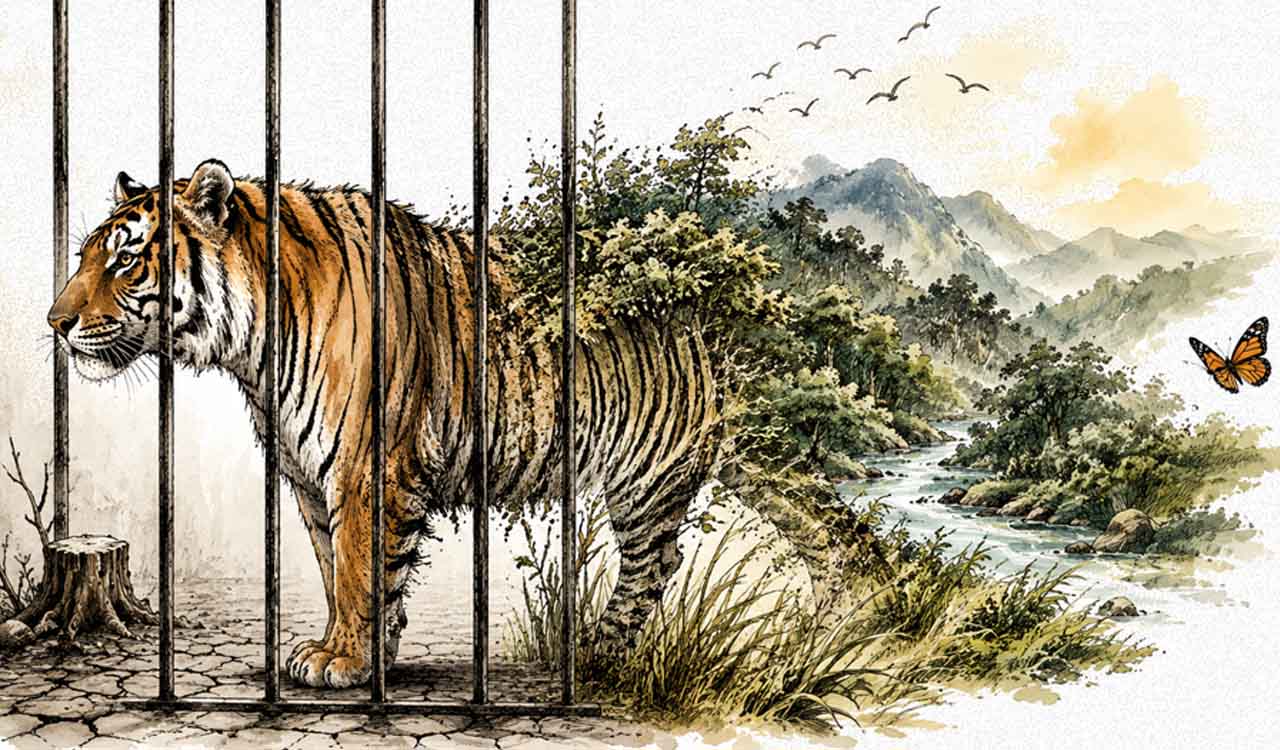
If a creature does not ask for freedom, will it be free? Freedoms are demanded and fought for, but what of those who cannot do either?
Published Date – 15 July 2026, 09:19 PM
By Pramod K Nayar
Demands for autonomy, including cognitive autonomy in the age of AI and neurotechnologies, and freedom are common enough for us to have reached a stage of ‘compassion fatigue’ (Susan Moeller’s apt term) for those lacking freedoms. But what of those who do not ask for freedom?
We know there are two axes underlying freedom: freedom from and freedom to, around which the bulk of human freedoms revolve. The 30 articles of the Universal Declaration of Human Rights enshrined the right to freedom from discrimination, inhuman treatment, slavery, unfair detainment, the right to freedom of movement, to assemble, social security, and so on.
Some of these freedoms apply across species as well, as the 1965 Brambell Report stated. While this is not to equate human and animal freedom, or identity, it is worth examining some commonalities.
Bodily Freedom
The right to life, and the right to freedom from torture or slavery hinge on the assumption that corporeal autonomy and freedom are crucial to sentient beings. The Brambell report lists as the first three freedoms of animals as follows:
- Freedom from Hunger and Thirst: by ready access to fresh water and a diet to maintain full health and vigour.
- Freedom from Discomfort: by providing an appropriate environment including shelter and a comfortable resting area.
- Freedom from Pain, Injury or Disease: by prevention or rapid diagnosis and treatment.
Conditions that cause pain, discomfort or hunger, such as cages or holding cells, cause the loss of bodily freedoms.
In the case of humans, these freedoms enshrined in legislation around the world may be thought of as legal freedoms, but in the case of the nonhuman, become more of a directive and difficult-to-implement set of rules.
Freedom of Spirit
Philosophers and ethicists from Immanuel Kant onwards speak of ontological freedoms. They argue that what is fundamental to human ontology – being – is freedom and spirit. While the law treats freedoms in terms of rights, and mostly as injunctions to the state against restraining humans, philosophers propose that ontological freedom is not about legal measures.
Freedom is an ontological given because it defines the very core of being, existence and awareness. Ontological freedom is defined as fullness and fulfilment. In other words, and perhaps reductively, such a freedom is directed at fulfilment of individual senses, requirements, etc.
The Brambell Report implies something on these lines when it also lists two further freedoms for animals:
- Freedom to Express Normal Behavior: by providing sufficient space, proper facilities and company of the animal’s own kind.
- Freedom from Fear and Distress: by ensuring conditions and treatment which avoid mental suffering.
These appear closely aligned with the idea of ontological freedom because distress and fear, when induced by contexts, prevent a sense of fulfilment or even the possibility of fulfilment. The freedom to express normal behaviour — normal for that species — is impossible to separate, as in the case of humans, from a sense of fulfilment.
It could be argued that all sentient creatures are not the same, and, therefore, not deserving of the same ontological freedoms. But, as early as 2012, the ‘Cambridge Declaration on Consciousness’ stated:
The absence of a neocortex does not appear to preclude an organism from experiencing affective states. Convergent evidence indicates that non-human animals have the neuroanatomical, neurochemical, and neurophysiological substrates of conscious states along with the capacity to exhibit intentional behaviors. Consequently, the weight of evidence indicates that humans are not unique in possessing the neurological substrates that generate consciousness. Non-human animals, including all mammals and birds, and many other creatures, including octopuses, also possess these neurological substrates.
If we were to take even a minimum of scientific evidence embodied in the above, we understand that we are speaking of the preliminaries to ontological freedom even for the nonhuman life form.
Imagining Animal Freedom
In his The Lives of Animals, Nobel Laureate JM Coetzee, through the protagonist Elizabeth Costello, voices ideas of animal freedoms. Costello proposes that a poetic imagining of animal freedoms is perhaps more effective.
Through Rainer Maria Rilke’s ‘The Panther’ and Ted Hughes’ ‘The Jaguar’ and ‘Second Glance at a Jaguar’, she argues that, first, humans can visualise through poetic thought the state of the animal and, second, it enables us to understand that humans cannot place themselves higher than other creatures simply on the basis of sentience.
Rilke’s poem about a caged panther calls upon us to imagine what the loss of corporeal freedom can mean for ontological freedom. It opens with:
His gaze is from the passing bars so weary
That now, within it, nothing more is held.
For him there are a thousand bars to see
But then behind a thousand bars, no world.
Rilke speaks of the panther’s ‘pacing strides’ that circle ‘ever smaller’. He then shifts to the state of the animal’s spirit: the ‘once-so-mighty will stands numbed’. There is memory of freedom though:
Now and again, the pupil’s curtains part
Without a sound. An image enters in,
Flows through the hush of tensely coiled limbs,
And vanishes within the beating heart.
Rilke draws us into the animal’s consciousness, and thus into its suffering. In nearly similar fashion, Hughes’ ‘The Jaguar’ says: ‘fatigued with indolence, tiger and lion/lie still as the sun’. But the jaguar is seen ‘hurrying enraged/through prison darkness’. There is the ‘bang of blood in the brain’. He is behind bars, but ‘there’s no cage to him/more than to the visionary his cell’. Hughes concludes:
His stride is wildernesses of freedom:
The world rolls under the long thrust of his heel.
Over the cage floor the horizons come.
The jaguar’s mind still experiences internal states of freedom. But does this really count, asks Hughes.
Hughes in ‘Second Glance at a Jaguar’ makes it clear that the animal has no freedom in the cage. From the ‘wildernesses of freedom’ in the previous poem, Hughes comments now of the very limited space to stride:
At every stride he has to turn a corner
In himself and correct it
The ‘corner’ is within the animal’s mind and an index of curtailed spirit. What of the rest of the body?
His head
Is like the worn down stump of another whole jaguar…
club-tail lumped along behind gracelessly.
Hughes concludes with:
The head dragging forward, the body keeping up,
The hind legs lagging. He coils, he flourishes
The blackjack tail as if looking for a target,
Hurrying through the underworld, soundless.
Although Hughes suggests that the caged jaguar is plotting escape, the overall sense we get is the jaguar is doomed to spend the rest of his life in misery. The references to the jaguar’s body is only matched by the attention to the mental processes which Hughes asks us to understand through the imaginaion.
The question of freedoms that the animal does not ask is perhaps best asked by poetry, where the law or science fails, literary knowledge comes in handy.
Behind and outside ‘a thousand bars’, there is ‘no world’ for the animal.
(The author is Senior Professor of English and UNESCO Chair in Vulnerability Studies at the University of Hyderabad. He is also a Fellow of the Royal Historical Society and The English Association, UK)