
Tobacco control must go beyond taxation and reflect a moral commitment to prioritising public health over revenue
Published Date – 24 February 2026, 12:15 AM
By Fr Don Prem Lobo, Dr Karamala Areesh Kumar
The Indian Tobacco and Pan Masala Tax Regime, 2026, recently announced, brings to the fore an old controversy: is the tax levied on an observational basis or on a generative basis? Is it intended to promote health or to generate revenue? While the government has indicated that the reform serves as a policy nudge to reduce tobacco use and its associated health effects, the question remains whether it has freed itself from the grip of pragmatism and idealism.
India currently has over 267 million tobacco users, according to the Global Adult Tobacco Survey (GATS 2). Tobacco kills around 1.35 million people each year, and is one of the leading preventable causes of mortality in the country. Smokeless forms of tobacco such as gutka, khaini, pan masala, and zarda lead to oral cancers, cardiovascular diseases, and respiratory problems. The financial toll is enormous. The Ministry of Health reports estimate that over Rs 1.8 lakh crore is spent annually on tobacco-related illnesses, exceeding the total revenue collected through tobacco duties.
Effective Tool
The 2026 tax regime, which raises excise duties and introduces uniform taxation slabs across tobacco and pan masala products, aims to make these products less affordable, particularly for young people and low-income groups. International evidence supports this approach. The World Health Organisation (WHO) identifies price and tax measures as the single most effective tool to reduce tobacco consumption.
India’s 2026 tobacco and pan masala tax regime must be strengthened with a comprehensive advertising ban, school-based prevention programmes, and sustained digital awareness campaigns
Countries like Australia, Thailand, and the United Kingdom, with high taxation, show that the move leads to a sustained decline in smoking rates. In theory, the new Indian policy framework aligns with international guidelines and standards. However, a larger fiscal concern persists: the country’s dependence on tobacco revenue. Tobacco taxation generates between Rs 70,000 crore and Rs 75,000 crore annually. In many States with large-scale tobacco production and processing units, this revenue is a significant component of their annual fiscal planning. This creates a dilemma: whether to discourage consumption or sustain revenue.
This balancing act is reflected in the 2026 tax structure. Although rates have increased, they remain below the WHO-recommended threshold of at least 75% of the retail price. In India, the tax burden stands at 55–60%. This raises an uncomfortable question: are we protecting public health or safeguarding revenue in the name of reform?
Significant Anomaly
Perhaps the most significant anomaly in this policy concerns the regulation of both pan masala and flavoured areca nut products. Despite substantial scientific evidence that links the consumption of areca nut to oral submucous fibrosis and oral cancer, these products are taxed at lower rates than cigarette products. Manufacturers exploit a loophole by selling tobacco and pan masala separately in sachets, bypassing the gutka ban in several States. The 2026 tax regime aims to plug this loophole by aligning tax rates for composite and twin-pack products.
However, taxation shocks may cause economic instability if livelihood transitions are not ensured, especially for women involved in home-based bidi work. The absence of large-scale rehabilitation measures undermines the moral case for steep tax increases. If health is the genuine concern, taxation must be accompanied by livelihood diversification, skill development, and employment generation in alternative areas. The tobacco industry argues that higher taxes fuel illicit trade, leading to revenue losses. While this risk cannot be ignored, evidence suggests that with proper enforcement mechanisms, the problem can be contained.
Long-term Investment
Countries such as Brazil and Turkey have proved that the use of technology to monitor trade is effective even at high rates of taxation. Therefore, India’s strategy should focus on enhancing, rather than undermining, the public health taxation agenda. Taxation has also proved effective in deterring youth initiation, as young people are particularly price-sensitive.
With over 65% of India’s population under 35, this becomes a critical policy issue. Every fiscal step that restricts youth access to tobacco is a long-term public health investment. However, flavoured smokeless products and attractively packaged pan masala, often targeted at young consumers, defeat the purpose. Taxes must, therefore, be accompanied by a ban on advertising, school-level interventions, and online campaigns.
One of the most significant weaknesses of India’s tobacco taxation policy is the absence of earmarking for health spending. In Thailand, tobacco tax revenue is directly allocated to health initiatives, unlike in India, where the tax revenue goes into the consolidated fund. Earmarking a portion of the tax collected from tobacco users, say around 25%, for cancer treatment, health infrastructures, addiction treatment, and health education would strengthen the policy’s legitimacy.
The New Tobacco and Pan Masala Tax Regime (2026) represents an incremental reform, constrained by fiscal and political economy considerations while acknowledging public health imperatives. For a country like India to truly move beyond a budgetary regime that has traditionally been health-centric, taxation would have to be higher and more progressive, uniform across products, digitally enforced, linked to livelihood transition support systems, and earmarked for health spending.
The choice is stark: continue to manage the issue of tobacco use or actively control it. We are living in a country facing a growing burden of non-communicable diseases, increasing threats from climate-related health challenges, and a rising strain of healthcare costs. The 2026 taxation and control of tobacco must signal not merely a shift in taxes, but a change in moral responsibility — prioritising public health above all other considerations. Only then can we honestly say that tobacco control lies at the core of Indian public health priorities, driven not by the need for revenue, but by the need to act humanely and socially.
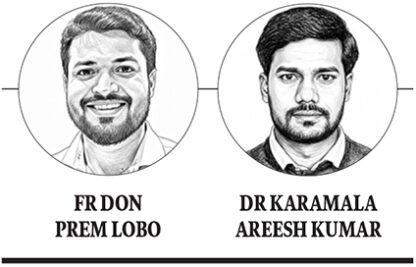
(Fr Don Prem Lobo is Research Assistant and Dr Karamala Areesh Kumar is Head, Department of International Relations, Peace and Public Policy (IRP and PP), St Joseph’s University, Bengaluru)