
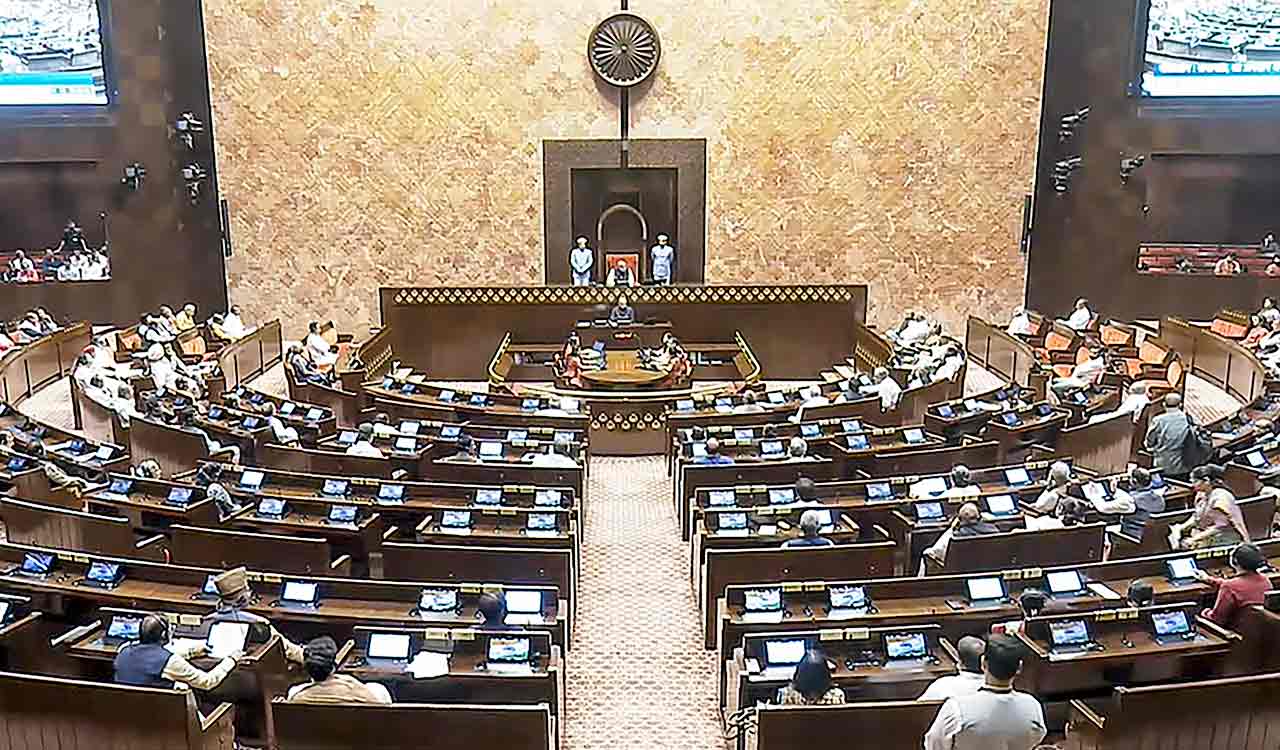
Why is the government proposing a bigger Lok Sabha at 850 while leaving the Rajya Sabha’s 250-member constitutional ceiling untouched? A stronger Parliament needs both Houses. Ignoring Rajya Sabha expansion is an incomplete approach to parliamentary and federal reform
Published Date – 28 November 2026, 11:27 AM
By Boianapalli Vinod Kumar
The Union government’s proposal to expand the strength of the Lok Sabha and State Legislative Assemblies has opened a significant debate on democratic representation, delimitation and the future of India’s federal structure. While the expansion is being projected as a step towards strengthening representation and facilitating the implementation of women’s reservation, an important constitutional question remains unanswered: Why is the Rajya Sabha being left out of this exercise?
If the government believes India’s growing population and democratic requirements necessitate a substantial expansion of elected representation, it must also examine whether the strength and institutional role of the Council of States should be strengthened.
The proposed expansion of the Lok Sabha, reportedly up to a maximum of 850 members, while retaining the Rajya Sabha’s constitutional ceiling of 250, raises questions Parliament must address before embarking on such a major constitutional restructuring.
Parliament is not merely the Lok Sabha
India has a bicameral parliamentary system for a reason. The Lok Sabha represents the people, while the Rajya Sabha represents the States and provides continuity, deliberation and legislative scrutiny.
The Rajya Sabha is not a ceremonial or subordinate institution. It is a constitutionally significant House whose role becomes particularly important in safeguarding the federal character of the Union. It provides a forum for States to participate in national legislative processes and enables a second, considered examination of legislation.
The constitutional design of Parliament must therefore preserve a meaningful balance between the two Houses. Expanding one House substantially while leaving the other unchanged should not be treated as a purely numerical exercise.
Widening imbalance between the two Houses
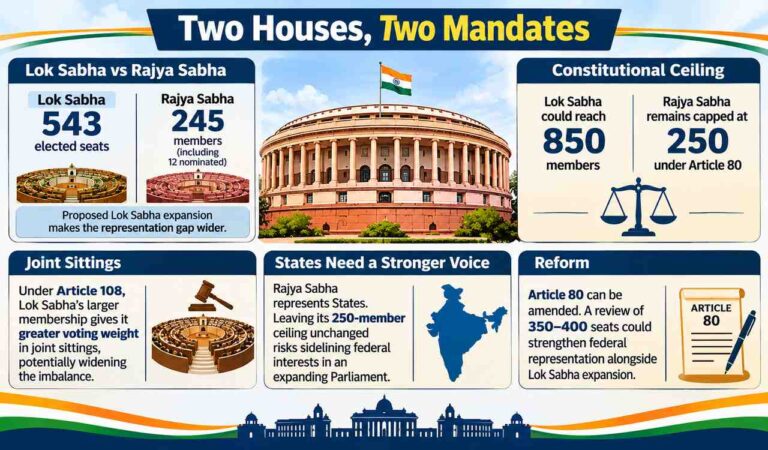
The Lok Sabha currently has 543 elected members, while the Rajya Sabha has 245 members, including 12 nominated members. Its constitutional maximum strength is 250.
If the Lok Sabha’s elected strength is substantially increased—reportedly to around 815—while the Rajya Sabha remains unchanged, the numerical ratio between the two Houses will widen considerably.
This has institutional consequences. Under Article 108 of the Constitution, a joint sitting may be convened in specified circumstances to resolve a deadlock between the Houses on legislation. In a joint sitting, the numerical strength of the Lok Sabha gives it an inherent advantage. A further expansion of the Lok Sabha without a corresponding strengthening of the Rajya Sabha will accentuate that imbalance.
The question is not whether the Lok Sabha should be expanded. The question is whether such expansion should take place without examining its consequences for the balance and functioning of Parliament.
Federalism cannot be an afterthought
The Rajya Sabha was conceived as the Council of States. Its composition and functioning are central to India’s federal parliamentary architecture.
At a time when the relationship between the Union and States is increasingly debated over fiscal powers, resource allocation, legislative competence and governance, the role of the Rajya Sabha deserves greater attention—not less.
The States are not merely administrative units of the Union. They are constitutionally recognised components of India’s federal structure. A parliamentary reform that substantially enlarges the House representing the people, while leaving the House representing the States frozen at its present strength, deserves a clear constitutional rationale.
The government should explain why expansion is necessary for the Lok Sabha but not for the Rajya Sabha.
Constitutional implications extend beyond legislation
The numerical composition of the two Houses also has implications for certain constitutional institutions and processes. Elected members of both Houses participate in the election of the President. A substantial expansion of the elected strength of the Lok Sabha without a corresponding increase in the Rajya Sabha would alter the relative weight of the two Houses in the Presidential electoral college.
Similarly, both elected and nominated members of Parliament participate in the election of the Vice-President. The relative composition of the two Houses is therefore relevant to the institutional balance of that electoral process as well.
These consequences do not invalidate the proposed expansion. They reinforce the need for a comprehensive parliamentary review rather than a piecemeal restructuring.
Why should Rajya Sabha remain capped at 250?
Article 80 provides for the composition of the Rajya Sabha and places its constitutional maximum at 250 members. That ceiling is not immutable. Parliament has the constitutional power to amend Article 80 through the procedure prescribed under Article 368.
India today is vastly different from the India of the early decades of the Republic. Its population, economy, administrative complexity, regional diversity and legislative workload have grown enormously. If the adequacy of representation is being reassessed for the Lok Sabha, it is only logical that the adequacy of representation in the Rajya Sabha should also be examined.
An increase in the strength of the Rajya Sabha to 350 or 400 members, for instance, could be considered after an expert review. The precise number need not be predetermined. What is essential is that the question itself should not be excluded from the constitutional reform agenda.
Expansion must balance population and federal interests
Rajya Sabha reform should not simply replicate the Lok Sabha’s population-based logic. The Council of States must preserve the principle of federal representation while ensuring fair representation for States of varying sizes.
A transparent formula could examine population, federal balance, the interests of smaller States and the need to ensure that States which have made significant progress in human development and population stabilisation are not disadvantaged in the broader constitutional framework.
Such a reform should be undertaken through consultation with States, constitutional experts and all political parties—not through a unilateral or narrowly focused approach.
A comprehensive reform—not a selective one
The Union government and Parliament should consider the following as part of the proposed constitutional restructuring:
- Raising the constitutional maximum strength of the Rajya Sabha from 250 to a suitably determined number, such as 350 or 400.
- Reviewing State-wise allocation of Rajya Sabha seats through a transparent and constitutionally informed process.
- Strengthening the Rajya Sabha’s role as the Council of States and as a revising chamber.
- Assessing the implications of Lok Sabha expansion for joint sittings, legislative scrutiny, parliamentary committees and constitutional electoral processes.
- Ensuring that parliamentary expansion strengthens both popular representation and federal representation.
The expansion of the Rajya Sabha need not be proportionate to the expansion of the Lok Sabha. The two Houses have distinct constitutional purposes. The objective should be to preserve their institutional balance and strengthen the overall parliamentary system.
Question the Government must answer
The proposed expansion of the Lok Sabha and State Legislative Assemblies is a major constitutional exercise that will shape India’s democracy for decades. Such a reform should not be confined to increasing the number of elected representatives. It should also strengthen the institutions through which India’s federal character is expressed.
If the government considers a substantial increase in the strength of the Lok Sabha necessary to meet India’s democratic requirements, why has it not initiated a corresponding debate on expanding and reforming the Rajya Sabha?
A stronger Lok Sabha and a stronger Rajya Sabha are not competing objectives. One represents the people; the other provides a vital federal voice to the States. India needs both to be effective, adequately represented and constitutionally balanced.
Parliamentary reform must strengthen the Union without diminishing the States, expand representation without weakening federalism, and modernise the constitutional structure without disturbing its essential balance.
The government must bring Rajya Sabha expansion and reform into the same national debate. A constitutional reform of this magnitude cannot afford to be incomplete.
(The author is a former Member of Parliament)