
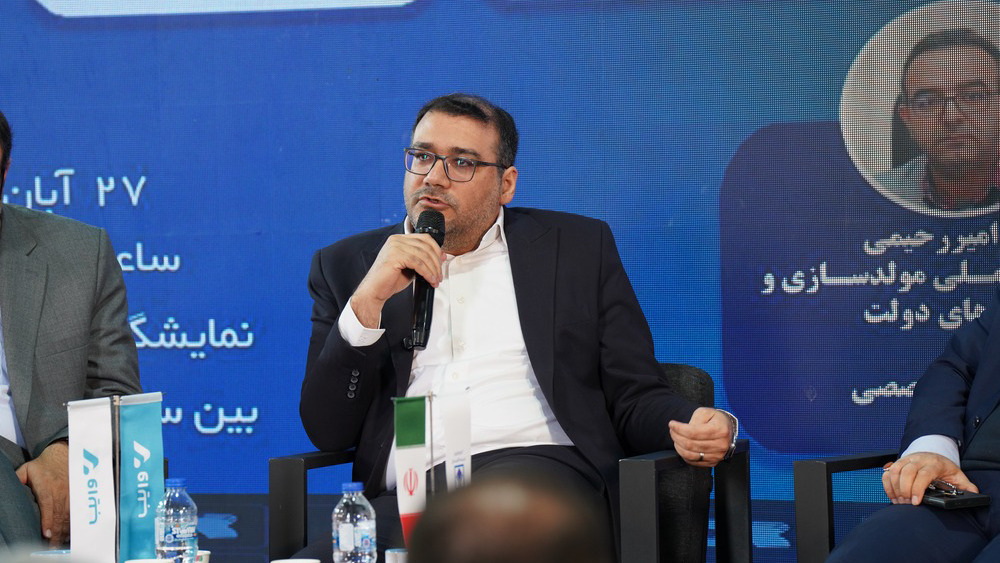
The government introduces new financial toolkits and decentralizes transaction approvals to provinces to accelerate infrastructure financing without relying on oil revenues.
Ehsan Askari, head of the State Asset Monetization Organization, addresses an exhibition panel in Tehran, Iran. (Photo by IRNA)
Iran has monetized 37 trillion tomans worth of state assets over the past five months and is launching a new 10-trillion toman real estate fund, a senior official announced, marking a significant acceleration in the government’s efforts to finance national infrastructure projects.
Ehsan Askari, head of the newly renamed State Asset Monetization Organization, outlined the new strategies at a specialized meeting with deputy governors for civil affairs across the country on Friday.
Askari announced that the first public asset monetization fund, capitalized at approximately 10 trillion tomans, will be launched in the upcoming days.
The fund’s capital will be sourced from the transfer of properties belonging to the Ministry of Cultural Heritage, Tourism and Handicrafts, and the Ministry of Economic Affairs and Finance.
To streamline the process, the organization has designed three distinct baskets of monetization tools for executive agencies.
The first basket focuses on participation and exploitation models, including long-term leases, public-private partnerships (PPP), civil participation with the private sector, and cooperation with municipalities.
The second basket introduces advanced financial instruments such as real estate funds, project funds, project companies, and promissory notes.
Askari emphasized a strategic shift in how the government manages its properties.
“Government agencies may lack the specialized expertise and capacity to create value and economically exploit their assets,” he said. “Consequently, in the new financing model, the role of ‘facilitators’ has been envisioned to utilize the specialized and executive capabilities of the private sector.”
Decentralization and provincial milestones
A major structural change is the decentralization of decision-making.
Askari revealed that a cabinet bill will be approved next week, granting provincial authorities the power to review and approve asset transactions up to 50 times the medium transaction threshold.
He highlighted the active role of provinces in this initiative, observing that Isfahan province recently identified 120 trillion tomans worth of surplus state properties.
Askari also pointed to flagship projects already funded through this mechanism, including the financing of the B1 Bridge project and the monetization of the Rajai Shahr Prison complex.
The state asset monetization program was initiated to reduce the government’s economic footprint and generate non-oil revenues for infrastructure development.
The policy requires government agencies to identify surplus, idle, or underutilized properties and transfer them to the private sector or utilize them through financial markets.
Proceeds from these transactions are legally designated for national development and infrastructure projects.
In recent months, the government has restructured the implementing body and introduced new financial instruments, such as real estate funds on the stock exchange, to accelerate the transfer of assets and circumvent traditional bureaucratic valuation processes.