
A senior Iranian official says the talks cover border infrastructure, customs capacity, and electricity transmission.
Iran and Armenia have established eight working committees aimed at expanding bilateral cooperation, covering infrastructure, customs, trade, culture and art, health and treatment, industry, mining and technology.
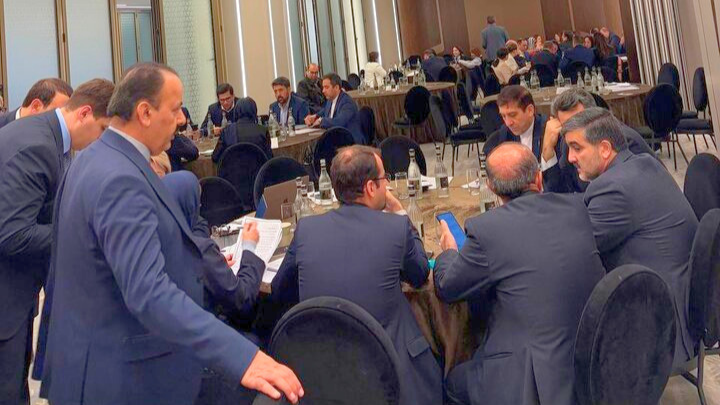
Seyyed Hamid Pourmohammadi, Vice President and Head of Iran’s Plan and Budget Organization, announced the formation of the committees on the sidelines of the 19th session of the Iran-Armenia Joint Commission for Economic Cooperation in Yerevan, where specialized delegations from both countries are taking part.
“The work of these committees began today and will continue until tomorrow afternoon,” Pourmohammadi said, adding that a joint cooperation document is expected to be signed at the conclusion of the session.
Turning to transport infrastructure, Pourmohammadi said work on completing the road from Jolfa to Norduz on the Iranian side is proceeding at pace, while Iranian contractors have also taken on construction of the Norduz-Yerevan section inside Armenian territory.
He listed the construction of a new bridge over the Aras River, the development of border terminals, and an increase in the two countries’ customs capacity among the measures planned to ease movement and trade.
Pourmohammadi said facilitating truck traffic and increasing the flow of Iranian and Armenian tourists were among the main subjects under discussion, noting that expanded economic and border cooperation could pave the way for higher trade volumes and closer ties between the two neighbors.
The vice president also reported progress in energy cooperation, saying Iranian contractors are currently building an electricity transmission line running through Armenia toward Iran, which he expressed hope would be completed soon.
He added that Iran’s supply of petroleum products to Armenia represents another area with potential for expanding bilateral energy cooperation.
Pourmohammadi said he was scheduled to meet Armenian Prime Minister Nikol Pashinyan to discuss key areas of bilateral cooperation, the outcomes of the specialized committees’ work, and ways to strengthen relations. Separate technical talks with Armenia’s deputy prime minister, who co-chairs the joint commission, are also underway.
He emphasized the long-standing friendly and historical relations between the two countries, saying their shared civilizational and cultural background and long common border give them considerable capacity to broaden cooperation.
He expressed hope that the commission’s results would translate into operational agreements and encouraging news for economic and commercial actors in both countries.
Armenia has become an increasingly important link in Iran’s northern trade and energy connections.
With Iran’s southern maritime routes under pressure from a US naval blockade, Tehran has moved to expand overland corridors through the Caucasus and the Caspian basin to sustain imports and exports.
The Armenia route also carries significance for regional transit politics.
Tehran has consistently opposed arrangements that would place corridors along its northern frontier under the control of extra-regional powers, favoring instead bilateral frameworks with Yerevan that keep transit decisions in the hands of the neighboring states.
Armenian officials have publicly stated that they will take no action against Iranian interests and have described proposed transit projects through their territory as purely economic in nature.