
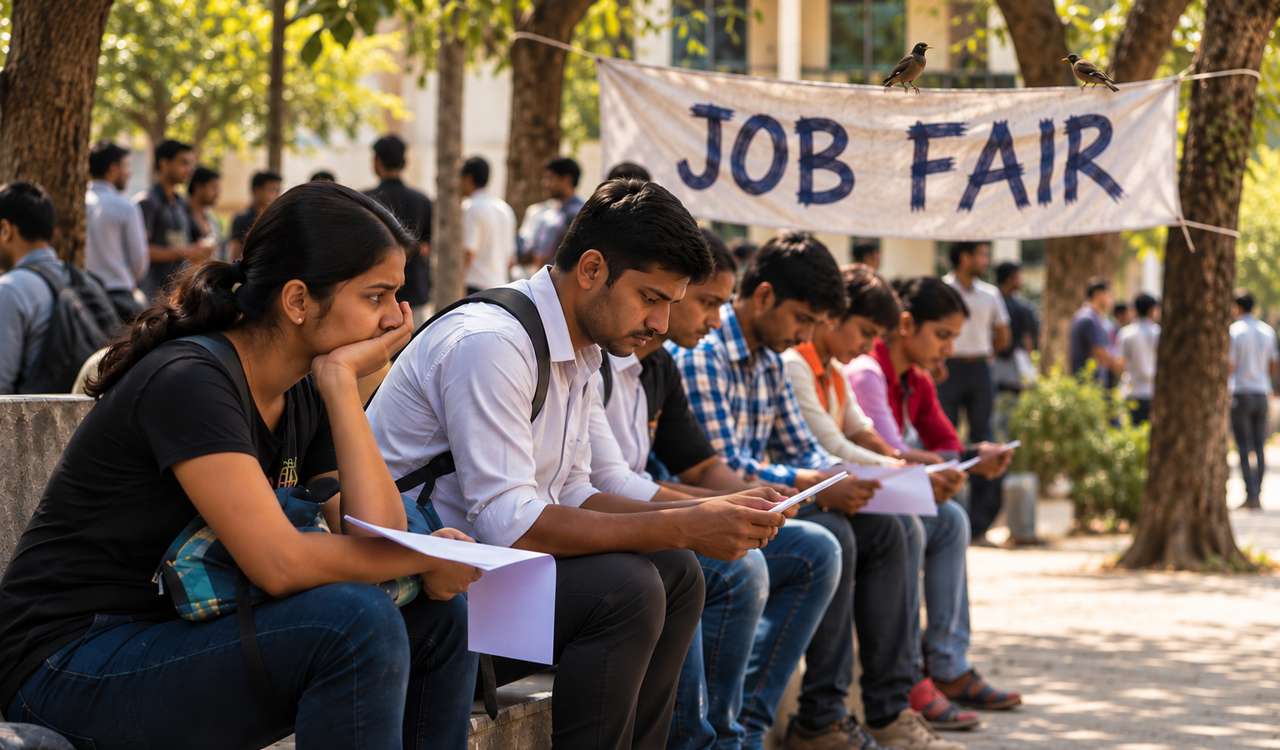
India’s growth story remains incomplete if young people must leave farms, families and communities behind to survive on insecure work
Published Date – 2 October 2026, 10:27 PM
By Aman Kumar Maurya, Neeraj Kumar
For many Indians who came of age around 2012, politics arrived with an unusual sense of possibility. The anti-corruption movement led by Anna Hazare convinced a generation that fundamental change was within reach. The change of government in 2014 and the emergence of new political alternatives in Delhi strengthened that optimism.
More than a decade later, however, hope has given way to a difficult question: why has India’s economic progress failed to provide so many young people with secure, dignified and productive employment?
Broken Promises
Grand speeches and promises to eliminate poverty are nothing new. India heard “Garibi Hatao” in 1971 and “Achhe din aane wale hain” in 2014. Yet the gap between the rich and the poor has become a painful divide. Farmers, daily-wage workers, office staff and small service providers often see their incomes rise at a slow arithmetic pace. It takes years of hard work to make a small step forward. Meanwhile, the wealth of the ultra-rich grows at a much faster geometric pace. For ordinary people, economic growth therefore feels deeply unequal.
Wrong Policies and their Colonial Imprint
Looking back at India’s journey since 1947, some policies contributed to today’s imbalance. The Freight Equalisation Policy of 1952 subsidised mineral transport across India. By weakening the locational advantage of resource-rich States, it hurt their manufacturing prospects and contributed to regional imbalances whose scars remained even after the policy ended in 1992. The pattern appeared colonial: resources left poorer regions, while finished products returned at higher prices.
The bigger mistake was failing to develop a sufficiently broad manufacturing base capable of supporting mass employment before services became dominant. American economist and political theorist Walt Whitman Rostow’s stages of development describe a movement from agriculture to industry and then towards services.
India’s service-led growth in the 1990s and 2000s appeared transformative, but it did not create secure work on the scale required. From today’s perspective, it looks like a temporary bandage over a deep wound. The question is whether governments will address that weakness honestly or apply another short-term bandage that burdens the next generation.
A Generation in Limbo and Neo-colonialism
The failure to create enough secure work has produced a silent crisis for those born in the 1990s and 2000s. We were told to study hard, earn degrees, and expect a better future. Yet many young people received little training to become entrepreneurs and found too few factory jobs to build stable lives.
Migration should represent a genuine opportunity for advancement, not an escape from agricultural distress, indebtedness and the absence of employment at home
At the same time, farming, traditional crafts and local work in rural India have weakened. The result can feel like a new form of colonialism. Just as foreign rulers once drained resources from the land, large cities now draw young people out of villages and small towns. Many leave home for education or employment and move into crowded, unsatisfactory urban spaces.
Former agricultural labourers, marginal farmers and craftspeople become construction workers, low-paid service workers or delivery workers, racing against time for mobile apps. Instead of building secure futures, they struggle to survive each day. This precarious migration can therefore resemble neo-colonialism.
Structural Root of Distress Migration
The youth crisis is not merely a cultural shift towards urban life. It is also rooted in an agricultural economy that often cannot sustain dignified livelihoods. For generations, farming was the social and economic backbone of rural India, offering self-reliance and stability.
Today, that foundation has weakened as the purchasing power of agricultural produce has fallen relative to assets such as gold and essential services such as healthcare and higher education. As journalist P Sainath noted, in 1972, the earnings from one quintal of cotton could buy approximately 15 grams of gold.
Input costs for fertiliser, diesel, seeds, electricity, and farm machinery have also risen, while nominal crop prices and government-announced Minimum Support Prices do not necessarily restore the losses in farm incomes. When families cannot meet basic needs despite continuous work, farming ceases to offer a viable path.
The resulting migration differs from the transition envisioned by classical development models, in which labour leaves agriculture for a booming, high-productivity manufacturing sector. Many young people leave declining farms not because prosperous industrial jobs await them, but because remaining can mean repeated cycles of debt and quiet despair.
Future Ahead
India’s future will depend not merely on how rapidly its economy grows, but on whether that growth creates secure and dignified livelihoods. Migration should represent a genuine opportunity for advancement, not an escape from agricultural distress, indebtedness and the absence of employment at home.
This requires revitalising rural economies, expanding labour-intensive manufacturing in smaller cities, connecting education with practical skills, and extending social protection to informal and platform workers. It also requires sustained investment in climate-resilient agriculture, clean air and reliable water supplies.
True progress cannot be measured only through rising GDP, expanding cities or tall buildings. It must also be measured by whether young Indians can build stable lives without being compelled to abandon their communities, health and aspirations merely to survive.
(Aman Kumar Maurya is Research Scholar, Department of Geography, University of Madras. Neeraj Kumar is Assistant Professor, Department of Economics, CHRIST Deemed to be University, Bengaluru)