A common currency may not be the answer; BRICS can reduce dependence through local-currency trade, digital payments and diversified reserves
Published Date – 21 September 2026, 10:10 PM
By Prof Ramakrishna Gollagari
The US dollar has occupied the centre of the international monetary system for more than seven decades. The Bretton Woods Agreement of 1944 established the foundations of this dominance. Although the Bretton Woods system ended in 1971, the dollar retained its central role in international trade, investment and foreign-exchange markets.
Recent data underline both its strength and the beginnings of diversification. According to the IMF, the dollar accounted for 57.13 per cent of global official foreign-exchange reserves in the first quarter of 2026, compared with 20.03 per cent for the euro and 1.99 per cent for the Chinese renminbi.
The dollar’s dominance is even more striking in currency markets. The Bank for International Settlements’ latest triennial survey shows the dollar accounted for 89.2 per cent of all foreign-exchange transactions in April 2025, while the euro accounted for 28.9 per cent and the renminbi 8.5 per cent.
Reducing Dollar Dependence
The dollar-based system has provided deep financial markets, liquidity, and convenience for international transactions. Its extensive network makes it difficult for any alternative currency to challenge its position quickly. Yet excessive dependence on a single currency creates risks, particularly for emerging economies. When a domestic currency depreciates, the domestic-currency burden of dollar-denominated debt rises. Changes in US interest rates can also affect capital flows, exchange rates, and borrowing costs in developing economies.
The Russia-Ukraine war and the financial sanctions that followed demonstrated another dimension of the issue: access to reserves and international payment systems can acquire geopolitical significance. This has strengthened the case for diversification.
A Practical BRICS Strategy
For BRICS, the approach is not to attempt an immediate replacement of the dollar. Instead, members can increase the use of national currencies, encourage local-currency lending and strengthen the role of the New Development Bank (NDB). This direction is already visible in recent BRICS discussions.
Local-currency lending can help achieve this objective. The aim should not be de-dollarisation but greater currency choice. India, Brazil and other BRICS members can expand trade settlement in national currencies where commercially feasible. The NDB can increase development lending in local currencies. The idea is not to replace one dominant currency with another, but to create a more diversified international monetary system.
Is BRICS Currency Necessary?
A common BRICS currency is an attractive idea, but it would be extremely difficult to implement. It would require substantial coordination of inflation, interest rates, fiscal policies, exchange-rate regimes, financial regulation, and capital markets. BRICS economies differ considerably in economic structure, levels of development, monetary policy, and geopolitical interests.
India should pursue diversification, not confrontation, as the dollar remains important for its international trade, energy imports, foreign investment, and financial markets
There are also other institutional questions. Who would control such a currency? Who would determine monetary policy? How would voting rights be allocated? What would happen when one member experiences a financial crisis?
A common currency should therefore be regarded as a long-term possibility, not an immediate objective. A practical middle path exists between complete dependence on the dollar and the creation of a common currency.
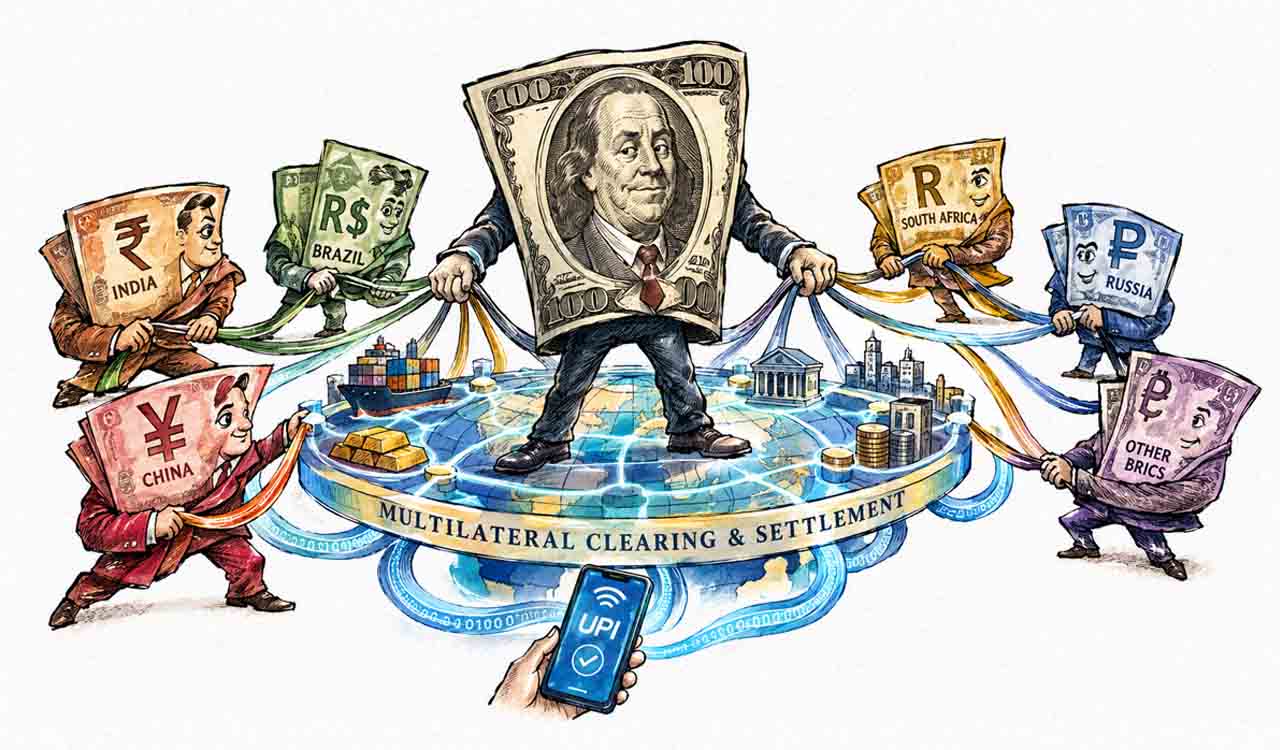
BRICS could develop a multilateral trade-clearing and settlement mechanism. Member countries could retain their national currencies while using a common accounting or clearing arrangement for cross-border trade. Such a mechanism could reduce the need to convert every transaction into dollars. It could begin with bilateral trade arrangements and gradually develop into a broader multilateral system.
Efficient Digital Payments
Currency diversification will succeed only if payment systems are efficient. BRICS countries should therefore explore interoperability among their domestic digital-payment systems. India’s UPI provides an important example of how a fast, low-cost digital payment infrastructure can change the way individuals and businesses transact.
The objective should be to extend this efficiency across borders. Secure, fast, and inexpensive cross-border payments can make national currencies more attractive to businesses. De-dollarisation would then become an economic process rather than merely a statement.
BRICS central banks can also gradually diversify their foreign-exchange reserves. But replacing the dollar with a single alternative currency would simply create another concentration risk. A more balanced portfolio involving the euro, yen, pound, gold and other reserve assets may be more appropriate.
India should pursue diversification, not confrontation with the dollar. The dollar remains important for India’s international trade, energy imports, foreign investment and financial markets. At the same time, India can encourage rupee-based trade settlement wherever commercially feasible.
The NDB’s Role
The New Development Bank could become one of the most important institutions in this transition. Greater local-currency lending would support infrastructure and sustainable development while reducing foreign-exchange risks for borrowers. However, there could be some issues: limited liquidity in some currencies, exchange-rate volatility, trade imbalances, capital controls, and differences in economic policies.
Local-currency trade will not automatically be cheaper or more efficient. Currency convertibility and the availability of liquid financial markets matter. The success of any alternative system will ultimately depend on credibility, transparency, liquidity, convertibility, and market confidence.
A More Diversified Order
The international monetary system is unlikely to move from a dollar-dominated structure to a BRICS-dominated structure in one dramatic step. The more plausible transformation is gradual: more currencies, more payment channels, more settlement options and greater diversification of reserves.
Thus, BRICS needs to create more credible alternatives. The more likely future is not a world without the dollar, but a world in which the dollar is no longer the only practical choice.

(The author is Visiting Professor, Centre for Economic and Social Studies [CESS], Hyderabad)