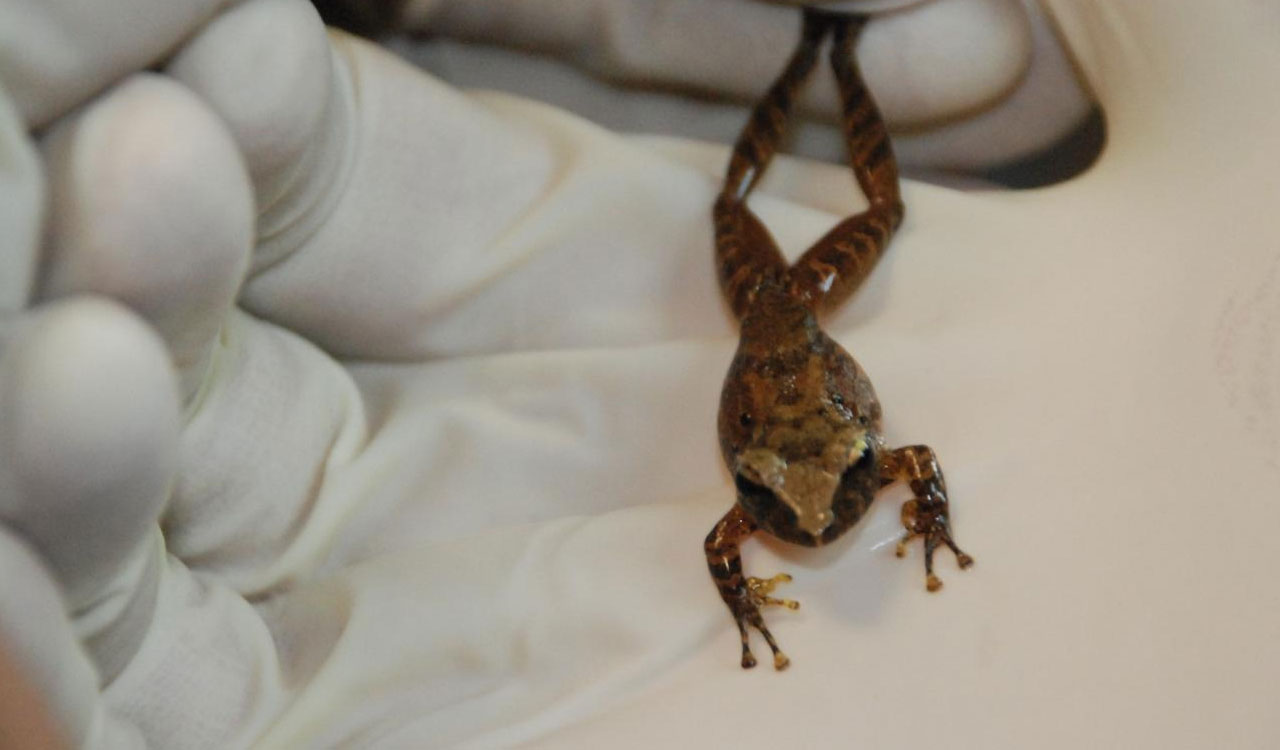
Researchers in Hyderabad have detected an amphibian-killing fungus across India’s major biodiversity hotspots. A nationwide survey of nearly 1,870 amphibians found low infection rates, while eDNA-based water surveillance could help authorities detect the fungus early and protect vulnerable frog populations.
Published Date – 20 August 2026, 03:40 PM
Hyderabad: For several years, conservation biologists were baffled by unexplained population drops among frogs along the Western Ghats and the rugged mountain ranges of Himalayas.
Most experts blamed the decline on routine monsoon shifts and the behaviour of animals to vanish during off-season. But researchers in Hyderabad have now figured out that an invisible intruder, an amphibian-killing fungus (Batrachochytrium dendrobatidis), has driven hundreds of frog species to the brink of extinction.
Across India’s primary biodiversity hotspots, sensitive stream-dwelling amphibians like the endangered white-lipped cricket frog and various endemic toads experienced subtle, unexplained population dips.
Researchers at Hyderabad’s Laboratory for the Conservation of Endangered Species (LaCONES-CCMB) launched a nationwide molecular survey to understand the development, and instead of waiting for dead frogs to wash up on riverbanks, scientists hand-caught nearly 1,870 amphibians across 147 locations. They captured microscopic fungal traces from the skin of the frogs, which were later released unharmed.
The LaCONES findings offer a measure of relief alongside a crucial warning for environmentalists. The researchers discovered that while the killer fungus is present across India’s major biodiversity hotspots, the region acts as a natural ‘safe zone’ where the overall infection rates remain low.
Genetic mapping indicated roughly 80 per cent of the fungal strains found in India are native locals, indicating a long, ancient history where Indian frogs and the fungus learned to live side-by-side rather than wiping each other out.
The skin of a typical amphibian like a frog is its lifeline, since it helps the animal to breathe, drink, and even balance body salts. When the deadly fungus attacks, even a mild infection causes thickening of the frog’s skin, which eventually leads to heart failure.
To track this without disrupting wildlife, the LaCONES researchers have also mastered a novel way to spot the danger (i.e., the fungus) even without the need to physically catch the frog species. By collecting routine water samples from forest streams, they use environmental DNA (eDNA) technology to sniff out invisible traces of the fungus left behind in the water.
By deploying the unique water-testing surveillance eDNA technology, the researchers made it possible for the Forest Department, in regions where rare frog species are endemic, to understand the early-warning systems and avoid large-scale deaths of frogs that eventually wash up on the riverbanks.