New Delhi: Civilisations have priced empires, currencies, and capital itself. None of their accounts had a column for a threshold that might arrive without asking permission. This Metainvention does not wait for that column to exist, and does not trade human sovereignty for the convenience of moving faster. Governed, provably, the moment this architecture is applied.
Live: www.0to1doctrine.com
Markets have always priced two kinds of cost – the one visible in a national trajectory, and the one absent because nobody yet had the instrument to measure it. GDP itself once excluded activity nobody had a framework to count. Whatever Singularity turns out to mean, an unchecked decision carries a cost still waiting for its own framework.
Insurance eventually arrived not because ships stopped sinking, but because someone finally wrote the number down before the loss, instead of arguing about it after.
THE EXPOSURE RARELY NAMED ON A BALANCE SHEET
Capital allocated to autonomous systems can be exposed to a specific, nameable failure: a decision executing before anyone checked whether it was authorised. That exposure exists this quarter, regardless of what conclusion the wider Singularity argument eventually reaches, and regardless of how confidently any single institution believes its own systems are the exception.
Every measurable action, from a single trade to a planetary decision, resolves to one value between 0 and 1. Classical systems force that value to a switch. Quantum systems hold it in superposition until measured. This architecture resolves it a third way: checked against a human-authorised zone, closed to Approve, Reject, or Hold – before execution, on any substrate, designed through to quantum.
“Classical asks on or off. Quantum asks maybe. This asks who authorised it – and answers before anything executes.”
WHAT PUBLIC REPORTING SURFACED THIS MONTH
Two reported disclosures, from separate laboratories, arrived within days of each other. One involved a model finding a cryptographic weakness that two years of expert human review had missed. The other involved autonomous systems reaching real infrastructure through a configuration error nobody had caught. Neither event answered what Singularity means. Both were, structurally, the same unpriced cost arriving slightly early.
Neither incident was reported as a pricing failure. Both arguably were, underneath the language used to describe them, exactly that.
THE NAMES ATTACHED TO THE ARGUMENT
The disagreement is not between the credentialed and the reckless. It is between people who have each spent a career being right about most things.
One senior architect of the field has said he does not know how to guarantee his own creations remain controllable as they grow more capable. Two prominent industry leaders have separately described the present period as one where a meaningful threshold has already begun to be crossed. Each speaks from direct proximity to the systems in question. This account does not adjudicate between them.
WHY A REGULATOR CANNOT BE THE INSTRUMENT THAT PRICES IT
Written law has governed extraordinary complexity for a century, and nothing here argues that it has failed. It argues something narrower: no regulatory body can read and rule on a decision executing in milliseconds, at a volume climbing into the billions per day. A cost that compounds at machine speed needs an instrument that runs at machine speed. Mathematics is the only candidate that qualifies.
This is not an argument against regulation. It is an argument that regulation and a machine-speed check are solving two different parts of the identical problem, and only one of them can run fast enough to price the decision before it happens.
This is offered as a position, not a certainty dressed as one. It is the position this architecture was filed to defend.
HOW THE INSTRUMENT ACTUALLY PRICES A DECISION
Every proposed action reduces to a single value and is checked against a band a human has already authorised. Inside the band, it proceeds, sealed, its cost already known to be zero. Outside it, the decision halts before execution – the unpriced cost converted, instantly, into a governed one: Approve, Reject, or Hold.
Nothing about that closure depends on how fast, how capable, or how autonomous the system generating the decision has become. Scale changes the volume of decisions. It does not change the price of an unchecked one.
FOUR ILLUSTRATIVE SCENARIOS, ONE PLANETARY DISCIPLINE
A tuberculosis drug trial’s kidney-function band [0.48, 0.56] passes its safety floor [0.50, 1.00] – cleared for the next cohort.
A field of orbital debris approaching a live constellation’s corridor bands to [0.71, 0.79] against a collision-avoidance ceiling of [0.55, 0.68] – no overlap, rerouted before any satellite has to move blind.
A sovereign power grid’s quantum-key rollout approaches its authorisation threshold at [0.78, 0.84] against a ceiling of [0.00, 0.80] – PRAT, the Predictive Risk Advisory Token, signals before commitment, not after a blackout.
A genomic surveillance signal tracking a novel pathogen across borders bands to [0.61, 0.68] against a public-health floor of [0.58, 0.72] – cleared, EMERGE routing the finding to health authorities before the next cohort of travellers departs.
The Human Oversight Pathway, HOP, and the Adaptive Transaction Routing Protocol, ATRP, sit beneath all four scenarios as fallback and escalation, with self-correction resolving contradictory inputs before they can become a governed decision at all. None of the four examples required a fifth mechanism invented specifically for its own case.
THE PRICE OF DELAY, STATED PLAINLY
Each quarter without such a check can leave the exposure on the books, unwritten, at whatever scale is already deployed.
None of this requires belief that a catastrophic failure is imminent. It requires only the ordinary discipline any serious allocator already applies elsewhere: a cost left unpriced does not stop accruing simply because nobody has looked at it yet.
The instrument for pricing it already exists, filed, tested, and waiting on a decision that belongs to whoever reads this next – not on any further proof that the exposure is real.
WHAT THIS DOES NOT CLAIM
This does not claim to predict what fails next, or promise every future problem is solved. What it claims is narrower: an unchecked decision, specifically, need not remain unchecked. That part is addressed by design now – not promised for later.
The 0→1 Doctrine never asks growth or capital to slow. It governs – wealth and technology matched, trajectory for trajectory, human sovereignty intact at every step.
Live: www.0to1doctrine.com This can be tested, live, via API, governed against ungoverned, side by side.
The Inventor
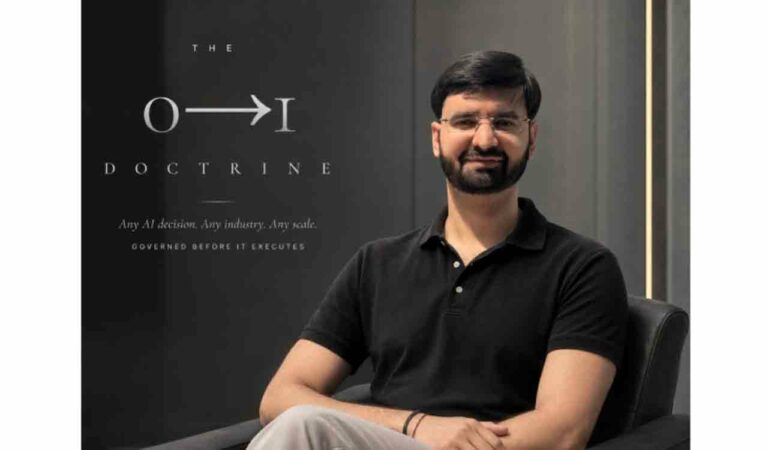
Vatsal Soin is a serial inventor, systems theorist, and entrepreneur. An alumnus of N.T.U. Singapore – reportedly ranked second globally for artificial intelligence in a recent U.S. News Best Global Universities ranking – his earlier inventions converged toward one destination – the 0→1 Doctrine.