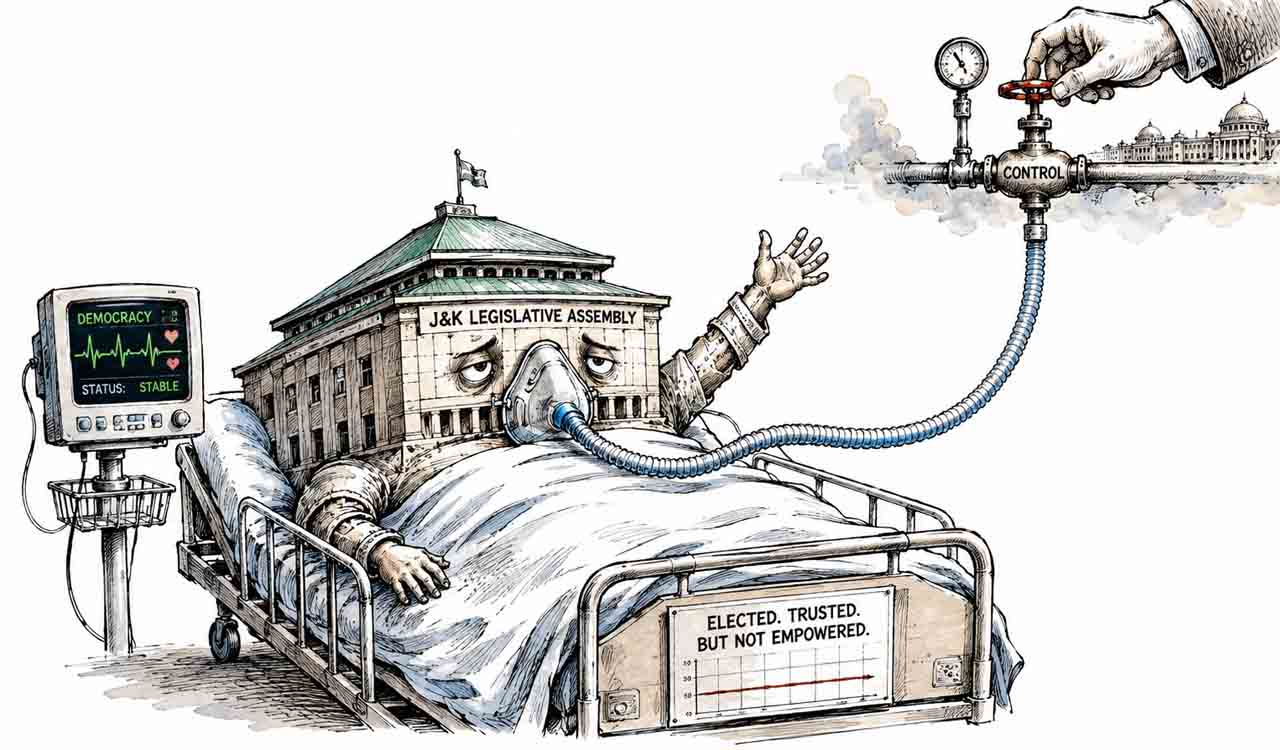
Nearly two years after J&K elected a new government, the promise of restoring statehood remains unfulfilled, raising questions about democratic accountability, federalism, and the region’s constitutional rights
Published Date – 17 July 2026, 11:37 PM
There is no justification for the central government to continue delaying the restoration of statehood to Jammu & Kashmir. The growing sense of restlessness among political parties and the general public over the non-implementation of the promise, even two-and-a-half years after the successful conclusion of the Assembly elections, is quite understandable. Opposition parties are also planning to hold a day-long protest at Jantar Mantar in the national capital on July 20, coinciding with the opening day of the Monsoon Session of Parliament. The restoration of statehood is not merely a political demand of the ruling National Conference or Chief Minister Omar Abdullah. It concerns the federal spirit, democratic accountability, and the rights of nearly 14 million people. The Centre has consistently maintained before Parliament and the Supreme Court that statehood would be restored at an appropriate time after the security situation stabilises. One wonders why there is still a delay in fulfilling this promise when an elected government is in place. Since the historic reorganisation on August 5, 2019, J&K has functioned as a Union Territory. The region successfully transitioned back to an elected democratic setup following the September–October 2024 Assembly polls, leading to the formation of a local government. Despite the completion of these elections and the continuous passage of resolutions by the newly formed Assembly, the promised upgrade to full statehood remains unfulfilled. While J&K possesses an elected legislative Assembly, its powers are strictly curtailed compared with a full-fledged Indian State.
In a full State, policing, public order, and the bureaucracy answer directly to the Chief Minister. As a Union Territory, the Lieutenant Governor, appointed directly by the Centre, controls the civil services cadre. Under statehood, the State Cabinet holds absolute legislative autonomy over the State List. Currently, the LG retains expansive veto powers and discretionary authority, leaving the elected Cabinet heavily dependent on federal approvals for major financial allocations and governance policies. The Centre has intentionally kept the timeframe for restoration of statehood open-ended. The primary factors driving this delay include security concerns, as the government argues that security architecture must remain completely centralised to prevent any sudden resurgence of cross-border militancy, infiltration or civil unrest. Retaining UT status ensures that the unified command of local police and federal intelligence agencies reports straight to New Delhi. It is obvious that the central executive is hesitant to quickly surrender overarching administrative control to a politically adversarial local government. In the process, the patience of both the local political class and ordinary citizens is wearing thin. People feel that the current Assembly is essentially toothless and are yearning for a return to full-fledged statehood, which would give them a sense of genuine empowerment. While Kashmiris have reconciled themselves to the reality that the abrogation of Article 370 is irreversible, they expect early restoration of statehood, which is their rightful due.