The Telangana High Court stayed further proceedings relating to the Raidurg land auction after SBI challenged the State’s decision to auction land originally allotted to the bank. The Court sought clarification on the public purpose behind the auction and granted interim relief.
Published Date – 18 June 2026, 08:36 PM
By Goutham Sirasani
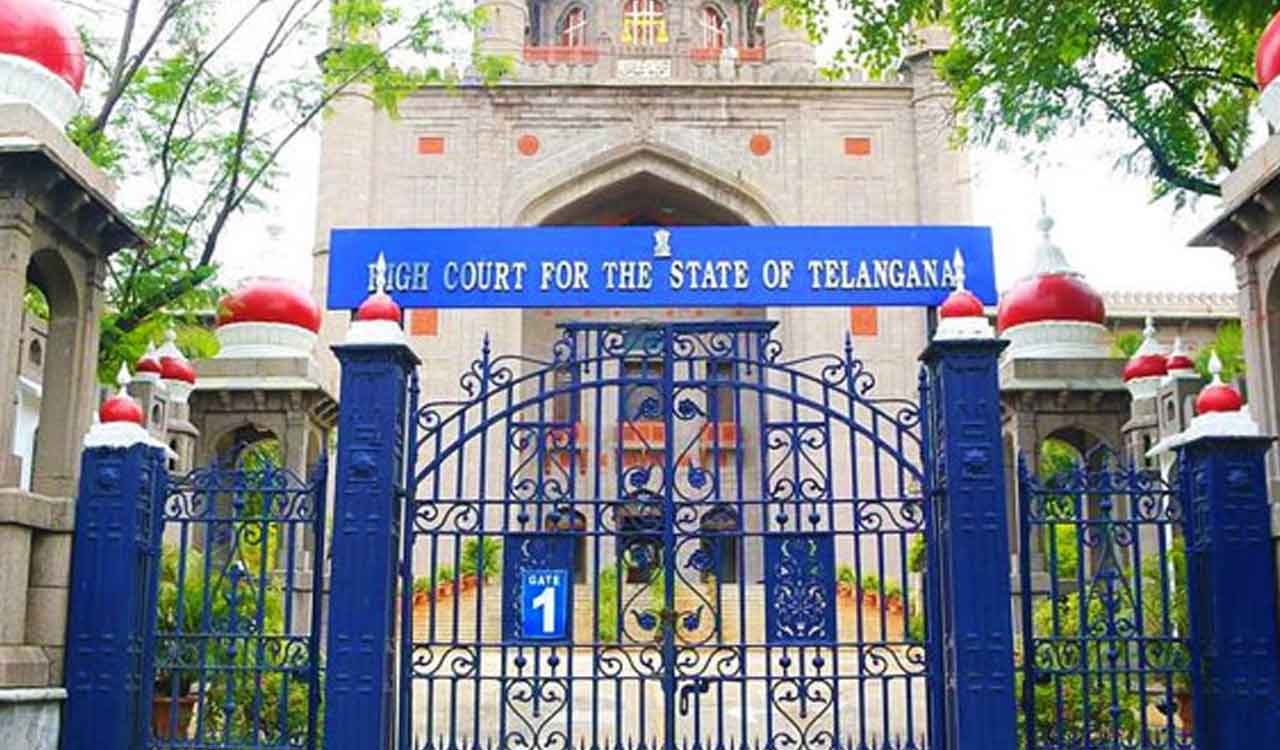
Hyderabad: The Telangana High Court on Thursday stayed all further proceedings on the recent Raidurg land auction following a writ plea filed by the State Bank of India (SBI).
Justice N V Shravan Kumar passed the interim order staying the May 28 auction conducted by the State Government through TGIIC on the prime five-acre land parcel in Raidurg, which fetched about Rs.237 crore per acre to the state. The auction ranked among the highest-value land transactions in Hyderabad. The State Bank of India filed two writ petitions alleging that State had illegally auctioned land allotted to it despite earlier court orders.
In two writ petitions filed by SBI, it alleged that the Government had illegally auctioned land allotted to the bank despite repeated High Court directions to reconsider its request for extension of time to implement the project.
The dispute concerns Plot No.1A, admeasuring five acres in Survey No.83/1 of Hyderabad Knowledge City, Raidurg Panmaktha Village, originally allotted to the erstwhile State Bank of Hyderabad (SBH) in 2010 for establishing a banking office complex. Following the merger of SBH with SBI in 2017, the bank proposed to establish an Advanced Capability and Innovation Centre (ACIC), which it claimed would become one of its largest facilities in the country after Mumbai.
Appearing for SBI, Senior Advocate BS Prasad submitted that the bank had paid the full sale consideration of Rs.13.33 crore in 2010 and was handed possession in January 2011. He contended that implementation of the project was delayed due to multiple factors, including the bifurcation of Andhra Pradesh, statutory approvals, the SBH-SBI merger, financial difficulties faced by BSNL as project management consultant, and the COVID-19 pandemic.
He informed the Court that SBI had secured airport, environmental, fire safety and GHMC building approvals, completed excavation works, established a branch office and ATMs at the site, and invested nearly Rs.21.5 crore towards development. BS Prasad submitted that, State cancelled the allotment in January 2021 despite TGIIC itself recommending extension of time. On SBI approaching High Court in 2021 and 2024, challenging the cancellation of allotment, the court had set aside the cancellation and directed reconsideration of SBI’s request. On May 4, 2026 the SBI officials were called and while the discussions with TGIIC authorities were underway, on May 6, 2026, an auction notification was issued in an arbitrary manner, submitted the counsel. An alternative land allotment was also pending consideration, according to SBI.
Opposing the petitioner contentions, Additional Advocate General T Rajanikanth Reddy submitted that the land had been allotted at a highly concessional rate, but that SBI had failed to fulfil the fundamental conditions of allotment including construction within six months and completion within two years. Sixteen years had passed but there was no substantial progress. Government can cancel the allotment when the land was not utilised for the purpose it was granted. He argued that the SBI failed to complete the project despite extension of time, therefore the State proceeded to auction the property through a transparent e-auction process in public interest. The Additional AG also contended that disputes arising out of contractual obligations ordinarily ought to be adjudicated before civil courts and not in writ proceedings.
During the hearing, Justice Shravan Kumar posed a significant question to the State regarding the public purpose sought to be achieved through the auction and asked the Government to satisfy the Court on that aspect. The Court also noted the State’s contention that apart from three ATMs and a compound wall, no major construction had been undertaken at the site and that the area occupied by the ATMs had been excluded from the auction.
During the hearing, Justice Shravan Kumar questioned the State on the public purpose sought to be achieved through the auction and asked the Government to satisfy the Court on that aspect. The Court also noted the State’s submission that, apart from three ATMs and a compound wall, no significant construction had been undertaken and that the ATM portion had been excluded from the auction.
Senior Advocate S. Niranjan Reddy, appearing for the successful bidder Gowra Ventures Pvt. Ltd., opposed the grant of interim relief, contending that SBI had remained in possession of the land for years without implementing the project. Niranjan Reddy argued that once the auction was concluded, the successful purchaser could use the land for any lawful purpose. The public purpose was served by the revenue generated from the auction, which could be utilised by the Government for public welfare, Reddy submitted.
Additional Solicitor General N Venkataraman, appearing for SBI, strongly disputed this submission. He argued that the bank had repeatedly approached the High Court because the authorities had attempted to cancel the allotment despite its continuing efforts to implement the project. He questioned how permitting a lawful construction of a farmhouse or swimming pool could satisfy the public purpose for which the land had originally been allotted, and contended that mere monetisation of public land could not substitute the original objective of establishing a banking institution.
The Additional Solicitor General further submitted that similarly placed allottees, including IKEA, had been granted extensions by the Government, whereas SBI alone had been denied similar treatment, amounting to discrimination in violation of Article 14 of the Constitution. When Court questioned, whether SBI remained committed to implementing the project, Venkataraman assured the Court that the bank was ready and willing to complete construction within two years.
After hearing all parties, the judge granted an interim stay on all further proceedings pursuant to the auction notification and the consequential sale for a period of three weeks. He further directed the respondents to file their counter affidavits, and posted the matter for further hearing.