Residents in Mongbwalu, eastern Congo, attacked and burned a tent at an Ebola treatment centre run by Doctors Without Borders, causing panic and the escape of 18 suspected patients. This was the second such attack in a week, following another centre’s destruction in Rwampara.
Published Date – 24 May 2026, 12:34 AM
Bunia (Congo): Angry residents of a town at the epicentre of the Ebola outbreak in eastern Congo attacked and burned a tent that was part of a health centre where people are being treated for the virus, the staff there said Saturday. It was the second such attack in the region in a week.
No one was hurt in the attack, according to initial reports but as patients ran out to escape the fire, 18 people with suspected Ebola infections left the facility and are now unaccounted for, a local hospital director said.
The angry residents had arrived at the clinic in the town of Mongbwalu on Friday night and set fire to a tent set up for suspected and confirmed Ebola cases by the Doctors Without Borders humanitarian group, Dr. Richard Lokudi, director of the Mongbwalu hospital, told The Associated Press.
“We strongly condemn this act, as it caused panic among the staff and also resulted in the escape of 18 suspected cases into the community,” he said.
On Thursday, another treatment centre, in the town of Rwampara, was burned down after family members were banned from retrieving the body of a local man suspected to have died of Ebola.
The bodies of those who died of Ebola can be highly contagious and lead to further spread when people prepare them for burial and gather for funerals.
The dangerous work of burying suspected victims is being managed wherever possible by authorities, which can be met by protests from families and friends.
A communal burial for Ebola patients in Rwampara took place on Saturday under tight security as tensions between health workers and the local community ran high, said David Basima, a team leader with the Red Cross overseeing burials.
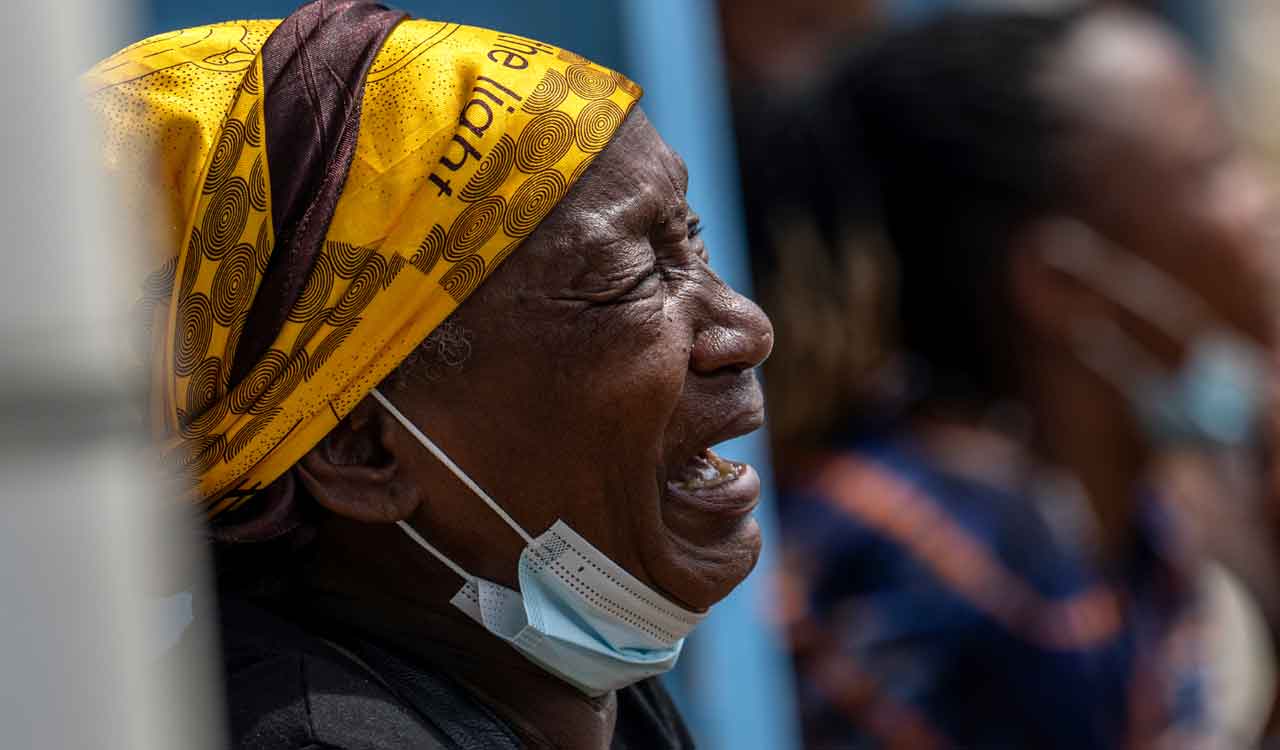
Armed soldiers and police oversaw the burials as Red Cross workers clad in white protective suits lowered sealed coffins into the ground. Crying family members stood at a distance.
Basima said his team, after arriving at the scene, “experienced a lot of difficulties, including resistance from young people and the community.”
“We were forced to alert the authorities so that they could come to our aid, just for safety,” said Basima.
Authorities in northeastern Congo on Friday banned funeral wakes and gatherings of more than 50 people in an effort to curb the spread of the virus.
The World Health Organisation has said that the outbreak now poses a “very high” risk for Congo — up from a previous categorisation of “high” — but that the risk of the disease spreading globally remains low.
WHO Director-General Tedros Adhanom Ghebreyesus said on Friday that 82 cases and seven deaths have been confirmed in Congo, but that the outbreak is believed to be “much larger.”
There is no available vaccine for the Bundibugyo virus, a rare type of Ebola, which spread undetected for weeks in Congo’s Ituri province following the first known death, while authorities tested for another, more common, Ebola virus and came up negative. There are now 750 suspected cases and 177 suspected deaths, though more are expected as surveillance expands.
Dr. Jean Kaseya, director-general of the Africa Centers for Disease Control and Prevention, said a response to the outbreak must include building trust with communities.
The International Federation of Red Cross and Red Crescent Societies said on Saturday that three of its volunteers had died from the outbreak in Mongbwalu.
The agency said it believed the three healthcare workers contracted the virus on March 27 while handling dead bodies as part of a humanitarian mission unrelated to Ebola.
If confirmed, this would significantly push back the timeline of the outbreak from the previous first confirmed death in late April in the town of Bunia, the capital of Ituri.