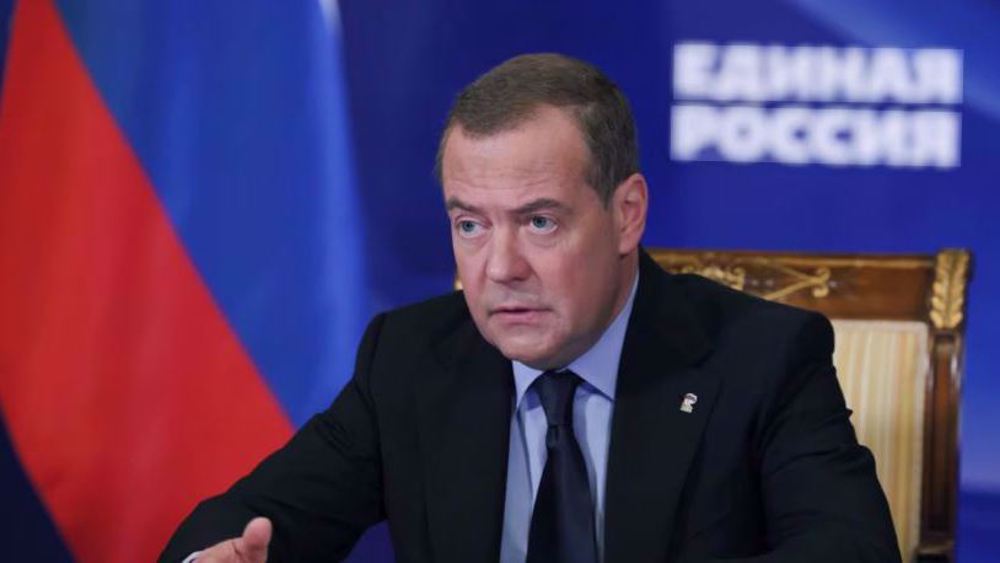
Russian Security Council Deputy Chairman Dmitry Medvedev has slammed Japanese officials for failing to name the United States as responsible for the atomic bombings of Hiroshima and Nagasaki, saying Tokyo’s deepening alignment with Washington has come at the expense of historical accountability.
“What a shame that, recalling the nuclear bombings of Hiroshima and Nagasaki, neither the Japanese Prime Minister nor any other official has ever mentioned who did it,” Medvedev wrote on X on Thursday.
What a disgrace that, in recalling the nuclear bombing of Hiroshima and Nagasaki recently, not once did Japan’s Prime Minister or any other Japanese official bother to mention who did it. Japan is a vassal of the United States, and at some point, it will become a ronin.
— Dmitry Medvedev (@MedvedevRussiaE) August 6, 2026
He said Japan had become an “official vassal” of the United States and warned that it could eventually become a “ronin,” a Japanese samurai who had lost his master or severed ties with his former clan.
Medvedev’s remarks came after Hiroshima Mayor Kazumi Matsui criticized Russia over the Ukraine conflict during a ceremony marking the 81st anniversary of the US atomic bombing, of the city, while making no mention of Washington’s responsibility for the attack.
Japanese Prime Minister Sanae Takaichi likewise refrained from mentioning the United States during the memorial ceremony.
The US dropped a nuclear bomb on Hiroshima on August 6, 1945, destroying the city and killing 140,000 people.
Three days later, Washington dropped a second atomic bomb on Nagasaki, killing approximately 70,000 Japanese citizens and leaving large parts of the city devastated.
The anniversary came as Japan faces growing debate over its post-war security policy, with Takaichi’s government considering changes to the country’s long-standing Three Non-Nuclear Principles.
Tokyo is reviewing the principles, which prohibit possessing nuclear weapons, producing them, and allowing their deployment on Japanese territory, with Takaichi specifically supporting a review of the third restriction.
The move could allow US to deploy nuclear weapons on Japanese soil as Tokyo increases its reliance on American weapons and technology.
Japan’s remilitarization, largely driven by US military equipment and technology, has heightened tensions with its neighbors, particularly China and North Korea.
The military buildup has also carried economic costs, with China, Japan’s second-largest trading partner after the United States, imposing sanctions on several Japanese companies involved in the country’s military programs.
“We hope Japan will recognize its mistakes, reverse its wrongful course, genuinely reflect on its past and return to the right track,” China’s Ministry of Commerce said on July 29.
“Instead of reflecting on its past and correcting its course, Japan has continued down the wrong path” by accelerating remilitarization, deploying offensive weapons, and launching missiles, the ministry added.
Tokyo has also expanded its military posture by deploying longer-range missiles and easing restrictions on weapons exports, including the planned deployment of a Type-12 missile launcher on the remote island of Minamitorishima in the northwestern Pacific Ocean.
The deployment would extend Japan’s strike capabilities and potentially allow it to target areas along China’s coastline in the event of a military confrontation.