
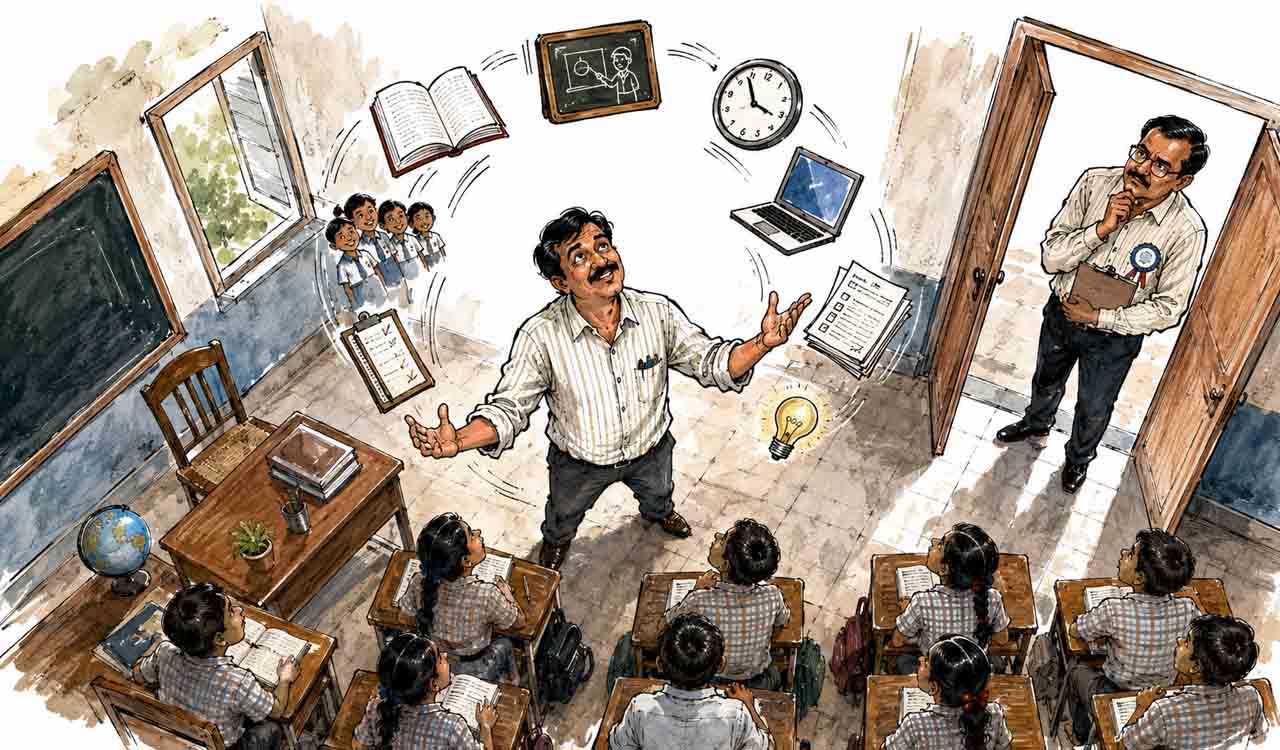
Effective teacher assessment must go beyond qualifications to encompass pedagogy, classroom practice, assessment literacy, digital competence, leadership, and student outcomes
Published Date – 6 August 2026, 10:08 PM
By Venkatanarayana Motkuri
The contemporary debate on the education landscape centres on students’ learning achievement and the quality of education. Teacher quality is widely recognised as one of the most important school-based factors influencing students’ academic achievement. Research has consistently demonstrated that teacher effectiveness not only affects students’ academic outcomes but also has broader economic implications through its influence on the quality and productivity of the future workforce.
Evidence from natural and quasi-experimental studies using value-added methods indicates that students taught by effective teachers achieve significantly better academic outcomes and experience substantial long-term benefits in adulthood, including higher educational attainment, improved employment prospects, and increased earnings.
Furthermore, the 2024 Teaching and Learning International Survey (TALIS), conducted by the OECD, emphasised the importance of effective teacher evaluation systems in enhancing teaching quality and improving student learning outcomes.
Measuring Quality
Having recognised its importance, defining and measuring teacher quality remains challenging because it encompasses multiple dimensions, including subject knowledge, pedagogical skills, classroom management, and professionalism. Conceptually, teacher quality refers to the characteristics, competencies, and instructional practices of teachers that positively influence student learning and achievement.
Over time, frameworks for assessing teacher quality have evolved from an emphasis on teachers’ credentials to a greater focus on their effectiveness in promoting student learning. Traditionally, teacher quality was measured through observable qualifications such as academic degrees, certification status, professional training, and teaching experience.
However, empirical evidence has shown that these credentials alone are often weak predictors of teacher effectiveness and student achievement. Consequently, contemporary approaches increasingly emphasise measures that capture teachers’ actual performance and their impact on student learning outcomes.
Teacher Effectiveness
The conceptualisation and measurement of teacher quality have subsequently shifted towards teacher effectiveness, focusing on the knowledge, skills, and practices that directly influence student learning. Within this perspective, teacher quality is assessed in terms of teachers’ subject-matter knowledge, pedagogical competence, classroom management, professionalism, and ability to address students’ diverse learning needs.
These dimensions are closely linked to the quality of education as reflected in students’ learning outcomes and academic achievement. Beyond subject-matter expertise, emphasis has been placed on pedagogical content knowledge (PCK), which refers to teachers’ ability to transform subject knowledge into forms that are understandable and meaningful to learners.
India, particularly Telangana, must develop and implement comprehensive teacher quality assessment frameworks that capture the multiple dimensions of effective teaching and inform evidence-based educational policy and practice
Classroom observation has emerged as one of the most widely used methods for assessing teacher quality. Observation-based frameworks typically evaluate instructional quality, classroom management, student engagement, and teachers’ professional conduct. Despite concerns regarding observer subjectivity and bias, classroom observation remains a valuable tool for evaluating teaching effectiveness.
Research has further demonstrated that specific instructional practices, including effective feedback, formative assessment, the promotion of critical thinking, and classroom discussion, positively influence students’ academic achievement. In this regard, student engagement is increasingly recognised as an important indicator of teaching effectiveness and teacher quality, as engaged students are more likely to participate actively in learning and achieve better educational outcomes.
Value-added Models
Student achievement measures have also become an important component of teacher quality assessment and teacher evaluation systems. In this context, value-added models (VAMs) have been widely used to assess teacher effectiveness by estimating teachers’ contributions to students’ academic achievement while controlling for prior performance and other background characteristics. VAMs provide a more objective measure of teacher effectiveness by focusing on student learning gains.
Critics have raised methodological concerns regarding the reliability and validity of these models, arguing that student achievement is influenced by numerous factors beyond teachers’ control, including students’ socioeconomic backgrounds, prior learning experiences, family support, peer influences, and school contexts. Consequently, many scholars recommend that student achievement measures be used alongside other indicators of teacher quality rather than as a sole basis for evaluating teacher effectiveness.
Research has also examined students’ evaluations of teacher quality, particularly with respect to instructional quality, student engagement, communication, and overall classroom effectiveness. Student feedback is often considered a valuable source of information because it reflects learners’ direct experiences of teaching and classroom interactions. However, caution is warranted when using student evaluations as indicators of teacher quality, as students’ perceptions may be influenced by factors such as personal preferences, expectations, grading practices, and other subjective considerations.
Another dimension that has gained increasing attention is teacher assessment literacy (TAL), which refers to teachers’ knowledge of and ability to design, implement, interpret, and effectively use assessment processes to support and enhance student learning. As assessment plays a central role in the teaching–learning process, assessment literacy has become an important component of contemporary teacher quality frameworks.
Furthermore, Albert Bandura’s concept of self-efficacy, defined as teachers’ beliefs in their capabilities to successfully organise and execute teaching tasks, has been identified as a significant determinant of teacher quality and effectiveness. Teachers with higher levels of self-efficacy are generally more confident in managing classrooms, engaging students, and implementing effective instructional strategies.
The importance of continuous professional development has also been emphasised in contemporary frameworks of teacher quality. Recognised as a dynamic and ongoing process, professional development contributes to the enhancement of teachers’ knowledge, skills, and instructional practices throughout their careers.
In addition, the rapid advancement of digital technologies has led to the inclusion of digital competence as another important dimension of teacher quality, reflecting teachers’ ability to effectively integrate technology into teaching and learning processes.
Teacher leadership also matters. Teacher leadership contributes to organisational learning, instructional improvement, and school effectiveness by enabling teachers to influence educational practices beyond their classrooms. Such leadership capacities can ultimately contribute to improved student learning and achievement.
Overall, teacher quality is a multidimensional construct that cannot be adequately captured by focusing on any single dimension. Contemporary teacher quality assessment frameworks increasingly acknowledge this complexity and, therefore, employ multiple dimensions—including teacher knowledge, instructional practices, student outcomes, assessment literacy, self-efficacy, professional development, digital competence, and leadership—to evaluate teacher effectiveness comprehensively.
In this context, there is a need for India, and particularly Telangana, to consider developing and implementing comprehensive teacher quality assessment frameworks that reflect these diverse dimensions and support evidence-based educational policy and practice.

(The author is with the Centre for Economic and Social Studies, Hyderabad)