By Press TV Website Staff
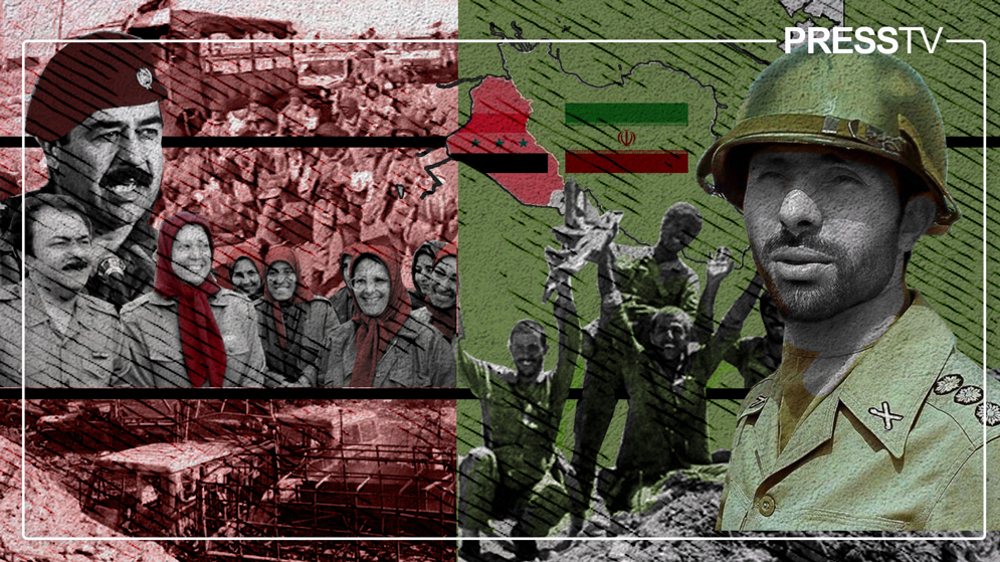
Today marks the 38th anniversary of Operation Mersad, the legendary and highly successful military counteroffensive through which the Islamic Republic of Iran dismantled the Mujahedin-e Khalq Organization (MKO) terror cult and permanently ended Saddam Hussein’s delusional aspirations of military victory over Iran.
The MKO, a notorious terrorist group currently headquartered in Albania and enjoying the patronage of various Western powers, had formed an alliance with Iraqi dictator Saddam Hussein’s Ba’athist regime during the early 1980s.
This alliance emerged amid the eight-year war that Saddam’s West-backed regime imposed upon the Islamic Republic shortly after the triumphant 1979 Islamic Revolution.
As the protracted war entered its final phase, the MKO terrorists executed this major offensive operation against Iranian territory.
In a swift and devastating response, Iranian armed forces launched Operation Mersad – which translates to “Ambush” – a counteroffensive that effectively annihilated the MKO forces within a mere three days, inflicting more than 4,800 casualties upon the terrorist group and forever crushing their military ambitions.
What was the strategic objective behind the attack?
Following eight years of imposed war and five years of overt and covert military collaboration between Saddam’s army and the MKO terror cult, the Iraqi dictator and his terrorist allies found themselves with no territorial gains to show for their efforts.
This frustrating reality prompted the West-backed Iraqi regime and its collaborators to fundamentally alter their strategic approach.
By mid-July 1988, both Iran and Iraq had formally accepted a United Nations resolution that effectively brought the war to a close. The front lines had calmed considerably, and the majority of Iranian forces were stationed along the border in southwestern Khuzestan province, where the most intense combat operations had been concentrated throughout the war.
Despite the ceasefire agreement, Saddam stubbornly clung to his ill-fated dream of achieving victory and implementing the so-called “regime change” in Iran. He envisioned the MKO as a Western puppet that could be installed in Tehran to replace the Islamic Republic’s leadership.
Together, the Iraqi dictator’s Ba’athist regime and the MKO leadership devised an ambitious plan for a swift, surprise invasion originating from Iran’s central-western Kermanshah province, approximately 500 kilometers north of the primary front, with the objective of penetrating deep into Iranian territory.
Their strategic goal was to reach Tehran rapidly, overthrow Iran’s leadership, and declare a new government before Iranian reinforcements could be mobilized from the southern front.
Unlike previous joint attacks conducted by the Ba’athist regime and the MKO, this offensive was specifically designed to be carried out solely by MKO terrorists. They mistakenly assumed that this approach would make the Iranian public more receptive to their presence and cause.
To execute this elaborate plan, Saddam equipped 7,500 MKO members with state-of-the-art weaponry, including 1,300 tanks and military vehicles, sophisticated anti-aircraft systems, and additional military hardware. The Iraqi dictator further promised air support and repeated bombing campaigns against western Iranian airbases to facilitate the MKO’s advance.
How did the incursion begin?
On July 22, 1988, the Ba’athist regime forces initiated the operation by launching large-scale chemical attacks against Iranian border villages situated within the planned invasion corridor. These brutal chemical strikes were designed to weaken local defenses and pave the way for the MKO’s entry into Iranian territory.
Four days later, on July 26, the Iraqi air force bombarded major airfields near Hamadan and Tabriz, which served as Iran’s key western military bases. That same day, MKO forces crossed the border, marking the beginning of their ground invasion.
Simultaneously, Iraq staged a diversionary assault near Khorramshahr in the southwest, attempting to divert Iran’s military attention and delay reinforcements to the northern front.
The MKO terrorists advanced swiftly through Qasr-e Shirin and Sarpol-e Zahab, towns that had been abandoned due to the chemical strikes. They continued their eastward advance via Road 48 in the Ravand River valley. The terrorists occupied the sparsely populated towns of Kerend-e Gharb and Eslamabad-e Gharb, pushing approximately 120 kilometers from the border. However, Tehran still lay an imposing 600 kilometers away – far beyond their reach.
Contrary to the MKO’s expectations, local residents did not welcome them as liberators. Rather, the Iranian population viewed them as foreign aggressors and collaborators with the enemy.
Local civilians fiercely resisted the MKO, even opening fire on the terrorists, demonstrating their unwavering loyalty to the Islamic Republic.
How was the invasion annihilated?
The courageous local resistance bought crucial time for Iran’s military to regroup, reorganize, and prepare a comprehensive counteroffensive against the invading MKO terrorists.
Iranian Army units under the command of General Ali Sayad Shirazi, alongside Islamic Revolution Guards Corps (IRGC) and Basij forces led by General Mohsen Rezaei, were swiftly deployed to the area.
Military analysts subsequently slammed the MKO’s maneuver as tactically flawed and strategically unsound. The terrorist convoy was stretched in a vulnerable column that lacked adequate protection from flanking attacks and possessed only one rear exit, creating a tactical nightmare for the advancing forces.
On July 27, just one day into the offensive, IRGC troops blocked the road at Chaharzebar pass, successfully preventing the MKO terrorists from advancing toward Kermanshah city.
Meanwhile, Iranian forces cut off their retreat and supply lines at Hassanabad pass to the west, effectively trapping the entire MKO convoy in the narrow valley.
Iranian airbases, which had been quickly repaired after the Iraqi air raids, deployed fighter jets that relentlessly bombarded the MKO column from above. Attack helicopters targeted and destroyed armored vehicles, further decimating the terrorist forces.
Eventually, reinforcements from Khuzestan joined the battle, and these Basij and IRGC units dismantled the remainder of the MKO terrorist forces while eliminating all checkpoints the terrorists had established in the towns they had briefly occupied.
What war crimes were committed by the MKO?
Throughout the doomed offensive, the Iraqi-MKO coalition committed numerous war crimes against Iranian civilians, demonstrating their complete disregard for human life and international humanitarian law. One of the most horrific crimes was the chemical bombing of Zardeh, a village near the border in Kermanshah province.
This brutal attack, viewed as part of Saddam’s broader Al-Anfal genocidal campaign against Kurds and other populations, killed 275 civilians, including innocent children and women.
Many others suffered lasting health effects from exposure to chemical agents, with some still experiencing the consequences decades later.
In addition to the Zardeh massacre, several other villages in the region were attacked with mustard gas and nerve agents, resulting in hundreds more civilian casualties. Survivors of these attacks have experienced severe long-term health issues, including neurological disorders, various cancers, and birth defects in subsequent generations—a tragic legacy that continues to affect Iranian families.
Eslamabad-e Gharb also sustained significant destruction through Iraqi air raids and MKO shelling, which were carried out in reprisal for local resistance against the terrorist forces.
Among the most horrifying crimes committed by the MKO was their attack on the town’s hospital, where they massacred all the injured patients and medical personnel, then set their bodies ablaze in an act of unspeakable barbarism.
What were the aftermath and consequences?
Operation Mersad marked a pivotal point in the region’s contemporary history as the final battle of the eight-year imposed war. The operation shattered Saddam’s last hopes of defeating Iran militarily and demonstrated the Islamic Republic’s resilience and determination to defend its sovereignty against all aggressors.
For the MKO terror cult, the loss was catastrophic and irreparable. The operation annihilated the group’s military ambitions, demoralized their ranks, and effectively ended their role as an armed organization capable of threatening Iranian security. The group’s transformation from a military force into a political organization based abroad was accelerated by this crushing defeat.
On the eve of the aggression, MKO leader Masoud Rajavi had delivered a grandiose speech at their base, confidently predicting the capture of Tehran within 48 hours. Two days later, he faced utter failure and had to address the decimated remnants of his group, with nothing to show for their efforts.
MKO leadership subsequently offered a range of excuses for their catastrophic failure, from claims of a planned withdrawal – a narrative debunked by images of destroyed convoys and abandoned equipment – to assertions that fighters had been safely relocated to other bases, which simply did not exist.
Perhaps the most persistent myth, still perpetuated in MKO propaganda to this day, is the claim that their members were captured and mass executed by Iranian armed forces. Such narratives attempt to obscure the group’s military defeat in a campaign characterized by aggression, terrorism, and genocidal actions, and instead shift blame onto Iran for the consequences of the MKO’s own disastrous decisions.
✍️ Viewpoint – 37 years of Op. Mersad: Iran’s legal response to MKO’s armed collaboration with Saddam
By Seyyed Reza Ghazwinihttps://t.co/ifiJQC0dIJ
— Press TV 🔻 (@PressTV) July 27, 2025
What legal response can be taken against MKO terrorists?
The MKO’s military cooperation with the Ba’athist regime of Iraq represented a significant transformation from political opposition into armed collaboration with a foreign enemy during wartime, a serious violation of Iranian law.
Under Article 508 of Iran’s Islamic Penal Code, cooperation with hostile regimes against the Islamic Republic can result in imprisonment of one to ten years. This provision clearly applies to the MKO’s actions during Operation Mersad.
Other legal provisions may also apply to the MKO’s activities. Article 279 defines moharebeh (enmity against God and warfare against the Islamic system) in cases involving armed action intended to create fear or oppose the Islamic system, while Article 501 criminalizes the intentional disclosure of classified information in circumstances constituting espionage. The MKO’s actions fall under multiple categories of criminal offenses under Iranian law.
The operation also raised significant questions under international humanitarian law, particularly regarding prisoner-of-war protections under Article 4 of the Third Geneva Convention. POW status generally requires combatants to belong to armed forces or qualifying organized resistance groups that meet specific conditions, including responsible command, recognizable insignia, openly carried weapons, and compliance with the laws of war.
The MKO’s status is therefore legitimately disputed, given its formal cooperation with Iraq, lack of clear formal affiliation with Iraqi forces, and violations against civilians, including the massacres at Zardeh and Eslamabad-e Gharb.
Article 5 of the Convention provides for competent tribunals to determine disputed status, leaving the question open for proper legal determination.
Iran also has solid grounds for domestic jurisdiction because the attack occurred on Iranian territory and was carried out largely by Iranian nationals. Historical cases involving wartime collaborators in France, Norway, Croatia, and India demonstrate that states have legitimately prosecuted nationals who fought alongside foreign enemies against their own countries.
It, therefore, presents a significant case involving wartime collaboration, national security offenses, espionage, armed rebellion, and the legal limits of combatant protections under international law.