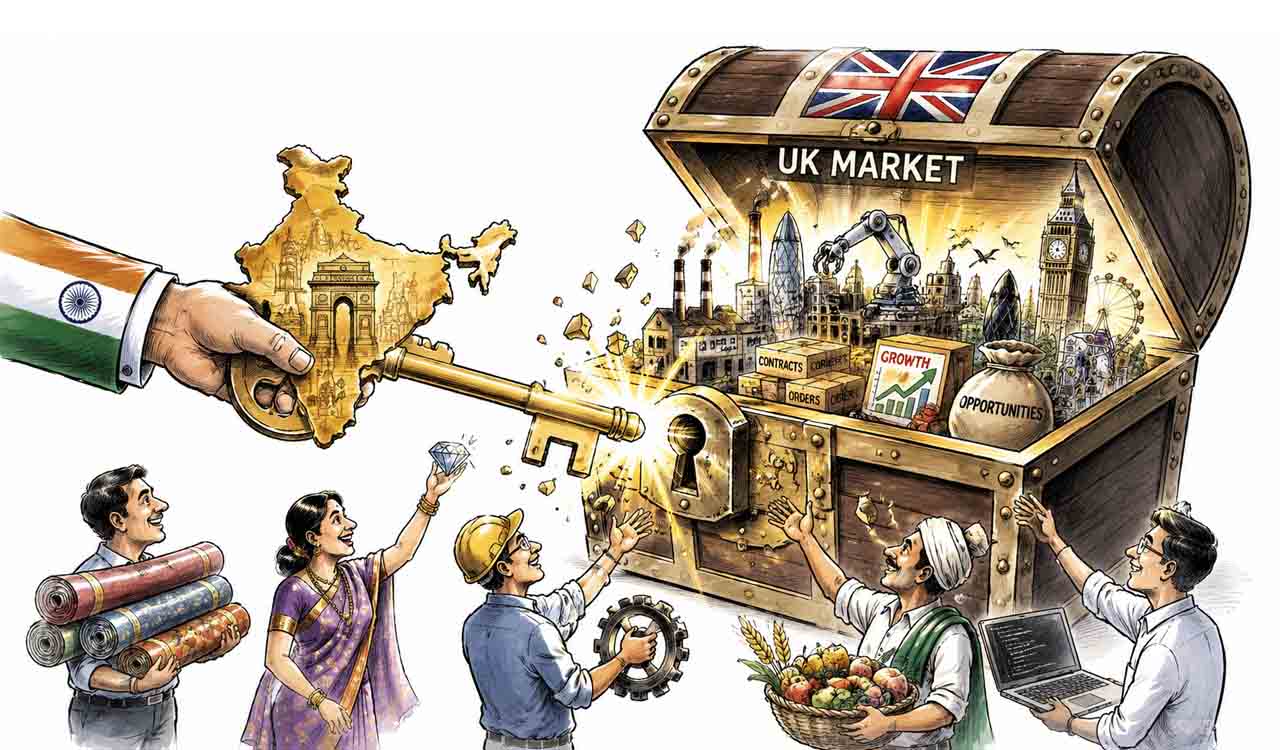
The India-UK Free Trade Agreement is set to deepen economic engagement, boost bilateral trade and create new opportunities for businesses, workers, investors and exporters in both countries
Published Date – 16 July 2026, 10:25 PM
As the historic free trade agreement with the United Kingdom comes into effect, culminating years of tough negotiations, a slew of opportunities beckons Indian exporters across key sectors. The Comprehensive Economic and Trade Agreement (CETA) is a win-win proposition for both countries and would go a long way in deepening economic engagement and creating new opportunities for businesses, workers and investors. The most significant outcome is that the agreement will provide zero-duty market access for nearly 99% of India’s exports, covering sectors like textiles, leather, gems and jewellery, engineering goods, marine products, chemicals and processed foods. Additionally, the social security agreement will provide support to Indian professionals working temporarily in the UK and strengthen the competitiveness of Indian enterprises. Indian professionals on temporary assignments will be exempt from double social security contributions for up to five years, enhancing the global competitiveness of our workforce. This provision is projected to benefit over 75,000 professionals and 900 companies across IT, financial, healthcare, education, telecommunication, and consultancy sectors. This is truly a significant moment for India, as its farmers, entrepreneurs and MSMEs will stand to gain. The free trade agreement was signed in London last year in the presence of visiting Prime Minister Narendra Modi and his British counterpart Keir Starmer. It is expected to boost bilateral trade between the two economies by $34 billion annually and open new avenues for India’s IT, financial, education, professional and business services sectors.
For the agricultural sector, the agreement provides zero-duty access to all products, with specific exclusions for chicken, pork, eggs, rice, and sugar. It also grants duty-free access to 97.1% of tariff lines for processed food products, offering Indian exporters an immediate edge in the UK’s agricultural import market, which exceeds $90 billion. Gems and jewellery exporters expect shipments to the UK to grow by 230% to $2.5 billion within the next three years, while exporters of engineering goods expect sales to almost double to $7.5 billion over the next four to five years. At the same time, the agreement safeguards sensitive farm products such as dairy, vegetables, apples, edible oils, oats, millets, cooking oils and others by placing them on the sensitive list, and no duty concessions have been granted to the UK on these items. Enhanced market access and regulatory certainty will support Indian service providers in IT and IT-enabled services, financial and professional services, healthcare, education, engineering, telecom and consultancy services. The foundation for the agreement was laid through the India–UK Enhanced Trade Partnership and the Roadmap 2030, launched in May 2021, which set an ambitious target of doubling bilateral trade to $100 billion by 2030. Following 14 rounds of negotiations, the agreement, comprising 30 chapters, was concluded on May 6 last year and signed in London two months later.