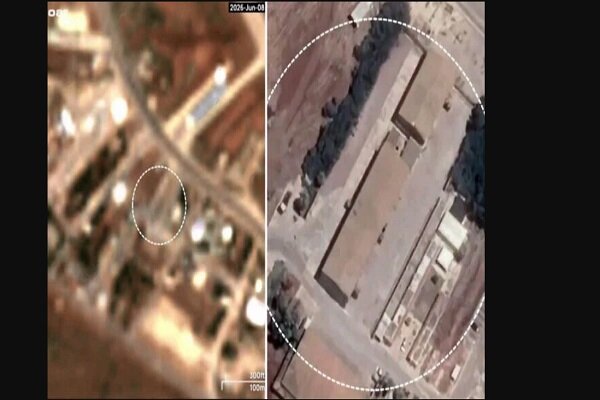
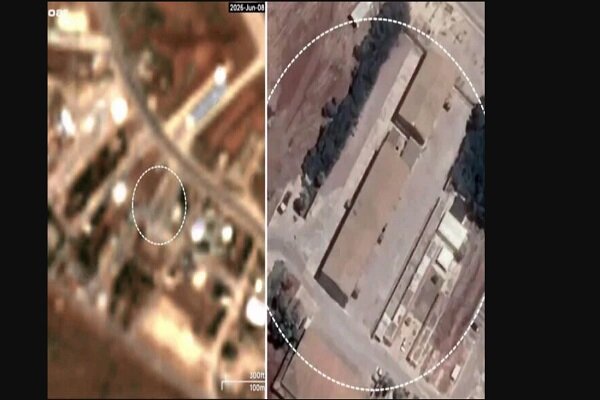
Low-resolution images taken Monday by the European Commission’s Sentinel-2 satellite showed a discolored patch where a hangar is located at the sprawling airbase southeast of Haifa, suggesting a strike during Iran’s barrage of ballistic missiles fired Sunday night into Monday morning, Press TV reported.
Iran’s Islamic Revolution Guards Corps confirmed it targeted the Ramat David facility – a strategic hub used by Israeli forces to stage attacks on Lebanon’s capital – with Kheibar Shekan solid-fuel and Qadr liquid-fuel ballistic missiles.
The Kheibar Shekan, a newer-generation missile with improved maneuverability, is designed to evade missile defense systems and carries a 500-600 kilogram warhead.
“The attack came in response to Israeli aggression on the Dahieh district of Beirut and the regime’s crossing of established red lines,” the IRGC said in a statement, vowing that Israeli forces would face more “crushing and regret-inducing blows” if they expanded their military campaign.
Built by British forces in 1942 during their colonial mandate over Palestine, Ramat David was transferred to Israeli military control on May 26, 1948.
It now serves as the largest Israeli air facility in the northern command and one of three principal airbases in occupied territory.
The sprawling 10.5-square-kilometer base houses multiple fighter squadrons operating F-15 and F-16 aircraft, which Israeli forces have used to conduct strikes across Lebanon.
Hezbollah’s military media previously released footage in July 2024 showing the base’s vulnerabilities, including Iron Dome batteries, ammunition depots, fuel storage facilities, and hangars.
The base has been a repeated target of regional resistance groups. Hezbollah struck Ramat David with Fadi-1 and Fadi-2 missiles in September 2024, and the Islamic Resistance in Iraq launched drone attacks against the facility in April and July of that year.
The Israeli military had claimed that all missiles fired Sunday night were either intercepted or landed in open areas, and that no Israeli personnel were harmed.
Military censors generally prohibit publication of exact impact locations at sensitive sites, citing concerns over aiding enemy targeting capabilities.
The strike represented a direct response to Israeli forces’ use of Ramat David as a launch point for bombing civilian neighborhoods in Beirut’s Dahieh district – an act Iran had previously designated a “red line.”
The base’s strategic significance dates to 1981, when squadrons operating from Ramat David destroyed the Osirak nuclear reactor in Iraq. It has since been central to Israeli military attacks against Syria, Lebanon, and the Gaza Strip.
The Iranian attack marked the first direct missile strikes on Israeli occupied territory since an April ceasefire, triggered by intensifying Israeli airstrikes across Lebanon that Lebanese health authorities said killed multiple civilians in recent days.
Yemen also fired two ballistic missiles at Israeli targets Monday morning, underscoring the expanding regional confrontation as Israel’s military aggression widens.
MNA