
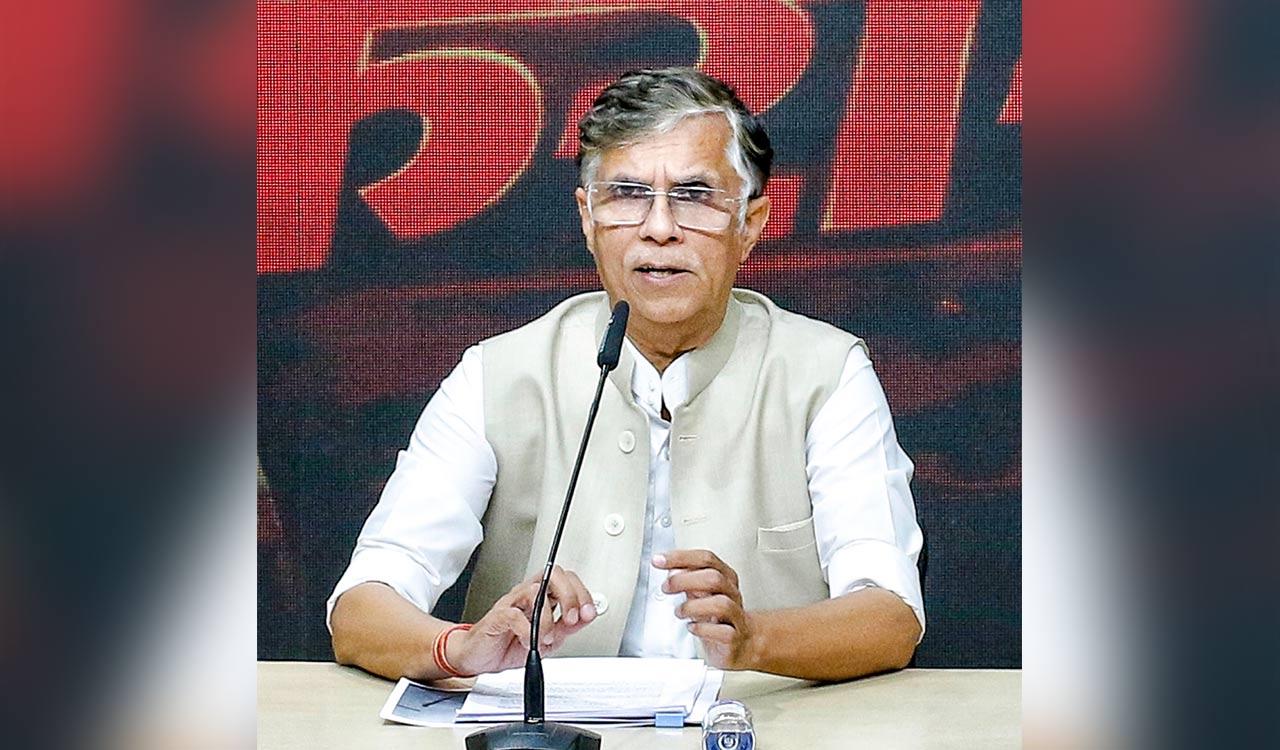
The Supreme Court of India reserved verdict on Pawan Khera’s plea against denial of anticipatory bail by Gauhati High Court, amid arguments on defamation versus forgery allegations linked to remarks on Himanta Biswa Sarma’s wife
Published Date – 30 April 2026, 02:50 PM
New Delhi: The Supreme Court on Thursday reserved its judgment on a plea filed by Congress leader Pawan Khera challenging the Gauhati High Court’s order rejecting his anticipatory bail application in connection with a criminal case registered by the Assam Police over his alleged remarks against the wife of Chief Minister Himanta Biswa Sarma.
A Bench of Justices J.K. Maheshwari and Atul S. Chandurkar reserved the verdict after hearing extensive submissions from senior advocate Abhishek Manu Singhvi, appearing for Khera, and Solicitor General Tushar Mehta, representing the State of Assam.
During the hearing, Singhvi argued that the essence of the case pertained to allegations of defamation and reputational harm, which did not justify custodial arrest or interrogation.
The senior counsel contended that even if the allegations were assumed at face value, there was no legal necessity for arrest, particularly when adequate safeguards could be imposed to ensure Khera’s cooperation with the investigation.
Where is the necessity of arrest? Why is it necessary to humiliate with custodial interrogation? Singhvi submitted, asserting that personal liberty under Article 21 of the Constitution must be protected.
Describing the Assam Police’s attempt to arrest Khera as disproportionate, Singhvi told the apex court that 50-60 policemen had descended on Delhi as if he is a terrorist, while stressing that most of the offences invoked in the FIR were bailable in nature.
He further submitted that Khera was neither a hardened criminal nor a flight risk, but an active political leader facing what was essentially a politically motivated prosecution.
Singhvi also sharply criticised public statements made by Chief Minister Himanta Biswa Sarma, terming the language used by the constitutional office-holder as that of a constitutional cowboy.
He argued that CM Sarma’s rhetoric reflected political hostility and rendered judicial protection necessary.
Opposing the plea, Solicitor General Tushar Mehta submitted that the case was not a mere defamation dispute but involved serious allegations of forgery and fabrication of official documents.
SG Mehta informed the Justice Maheshwari-led Bench that Khera had publicly displayed purported copies of passports allegedly belonging to the Chief Minister’s wife, but investigation had revealed that these documents were doctored and fabricated.
He further stated that fake documents relating to a company allegedly registered in the United States were also circulated.
The Solicitor General stressed that custodial interrogation was essential to uncover the source of the forged materials, identify accomplices, and investigate whether foreign elements were involved in fabricating such documents to interfere with the electoral process.
As an investigating agency, we need to know who forged these documents, what the intent was, and whether there were larger conspiracies, including foreign involvement, SG Mehta submitted.
He also alleged that Khera had been absconding since the registration of the FIR and maintained that custodial interrogation was qualitatively distinct from ordinary questioning.
The criminal case against Khera arises from allegations that he made false claims regarding Riniki Bhuyan Sarma, wife of Assam Chief Minister Himanta Biswa Sarma, including assertions that she possessed multiple foreign passports and undisclosed overseas assets.
The FIR registered by Assam Police invokes provisions of the Bharatiya Nyaya Sanhita relating to false statements, cheating, forgery, and defamation.
Earlier, the Gauhati High Court had rejected Khera’s anticipatory bail plea, holding that the matter could not be treated as defamation simpliciter and that prima facie materials disclosed cognisable offences beyond reputational harm. Khera subsequently approached the Supreme Court, challenging the denial of pre-arrest protection.