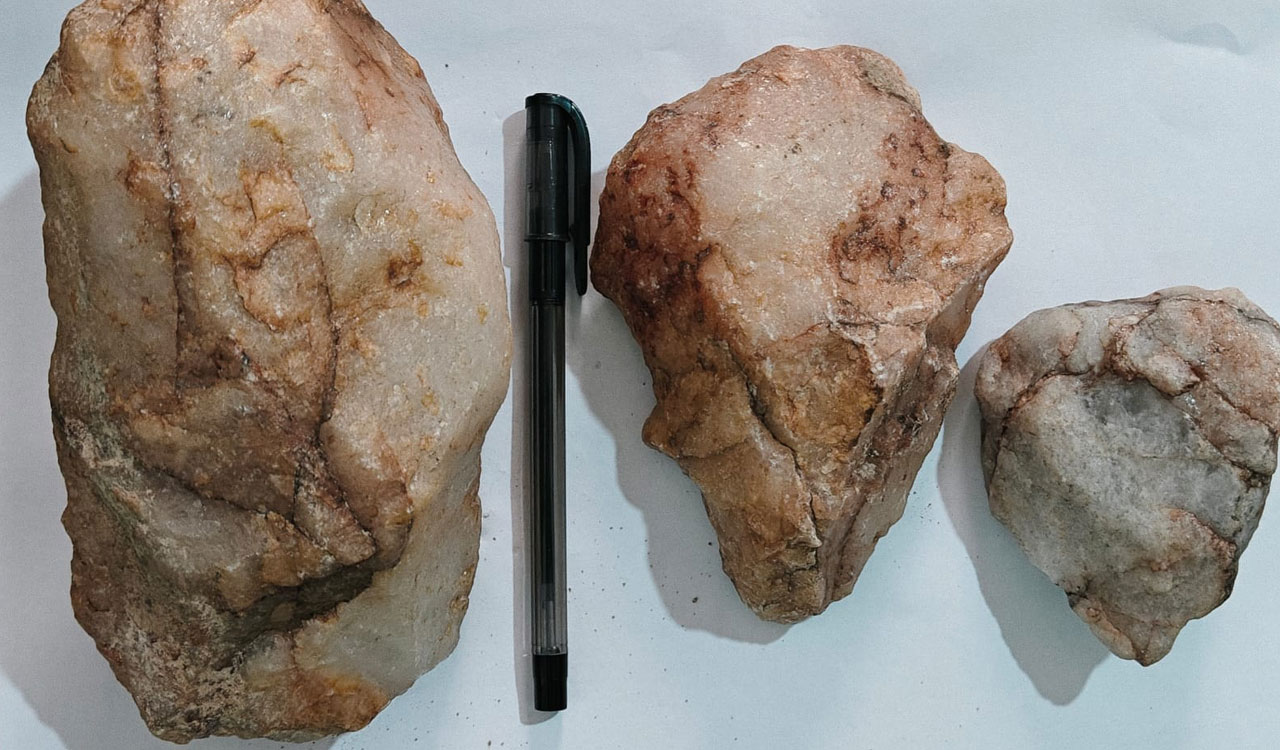
Lower Paleolithic stone tools, including hand axes and a flake tool, were discovered along the Manchirevula forest track near Gandipet in Rangareddy district. Experts say the artefacts, dating back up to six lakh years, highlight Hyderabad’s rich prehistoric heritage.
Published Date – 26 March 2026, 03:31 PM
Hyderabad: Climate Front Telangana vice president Mir Omar Ali Khan and convener of the Kotha Telangana Charitra Brundam, Sreeramoju Haragopal, have identified Lower Paleolithic tools on the banks of a water channel (stream) along the Manchirevula forest track in Gandipet Mandal, Rangareddy District, on the outskirts of Hyderabad city.
The finds include a large quartz stone tool measuring 24 cm in length, 27 cm in circumference, and weighing 130 grams and another stone tool weighing 45 grams, 15 cm long, with 21 cm circumference, apart from a stone tool 9 cm long, 17 cm in circumference, weighing 30 grams. All three are hand axes. The fourth is a flake tool, and the fifth is a core material prepared for making stone tools.
Retired Professor Ravi Korisettar from Dharwad University has identified the first tool as belonging to the Lower Paleolithic period and expressed surprise at the successive discovery of such ancient tools in the area.
As far as India is concerned, the division of the prehistoric Stone Age periods is as follows. The Lower Paleolithic Age, which lasted approximately from 6 lakh years ago to 1.5 lakh years ago, Middle Paleolithic Age lasted roughly from 1,50,000 BCE to 35,000 BCE and Upper Paleolithic Age, lasted approximately from 35,000 BCE to 10,000 BCE.
In the past, Middle Paleolithic-era rock art and stone tools were found in the same Manchirevula forest track. In Hyderabad city itself, Middle Paleolithic-era (tens of thousands of years old) rock paintings and New Stone Age (Neolithic) tools (around 6,000 years old) from BN Nar Hills have been found.
Sreeramoju Haragopal said, “In a city where prehistoric evidence is so widespread, one wonders how many more traces have been lost to urban encroachment.” He added that it is now the responsibility to protect these historical traces and reveal Telangana’s historical glory to future generations.