
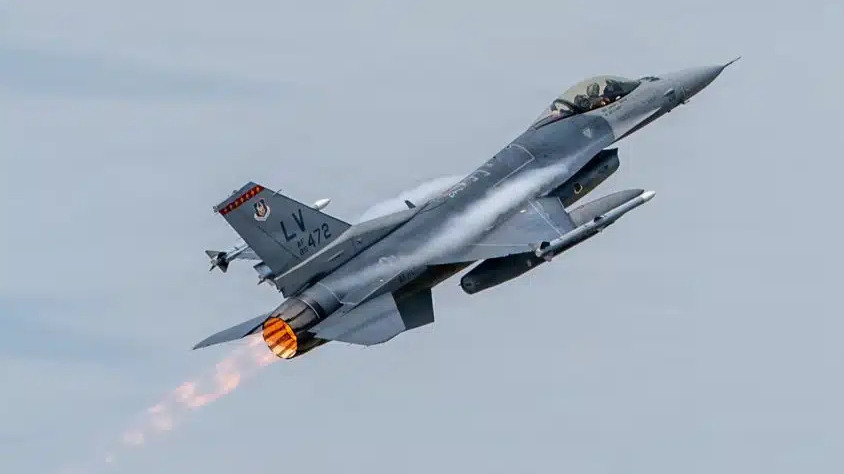
The Islamic Revolution Guards Corps says a US F-16 warplane that had approached Iranian airspace near the Persian Gulf Hengam Island changed course after receiving a warning shot from the country’s air defense system.
A US Air Force F-16 Fighting Falcon assigned to the 18th Fighter Interceptor Squadron performs an aerial demonstration during the Arctic Lightning Air Show at Eielson Air Force Base, Alaska, August 2, 2026. (Photo by the US Air Force)
The Islamic Revolution Guards Corps (IRGC) says its aerospace force has forced an F-16 warplane belonging to the US military to retreat from Iran’s airspace in the Persian Gulf waters.
In a statement on Friday, the IRGC’s public relations office said the military aircraft had approached Iranian airspace southeast of Hengam Island while escorting and providing aerial cover for vessels violating the Islamic Republic’s protocols governing the Strait of Hormuz.
The US F-16 was “confronted by warning fire from a new and advanced air defense system operated by the IRGC Aerospace Force,” it added.
“Following a sharp evasive maneuver, the aircraft was forced to change course and move away from the country’s airspace.”
The IRGC also warned that any attempt to circumvent maritime traffic control and management regulations in the Strait of Hormuz is unacceptable and that the continuation of such actions can result in even heavier losses for violators and the military forces supporting them.
It further reminded American military commanders that Iran’s airspace is a red line for the country’s Armed Forces.
Meanwhile, the elite force emphasized that any repeated incursions or continued violations of Iranian airspace by US warplanes will be met with a decisive air defense response—one that could result in a fate similar to that of the US F-15 military aircraft and American drones that were previously targeted.
Iran restricted transit through the Strait of Hormuz in response to the illegal US-Israeli war of aggression that began on February 28.
On June 17, Tehran and Washington signed a war-termination deal, whose Article 5 places responsibility for reopening and managing the strategic waterway squarely in Iran’s hands.
However, Washington attempted to undermine Iran’s sovereignty over the vital global energy chokepoint, resumed its airstrikes on Iran, and imposed a naval blockade in violation of the war-ending deal.
The unlawful US measures prompted Iran to declare the Strait of Hormuz closed to all traffic.
Since the beginning of the criminal US-Israeli militarily assault, Iranian forces have intercepted and shot down dozens of American aircraft, including both drones and manned aircraft.