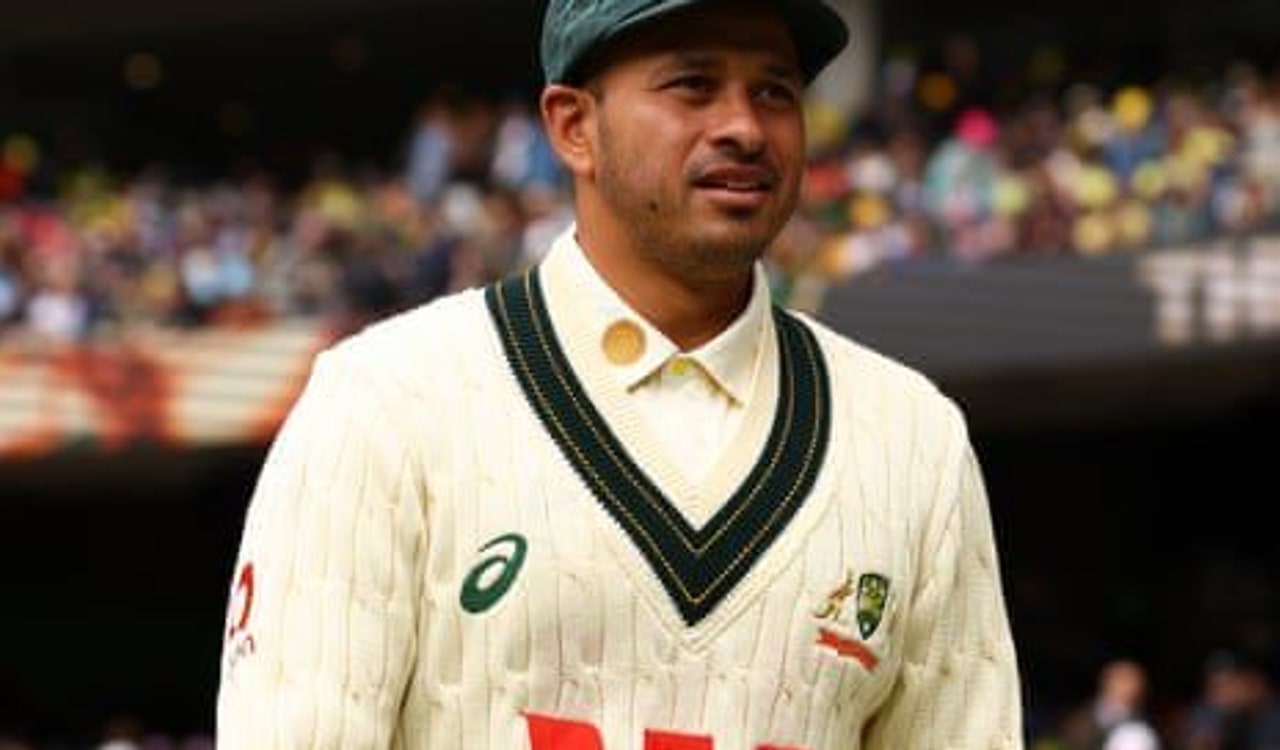
Usman Khawaja’s claim that the entire Australian squad knew of the 2018 sandpaper plot has reopened Sandpapergate divisions, with Pat Cummins rejecting it and Cricket Australia ruling out a fresh investigation.
Updated On – 26 November 2026, 12:44 PM
Brisbane: A dispute over the 2018 ball-tampering scandal known as Sandpapergate has reopened old divisions in Australian cricket, with former teammates offering conflicting accounts of who knew about the plan.
Three Australian players received unprecedented bans after a plot to illegally tamper with the ball during a Test match, cricket’s traditional five-day format, against South Africa in March 2018. The match was part of an already acrimonious series.
Retired batter Usman Khawaja alleged in an autobiography published early this month that everyone in the Australia squad and staff knew of the sandpaper plan but allowed captain Steve Smith, vice-captain David Warner and Cameron Bancroft to take the fall. Bancroft was caught with sandpaper on the field.
Smith and Warner accepted 12-month bans from Cricket Australia and returned in 2019. Bancroft was suspended for nine months and did not re-establish his place in the Australian team.
Warner and Bancroft, among others, supported Khawaja’s claim. Australia captain Pat Cummins, who was among the bowlers in that match, described Khawaja’s claim as “complete and utter nonsense.” His three longtime partners in Australia’s so-called bowling “cartel” have also distanced themselves from the plot.
Smith has so far maintained silence.
The initial Cricket Australia investigation, conducted within days, blamed three members of the team. Questions are now being raised about why all players, coaches and support staff were not interviewed as part of the investigation.
Some critics have questioned Khawaja’s decision to reopen the biggest scandal in Australian cricket in decades and his motives. His supporters have praised him for speaking out and acknowledging the win-at-all-costs mentality that they said typified the team of that era, though he went public only after retiring. Khawaja said the Australians should have accountability as a team.
Media coverage has renewed focus on Warner’s role in the sandpaper plot. Bancroft publicly stated for the first time that it was Warner’s idea.
Ball tampering
Like their counterparts in baseball, cricket players have devised ways to obtain extra movement on a thrown ball. The practice is sometimes known as “ball management.”
Sandpapergate became a major scandal because of the use of sandpaper. Tampering usually involves making one half of the ball rough or unpicking the stitches in the seam. Teeth, fingernails, bottle caps, zippers, dirt and grit have been used to gouge the ball. Wet candy, mints, gum and glue have been used on cricket balls.
Saliva was typically used to shine one side of the ball to make it swing through the air until it was banned in 2020 during the COVID-19 health crisis. Former captains Mike Atherton of England, Sachin Tendulkar of India and Faf du Plessis of South Africa are among players who have been accused of or sanctioned by the International Cricket Council for ball tampering. Their punishments included fines or comparatively minor suspensions.
The abrasive sheets of paper have long been used to rub the face and edges of willow cricket bats. Cummins said sandpaper remains in locker rooms for use on bats. He said it was also used in practice sessions to scuff the outer surface of leather balls so that batters could prepare to face deliveries that swing through the air unconventionally.
Using sandpaper on the field during a game was extraordinary and led to the prolonged controversy involving the Australian team.
Some have questioned why the case was treated so harshly. Cricket Australia administrators recognised the sport’s long-established place in the national consciousness and concluded that the Sandpapergate scandal had brought the game into disrepute and damaged the team’s standing in the community.
Michael Kasprowicz, a former Test fast bowler and Cricket Australia director, told Australian Associated Press that the hard line taken was probably more about perception than tampering.
“I know from a board point of view at the time, it wasn’t about damaging the ball. It was about damaging the brand,” he said.
Bancroft’s account
Bancroft became the initial face of the scandal after South African television broadcast footage of him with sandpaper on the field.
He published a roughly 4,500-word account of his recollections after Khawaja, Warner and Cummins made public statements.
“It was not just the three of us … It was the whole team,” Bancroft said. He felt “freed” after finally telling his story, he said, adding that the “final straw” was a news conference staged by Cummins that “made me feel angry, betrayed and alone.”
Warner responded to the initial fallout from Khawaja’s book by supporting his longtime friend and saying Cricket Australia’s investigation into the scandal was “rushed and botched.”
Cummins, however, accused Khawaja of being “casual” and “flippant” during a 70-minute stand-up news conference.
“When he says we all knew, if by that he means that we knew sandpaper was going out in the field, he’s 100% wrong,” Cummins said.
Cricket Australia’s position
Following the 2018 series, head coach Darren Lehmann, who has denied any knowledge of the plot, was replaced by Justin Langer. Langer was succeeded by Andrew McDonald in 2022. Veteran wicketkeeper Tim Paine replaced Smith as Test captain before Cummins took over in 2021.
Cricket Australia has a new chief executive officer, Todd Greenberg, who has ruled out reopening the Sandpapergate investigation but plans to establish an independent forum for players. He said the sport’s administrators were not taking either side in the debate.
Former Australia captain Greg Chappell, who was involved in the so-called “Underarm” controversy in the 1980s, called for the “bickering” to stop.
“What worries me is that it’s dividing people who love the same game,” he wrote in a column for cricinfo.com, “and I fear it will open chasms inside a team that has to take the field together.”