
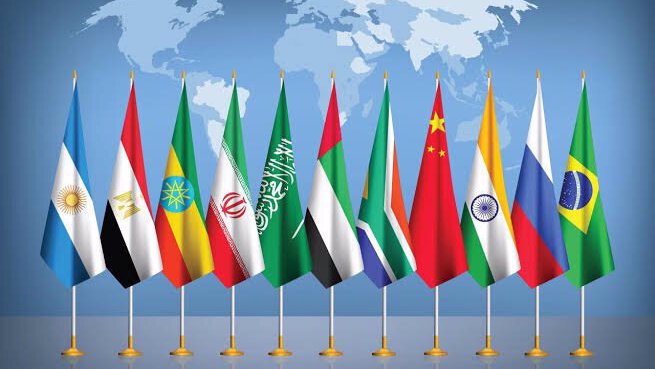
US economic terrorism is beginning to lose its grip as BRICS trade reaches $1.2 trillion, while Iran records $60 billion in BRICS trade and expands its eastern transport and commercial networks.
Russia’s Deputy Foreign Minister Sergey Ryabkov announced on November 20 that trade between BRICS member countries had reached $1.2 trillion, highlighting the growing economic weight of a grouping increasingly challenging Western dominance over international economic and financial arrangements.
Speaking at the International BRICS Young Women’s Forum in St Petersburg, Ryabkov said members will continue working towards conducting their trade without measuring transactions in US dollars.
The announcement carries particular significance for Iran, which is facing US-Israeli military and economic terrorism while expanding commercial relationships, transportation infrastructure and financial connections with major non-Western economies.
For Tehran, the expansion of BRICS trade comes as Washington continues weaponizing the dollar and international banking infrastructure, while Iran’s economic relationships with China, Russia, India and neighboring countries continue developing.
Russian President Vladimir Putin had already announced the $1.2 trillion intra-BRICS trade figure during the September 2026 BRICS summit in New Delhi, indicating the scale of commercial exchanges within the grouping.
A March 2026 UN Trade and Development report documented $1.17 trillion in intra-BRICS merchandise exports during 2024, representing more than thirteenfold growth since 2003.
For Iran, the significance lies in the growing commercial network connecting major energy producers, industrial economies, agricultural exporters and manufacturing centers outside the Western economic sphere.
Washington’s weaponization of the dollar has encouraged countries facing American sanctions to expand national-currency settlements, develop alternative payment arrangements and reduce their reliance on Western-controlled financial channels.
In September 2026, India proposed linking BRICS central bank digital currencies to facilitate cross-border transactions. The September New Delhi Declaration advanced BRICS cooperation on cross-border payments and local-currency settlements.
India’s proposal to connect BRICS central bank digital currencies opened another avenue for reducing dependence on dollar-centered financial transactions.
Additional payment arrangements could facilitate trade with participating economies without requiring every transaction to pass through conventional dollar-based correspondent banking.
Iranian deputy head of the Trade Promotion Organization Mohammad Sadegh Gannadzadeh reported on September 17 that annual trade between Iran and BRICS members had reached approximately $60 billion.
Iran exported $23 billion in goods and imported $37 billion, according to the official, establishing the scale and composition of its existing commercial relationship with the grouping.
The figures show that Iran already maintains substantial economic exchanges with BRICS members despite US-Israeli economic terrorism and Washington’s campaign to restrict Iranian access to international markets.
Gannadzadeh specifically identified trade, freight transportation, investment, customs cooperation and local-currency payments as areas in which Iran could expand its existing relationships with member countries.
The figures demonstrate Iran’s importance as a commercial partner within BRICS, particularly for countries seeking energy supplies, petrochemicals, agricultural products and access to regional transportation markets.
Iran’s railway infrastructure is increasingly carrying international freight connecting Chinese suppliers, Central Asian markets and Russian commercial interests with destinations across West Asia.
A June 25, 2026 report by Kazakhstan’s Kursiv documented that Chinese cargo transported through Kazakhstan towards Iran increased from 5,200 tonnes in 2024 to 2.1 million tonnes in 2025.
The report identified Iran as the destination for approximately 11 percent of Chinese transit cargo crossing Kazakhstan, making the southern route an increasingly important component of regional freight transportation.
More recent reporting published by Deutsche Welle in October 2026 indicated that Chinese freight trains travelling from Xi’an to Tehran had increased from approximately weekly departures to one every three or four days.
The same report placed Iran’s railway network at approximately 15,000 kilometers, with 44 million tonnes of freight transported during the Iranian financial year ending March 2026.
Iranian railway authorities are targeting 54 million tonnes of freight during the current financial year, reflecting the increased importance of railway transportation in the country’s commercial activity.
The expansion gives Iran additional capacity to receive Chinese industrial goods and distribute cargo towards neighboring countries, while providing Central Asian economies with connections to southern transportation routes.
The International North-South Transport Corridor connects Russia with Iranian ports on the Persian Gulf and Indian Ocean, providing a direct transportation framework between Eurasian markets and southern maritime routes.
Iran’s railway connections through Kazakhstan and Turkmenistan provide Russia with another route towards the Persian Gulf, while Iranian businesses gain access to additional suppliers and regional markets.
Iran is gearing up for the imminent completion of the 730-kilometre Chabahar-Zahedan railway, connecting its only deep-sea ocean port with the national railway network and northern transportation routes.
The connection extends the possibilities of transporting cargo from Chabahar towards Mashhad and subsequently through Turkmenistan into Kazakhstan and Uzbekistan, linking southern Iran with Central Asian markets.
Iran’s Khaf-Herat railway connection with Afghanistan also carried more than 640,000 tonnes of freight during the 2025–26 financial year, according to a November 2026 regional infrastructure assessment.
Afghanistan’s plans to extend its railway network towards Mazar-i-Sharif will provide another connection through which Iranian companies can access Central Asian markets and onward Eurasian transportation networks.
India’s relationship with Chabahar remains important because the port provides access to Afghanistan and Central Asia.
The Chabahar-Zahedan railway completion in November now provides the port with a direct connection to Iran’s national railway network, strengthening its integration with northern transportation corridors.
For India, these connections offer an additional route into Eurasia; for Iran, they bring together port infrastructure, railway transportation, transit services and commercial relationships with another major BRICS economy.
The $60 billion trade relationship, expanding Chinese freight movements, growing railway capacity and completion of the Chabahar-Zahedan connection show how Iran’s commercial geography is changing.
BRICS’ expanding trade relationships and developing settlement arrangements are changing the commercial options available to participating economies.
Iran’s position within this changing economic geography is increasingly visible through actual freight movements, port investments, cross-border railway connections and established trade relationships.