
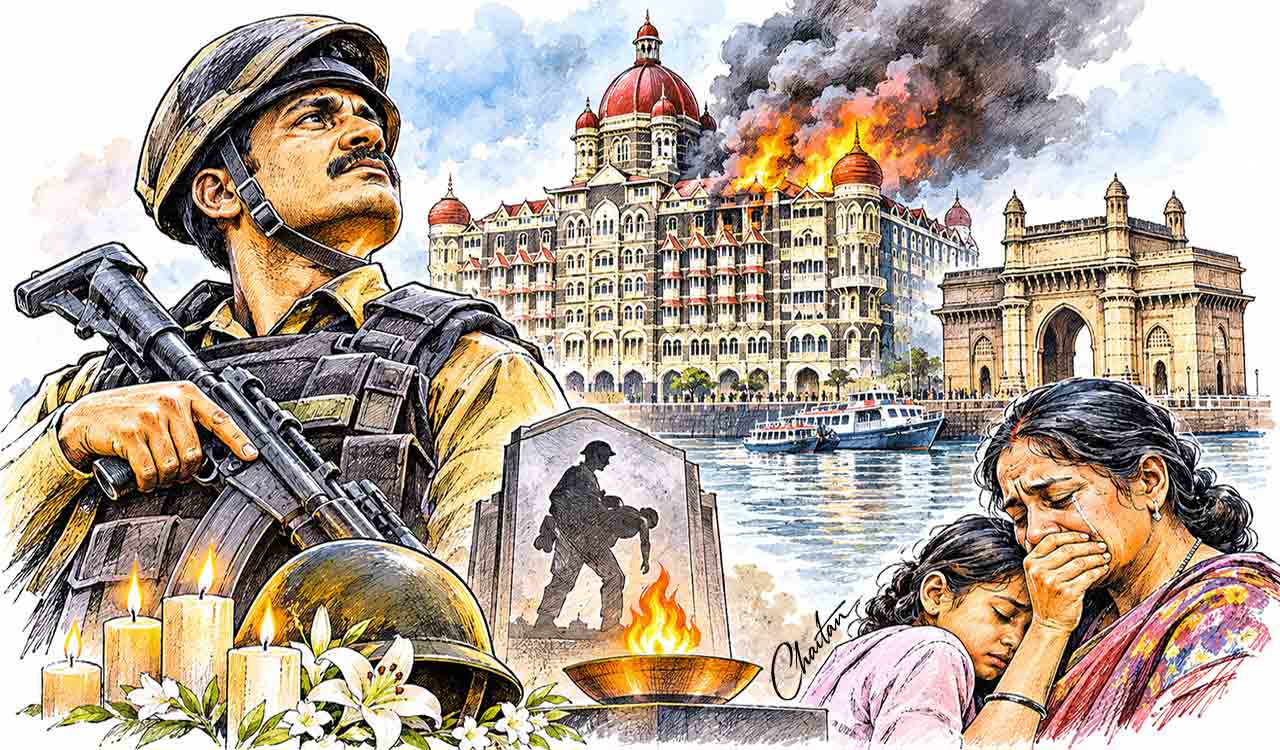
Eighteen years on, India’s counterterrorism capabilities have strengthened, but persistent cross-border threats demand continued vigilance and preparedness
Updated On – 27 November 2026, 12:25 AM
Illustration: Chaitanya Mulla
As India observed the 18th anniversary of the horrific 26/11 Mumbai terror attacks and paid homage to the innocent victims and the brave hearts who sacrificed their lives in the line of duty, the tragedy remains a dark chapter in the country’s history. It exposed the devastating threat posed by terrorism and left an indelible scar on India’s security landscape. The events of that night remain a constant reminder of the importance of unwavering commitment to counterterrorism. A group of ten terrorists, belonging to a Pakistan-based organisation, arrived by sea. The mayhem that followed over the next 60 hours claimed 166 lives and left more than 300 people injured. The targets were carefully chosen: Leopold Café, popular with foreign visitors, the Taj Mahal Palace and Oberoi Hotels; and Chabad House, a Jewish establishment frequented by Jewish visitors from abroad. Even after all these years, it is still difficult to say that we are completely safe from terror strikes. No doubt, India’s counterterrorism strategy has seen marked successes in recent years, but it would be premature to declare victory. Occasions such as this provide an opportunity to reflect on how the fight against terrorism has evolved and which loopholes need to be plugged. It was painfully evident that the Mumbai Police did not then possess a specialised force adequately equipped to deal with an attack of this nature. The authorities had to seek assistance from New Delhi, and the National Security Guard (NSG) was flown in. One important consequence of the tragedy was the strengthening of Mumbai’s counter-terrorism capabilities.
The Anti-Terrorism Squad and other specialised arrangements were subsequently strengthened, giving the police greater capacity to respond to such threats. From a passive and often submissive strategy to a bold and highly kinetic strategy of “zero tolerance to terror,” the country’s journey has been long but determined. Strong political resolve has aptly backed the armed forces in their sustained fight to dismantle the terror ecosystem, choke its support networks, and bring terrorist forces to their knees decisively. A glimpse of this was demonstrated during India’s response to the Pahalgam terror attack, which involved 88 hours of precision strikes into Pakistan under Operation Sindoor in May last year. India’s commitment to a policy of zero tolerance towards terrorism is also reflected in its evolving counterterrorism framework. In February 2026, the Ministry of Home Affairs unveiled PRAHAAR, India’s first comprehensive National Counter-Terrorism Policy and Strategy. The framework focuses on seven pillars, including prevention, swift response, coordination among agencies, international cooperation, and recovery and resilience. India has made the fight against terrorism a cornerstone of its national security strategy. The results are there for all to see. However, the history of the global fight against terrorism tells us that the threat can never be completely eliminated, especially when it is supported by an adversary across the border and has an active support system within the country.