Major General Ahmad Vahidi says the Iranian Armed Forces are fully prepared to make the battlefield larger wherever necessary.
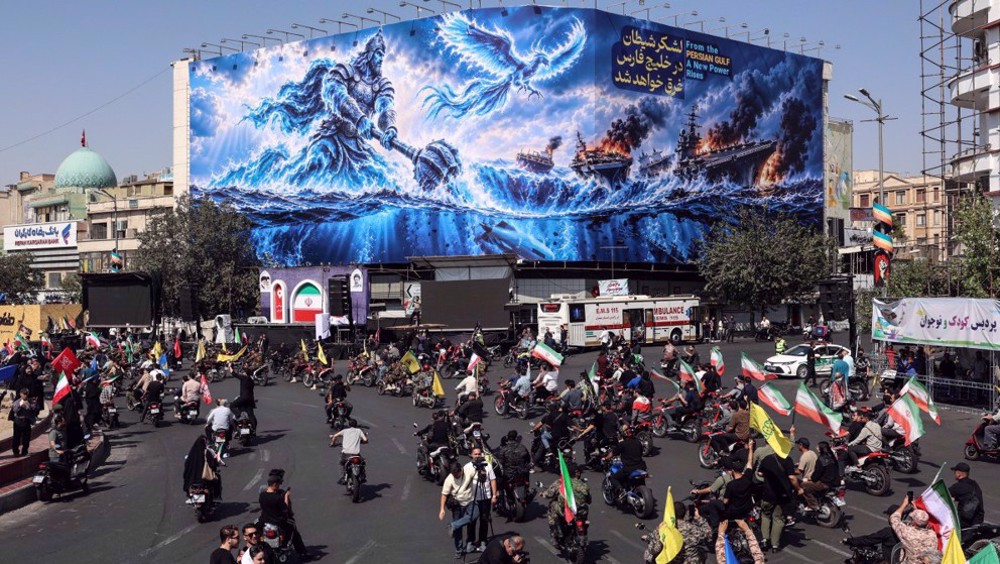
Hundreds of volunteers ride past a large anti-US billboard as they take part in the Janfada motorcycle rally in Tehran on September 25, 2026. (Photo by AFP)
Any future confrontation will extend beyond the region, Chief Commander of the Islamic Revolution Guards Corps (IRGC) Major General Ahmad Vahidi has warned.
General Vahidi said the Iranian Armed Forces are fully prepared to make the battlefield larger wherever necessary.
Speaking to reporters on the sidelines of the closing ceremony of the 8th Basij Digital Content Production Festival on Tuesday, the IRGC chief said the enemies should understand that future aggression would not necessarily remain inside the region.
“As the Leader of the Islamic Revolution has stated, war today will no longer be merely regional in nature, and we may witness the expansion of the battlefield wherever circumstances require.”
The situation in the region remains in full control of the Iranian Armed Forces and they are more prepared than ever to defend the country. General Vahidi stated.
“Everything is under the control of our brave fighters, who are firmly holding their positions. Our forces are stronger than ever and remain on the battlefield to defend Iran, Islam and our dear nation.”
Vahidi also slammed the US military presence in the region, saying Washington’s objective is to dominate the countries there and seize control of the entire region.
The IRGC commander referred to previous US descriptions of regional countries as a “milking cow,” saying such rhetoric reflected Washington’s desire to dominate the resources of the region.
“America’s presence in the region is driven by greed, and it has no regard for the interests or concerns of regional countries.”
The United States and the Israeli regime launched their first illegal war against Iran, which lasted 12 days, in June 2025. Their second aggression began on February 28, 2026, and came to a halt in early April after 40 days.
During both wars, Iran’s Armed Forces struck US and Israeli assets throughout the region with ballistic missiles and drones.
Iran has also shut the Strait of Hormuz, a crucial energy chokepoint, since early in March in response to the aggression, sending energy prices soaring worldwide.