
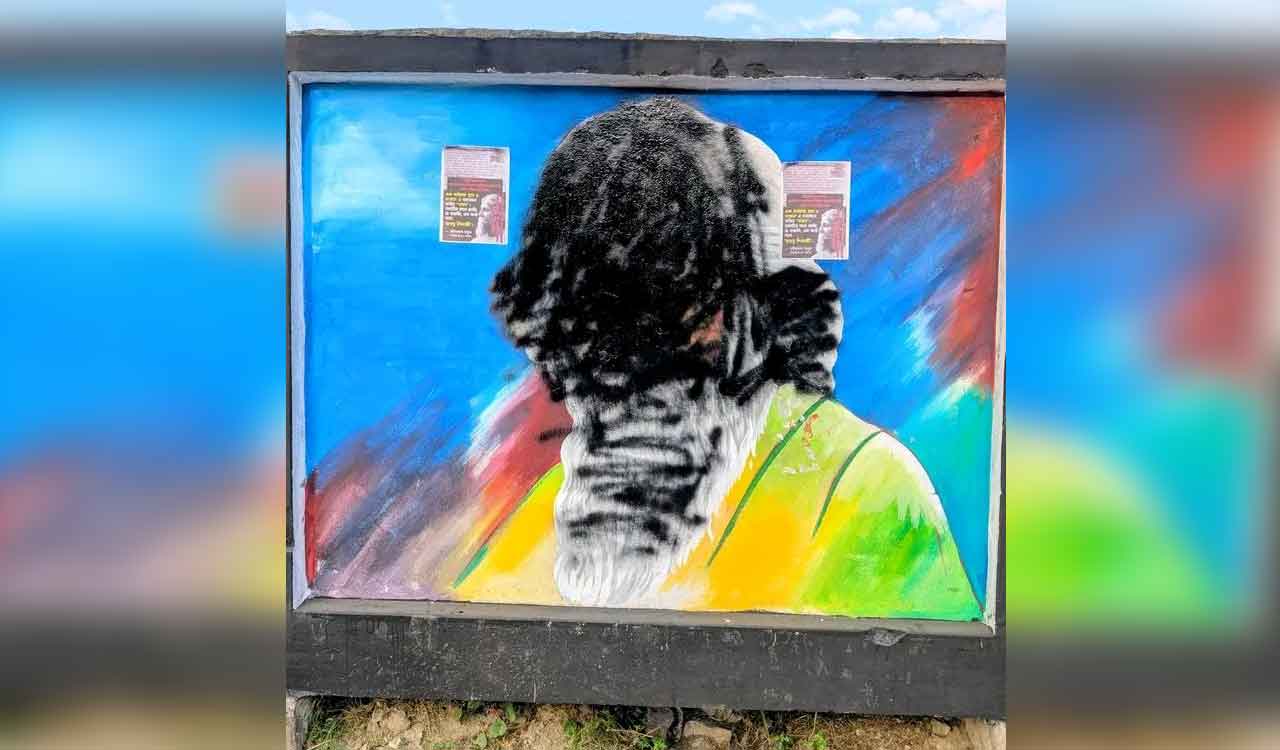
Rabindranath Tagore’s portrait at Khulna Railway Station in Bangladesh was defaced with black ink for the second time within days of its restoration. The incident sparked outrage among cultural activists, who demanded action against those responsible
Published Date – 23 November 2026, 10:59 AM
Dhaka: In a disturbing recurrence of vandalism in Bangladesh, a wall portrait of Nobel laureate Rabindranath Tagore at Khulna Railway Station has once again been smeared with black ink, according to local media reports.
The latest act of vandalism came to light on Sunday, barely days after the portrait was restored following an earlier attack. “Police personnel are being sent to the spot to look into the matter and find out who was involved,” Bangladesh’s newspaper The Daily Star quoted Lokman Hossain, officer-in-charge of Khulna Sadar Police Station, as saying while confirming the incident.
Reports suggest that the portraits of prominent figures were painted on the wall opposite the Khulna Development Authority (KDA) building as part of an urban beautification drive overseen by Khulna City Corporation (KCC). The murals also feature National Poet Kazi Nazrul Islam, folk mystic Fakir Lalon Shah, artist SM Sultan and poet Michael Madhusudan Dutt, but Tagore’s portrait alone was defaced with black spray paint.
Earlier this month, the same portrait was defaced with black ink by unidentified miscreants, triggering outrage among local residents and cultural activists. Expressing outrage over the incident, KCC Administrator Nazrul Islam Manju said, “By defacing the portrait, they have exposed their narrow-mindedness and sick mentality.” Shariful Islam Salim, a cultural activist and general secretary of Nattyalok, suspected that an organised group was behind the incident.
“They have carried out similar acts in Dhaka as well. These incidents are being orchestrated deliberately. Those responsible must be identified and brought to justice. This may not stop with Rabindranath; they could target other eminent personalities too,” The Daily Star quoted him as saying.
Emphasising that Tagore’s literature and philosophy had shaped generations to uphold free thought, secularism and human dignity, Salim said, “Some young people are being misled into engaging in such disgraceful acts.”
Calling Tagore an inseparable part of Bangladesh’s cultural identity and a beacon of inspiration, he urged people from all walks of life to raise a united voice against the perpetrators. Last month, a graffiti mural of Tagore outside the Bangladesh Shilpakala Academy in Dhaka was defaced with black ink. Following the incident, at least 37 prominent Bangladeshi citizens expressed grave concern over the incident involving the defacement of Tagore mural in the capital, local media reported.
In a statement, the signatories warned that such growing incidents risk emboldening religious extremists and deepening communal tensions in Bangladesh. They recalled how Pakistani rulers had politically portrayed Tagore as anti-Muslim in the 1960s, comparing that campaign with the recent defacement of his portrait.