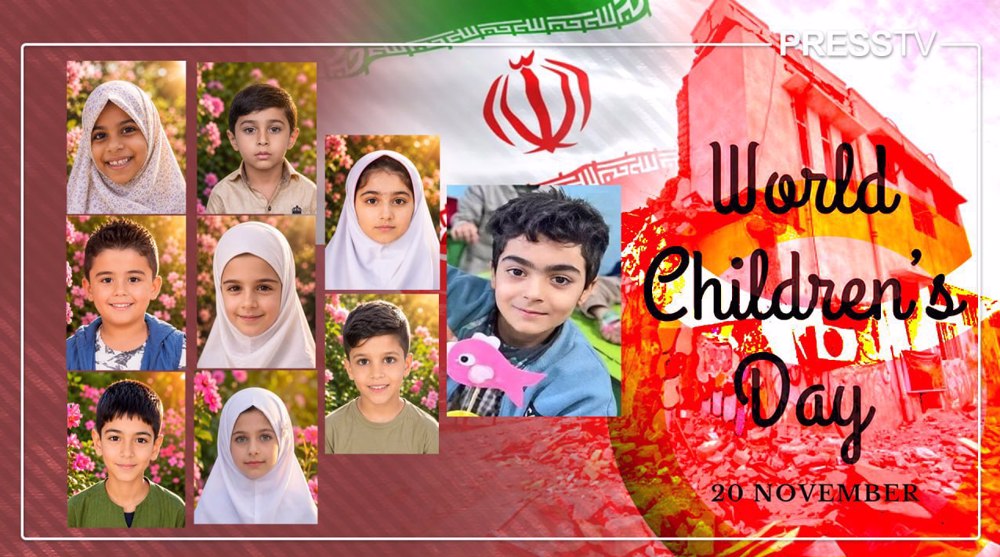
On World Children’s Day, the stories of children killed in the US-Israeli attack on Minab’s Shajareh Tayyebeh school offer a heartbreaking glimpse into lives cut short, dreams shattered and the immeasurable loss their families continue to endure.
A little girl asks her father whether he has had dinner. Another gives him a fist bump before heading to school. A boy draws a picture of a school, while another dreams of building rockets when he grows up.
These are the everyday moments that make up a childhood: conversations with parents, drawings filled with imagination and dreams of what lies ahead. At the time, none of these exchanges seemed extraordinary. Today, they are among the last memories families have of children who never came home.
For the families of Minab, in southern Iran, the morning of February 28 began like any other school day. Children walked into Shajareh Tayyebeh Elementary School with their schoolbags and notebooks, ready for lessons and time with their classmates.
Some were in their first years of learning to read and write, others were already thinking about what they wanted to become when they grew up.
They never made it home.
The massacre at the school was among the deadliest attacks on children in the latest US-Israeli aggression against Iran. But the loss of young lives in Minab is part of a much wider pattern of attacks across West Asia, where children have paid a devastating price for the military campaigns of the United States and Israel.
In Gaza, the Israeli genocide has killed at least 22,000 Palestinian children since October 2023, according to recent figures from the Palestinian Foreign Ministry.
In Lebanon, Israeli attacks over nearly three years have claimed the lives of nearly 800 children.
Iran, too, has suffered a staggering toll. During the 12-day US-Israeli war, 47 Iranian children were killed. In the subsequent 39-day US-Israeli aggression, another 383 children were martyred and 2,115 wounded.
As International Children’s Day is observed around the world, these figures stand in stark contrast to the principles the day is meant to uphold.
For the families affected, however, the loss is measured not in statistics but in the children who are no longer with them.
The 13 children whose stories follow were among those killed in the Minab school massacre. Their photographs, family memories and the details of their short lives offer a glimpse of who they were before the US-Israeli attack , their interests, their dreams and the ordinary moments their families will never forget.
Mohammad Mehdi Jangichi Minabi
Mohammad Mehdi Jangichi Minabi was a 10-year-old fifth-grade student at Shajareh Tayyebeh Elementary School in Minab. He was the son of Abbas Jangichi Minabi and Marzieh Jangichi.
His parents had waited 25 years for his birth. When he finally arrived, he became the centre of their lives, bringing joy to a family that had long hoped for a child. His life was cut short on February 28, 2026, when US-Israeli missiles struck his school.
Mohammad Mehdi was in the schoolyard when the explosion occurred. The force of the blast threw his small body into the air, leaving him with multiple injuries from missile debris.
After his death, his father found a way to keep his son’s memory alive. He painted anti-imperialist and anti-oppression designs along the route between their home and Mohammad Mehdi’s grave, a path he now walks every day.
The grave is in a park opposite the family home. Neighbourhood children often gather around it with their little bicycles. They call Mohammad Mehdi’s father “Uncle”, and their visits have become part of the family’s efforts to keep the boy’s memory alive.
Mohammad Mehdi was buried in Tayebi Shahi. For his father, the daily walk to the grave has become a way of remaining close to the son he waited 25 years to hold.
Masih Salari
Eight-year-old Masih Salari was a first-grade student at Shajareh Tayyebeh Elementary School in Minab.
He was the son of Rasoul Zarei and Reyhaneh Zarei. On February 28, 2026, he was among the children killed when US-Israeli missiles hit the school. He was buried in Eslamabad.
Masih was a lively, kind-hearted boy who had only recently begun learning to read and write. His father served as a police officer, while Masih’s days revolved around the simple pleasures and expectations of childhood.
One of the most striking reminders of his short life is a drawing he made about two months before the attack.
It showed a school and a missile heading towards it. At the time, it was regarded as an ordinary product of a child’s imagination. After the school was bombed and Masih died with his classmates, the drawing took on a devastating significance.
Moein Zeinali
Moein Zeinali was an eight-year-old second-grade student at Shajareh Tayyebeh Elementary School in Minab.
The son of Mostafa Zeinali and Alameh Khajehdadi, he was among the children killed in the February 28 US-Israeli missile strike. His body was recovered three days later from the rubble.
The wait for news of Moein’s whereabouts was agonising for his family. His father, Mostafa, later recalled identifying his son by the shoelaces he was wearing.
Moein was an energetic and enthusiastic boy. A video preserved by his family shows him passionately chanting slogans, his confidence and excitement evident in his voice. The footage has since circulated widely, offering a glimpse of the boy he was before the attack.
His schoolbag is another reminder of the child who went to school that morning. With the family’s consent, his backpack, along with that of another child killed in the strike, was sent to the United Nations for an exhibition associated with the Caravan of the Narrative of the 20-Year Defeat.
The bags were presented as reminders of the children killed in the US-Israeli attack on the school and the suffering their families have endured.
Mikaeil Mirdorqi
Mikaeil Mirdorqi was a nine-year-old third-grade student at Shajareh Tayyebeh Elementary School in Minab.
The son of Javad Mirdorqi and Shakiba Darykond, he was killed when US-Israeli missiles struck the school on February 28, 2026. He was buried in Qaleh Lor.
Mikaeil had developed a strong attachment to the Quran and religious ceremonies from an early age.
His family recalls that, from the age of four, he was drawn to the funerals of martyrs and the religious traditions surrounding them.
He later attended Quran classes and religious programmes, memorising passages of the Holy Quran, including Ayat al-Kursi, which he recited enthusiastically.
The evening before the attack, Mikaeil told his mother, “Mom, your food tastes like heaven.”
He performed ablution, prayed and asked her to bring him the Quran so he could recite Surah Al-Buruj, a chapter that speaks of the steadfastness of believers in the face of oppression.
That night, he also drew a picture of a school, several students and three missiles. Beside the drawing, he wrote in his own handwriting: “The children died.” He later played a war game with his brother and confidently declared, “Iran will win.”
Before leaving for school on February 28, Mikaeil asked his mother to take a photograph of him. As he walked down the stairs, he turned back and asked with a smile, “Mom, can I go?”
It became his final photograph. His father, who was away on a work assignment in another city, rushed to Shajareh Tayyebeh after learning of the US-Israeli attack. By then, the school where his son had spent the morning had been reduced to rubble.
Atena Chamlizadeh
Six-year-old Atena Chamlizadeh was a first-grade student at Shajareh Tayyebeh Elementary School in Minab. The daughter of Ruhollah Chamlizadeh and Zeinab Zaeimi, she was killed in the February 28 US-Israeli missile strike. She was buried in Minab.
Her father described their relationship in simple words: “I was Atena’s only refuge, and she was mine. We were two friends.”
They spent much of their time together, walking, playing and laughing. When Atena became tired, she would climb into her father’s arms. If she noticed that he was tired during a walk, she would tell him, “Dad, I’ll walk by myself.”
When her father heard the explosion on February 28, he rushed to the school, hoping his daughter had survived and was simply frightened. Instead, he found the building buried beneath rubble.
He spent hours searching through the ruins. First, he found Atena’s tiny hand, then one of her shoes. The search ended with confirmation that his six-year-old daughter had been killed in the attack.
For her father, Atena was more than a daughter. She was the little companion who shared his walks and games, found comfort in his arms and worried when he became tired.
Hanieh Ahmadi Teyfekani
Seven-year-old Hanieh Ahmadi Teyfekani was a first-grade student at Shajareh Tayyebeh Elementary School in Minab.
Her father, Mohammadreza Ahmadi Teyfekani, remembered her as a girl who could be stubborn at times but was deeply attached to her parents. During his prayers, she would sit on his shoulders and stay there until he finished.
Her family particularly cherished her Minabi accent. They often recorded short videos of her speaking, preserving the expressions and mannerisms that brought them joy.
On the morning of February 28, her father took her to school as usual. Her brother, Sobhan, accompanied her, carrying her schoolbag and belongings. The last image their father remembers is of the two siblings walking hand in hand towards the school. Before entering, they turned around, said goodbye and looked back at him.
Hours later, US-Israeli missiles struck Shajareh Tayyebeh, destroying the school. Hanieh and Sobhan were trapped beneath the rubble. Hanieh’s body was recovered at around 11 pm.
Esra Zakari
Nine-year-old Esra Zakari was a fourth-grade student at Shajareh Tayyebeh School in Minab. The daughter of Mokhtar Zakari and Razieh Shahsavari, she was killed in the US-Israeli attack on February 28, 2026. She was buried in Islamabad Cemetery.
Esra grew up with her younger sister, Salma, and their brother, Pouria. Pouria was a sixth-grade student and was expected to enrol at Shajareh Tayyebeh that year, so that all three siblings could attend the same school. Instead, the attack left him the family’s only surviving child.
Esra was gentle and affectionate, and shared a particularly close bond with her father. As a young child, she loved falling asleep in his arms. She would tell him that she did not want to grow up because she feared she would no longer find the same comfort in his embrace.
That year, she had also begun observing the Ramadan fasts with enthusiasm. On the morning of February 28, she left for school with Salma, accompanied by their father.
Their father identified Esra by the small sock doll she had been carrying. Esra and Salma were buried together.
Salma Zakari
Six-year-old Salma Zakari was a first-grade student at Shajareh Tayyebeh School in Minab.
On the morning of February 28, their father dressed the two girls and drove them to school, as he had done many times before. As they said goodbye, Salma held out her small fist and bumped it against her father’s fist, copying her older sister.
It was a gesture she had not made before. It became one of the last memories her father carried from that morning.
After US-Israeli missiles struck the school, their father first identified Esra. He continued hoping that Salma might have survived. Her body was eventually found intact, lying beside her sister.
Salma had only just started first grade and was beginning to learn to read and write.
Her final fist bump with her father remains one of the family’s most cherished memories of a little girl who rarely left her sister’s side.
Asra Farahizadeh
Asra Farahizadeh was a seven-year-old first-grade student at Shajareh Tayyebeh Elementary School in Minab.
The daughter of Asghar Farahizadeh and Tayebeh Farahizadeh, she was killed when US-Israeli missiles struck the school on February 28, 2026. She was buried in Goorzang Cemetery.
Her family remembers her as an energetic and affectionate child who enjoyed going to school.
On the morning of the attack, she was at school with her cousin, Fatemeh Yazdanpanah. Both girls were killed.
Asra had only begun her first year of elementary education. She was at the age when children are learning to read and write, making friends and discovering the world beyond their homes.
The attack brought her first steps in education to an end. Her family is left with memories of a little girl who looked forward to school and the everyday pleasures of childhood.
Asra is remembered alongside her cousin Fatemeh. The two girls went to school together that morning and neither returned home.
Amir Mohammad Bagheri
Amir Mohammad Bagheri was an 11-year-old fifth-grade student at Shajareh Tayyebeh School in Minab.
The son of Ebrahim Bagheri and Zeynab Taheri, he was among the children killed in the US-Israeli missile strike on February 28, 2026. He was buried in Minab.
Amir Mohammad loved making things with his hands. One of his favourite activities was building small model rockets from simple materials.
He had an ambitious answer when asked what he wanted to do when he grew up. “When I grow up, I’ll build rockets so I can hit Trump with them,” he would say.
It was the kind of bold declaration that came naturally to a boy with an active imagination and an interest in building things.
His parents are left with memories of a curious boy who liked to make things and imagined a future in which he would build rockets.
Adrina Pegah
Seven-year-old Adrina Pegah was a first-grade student at Shajareh Tayyebeh School. Her father, Faramarz Pegah, was an educator in the town. He remembered her as a creative girl with an unusually wide imagination.
Known at school as “the blue-eyed girl”, Adrina loved basketball, drawing and poetry. After dinner, she and her father would often go to a nearby park to play. She was also devoted to her religious teachings.
Her mother, Farideh Jahangirnia, worked for the agricultural insurance fund in Minab County. She too was killed in the US-Israeli attack on the school.
On February 28, Faramarz was teaching a class when he received news that US-Israeli missiles had struck Shajareh Tayyebeh. He reached the school within minutes, but the stairway had been destroyed, along with the building where he had once kissed his daughter goodbye each morning.
At around 2:30 pm, he was told that Adrina was among the injured at Minab Hospital. He then went to his wife’s workplace at the agricultural jihad office, hoping to find her, but learned that she too had gone to the school.
For nearly 48 hours, he had no confirmation of his wife’s fate. He eventually learned through images recorded by personnel from Hormozgan University of Medical Sciences that she had been killed. After her funeral, he received the news of Adrina’s death.
Among the last messages Adrina sent her father from her mother’s phone was a simple question: “Daddy, did you eat dinner?”
The previous year, for Girls’ Day, he had given her a pair of gold earrings. After the attack, the earrings were recovered from her belongings.
Masoumeh Nazari
Masoumeh Nazari was a seven-year-old second-grade student at Shajareh Tayyebeh School. Her parents, Hossein Nazari and Farrokhandeh Nazari, had waited 12 years for her birth.
She was the much-awaited child who filled their home with joy, and the birth of her younger brother later completed their family.
Masoumeh was an intelligent and energetic girl who enjoyed learning. Her cousin, a teacher, often sat with her for hours to help with her schoolwork. She remembers the little girl’s excitement as she practised reading and writing, sounding out words and taking pride in what she had learned.
Those lessons became some of the family’s most cherished memories after Masoumeh was killed in the February 28 US-Israeli attack on Shajareh Tayyebeh.
The loss has been particularly devastating for her mother, who has been so overwhelmed by grief that she has still not found the strength to visit her daughter’s grave.
Mohammad Sadegh Gholami
Seven-year-old Mohammad Sadegh Gholami was a first-grade student at Shajareh Tayyebeh Elementary School. He was the son of Ali Gholami and Azra Raghib Kardmahaleh.
His family had moved from Qom to Minab in October 2025, following his father’s work and religious activities at a seminary in the town.
Mohammad Sadegh had only recently begun settling into his new surroundings and attending school when US-Israeli missiles struck Shajareh Tayyebeh on February 28, killing him and his classmates.
He was remembered as a kind-hearted boy with strong religious faith. Despite his young age, he had already made a pilgrimage to Karbala.
After his body was identified, his family decided to take him back to Qom, the city where he was born.
His funeral drew a large gathering of mourners. His body was carried in a procession from the holy shrine of Lady Fatima Masumeh (SA), alongside those of other children killed in the US-Israeli attack, before being laid to rest in Qom.
Although Mohammad Sadegh had spent only a few months in Minab, his name became part of the town’s painful record of the children killed at Shajareh Tayyebeh.
The stories of the 13 children are different, but each is marked by the same tragedy: they were killed in the US-Israeli attack on Shajareh Tayyebeh, leaving their families to hold on to memories of children whose lives had barely begun.