
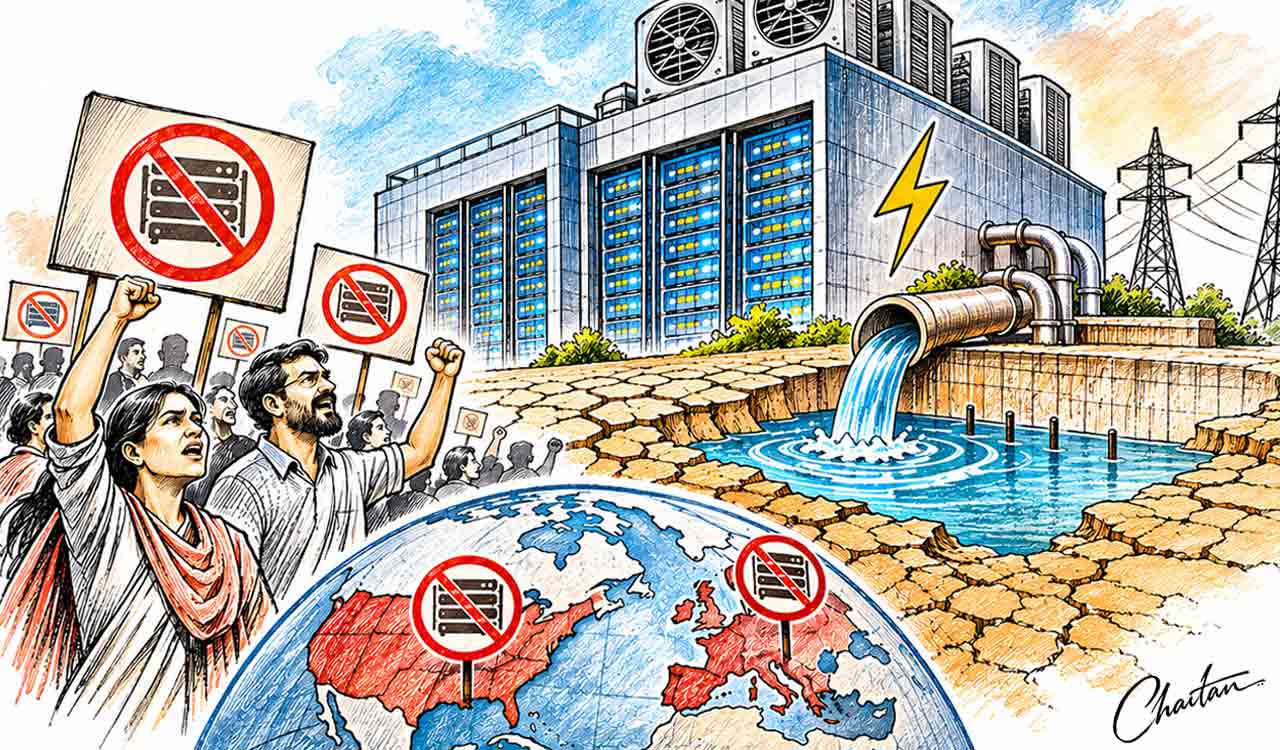
Growing global resistance to data centres over their water and energy consumption offers India an important warning, even as several States compete to attract data-centre investments
Published Date – 18 November 2026, 11:48 PM
One of the key messages from the recent midterm elections in the United States was the strong voter backlash against the establishment of data centres in local communities, largely because of environmental concerns. Candidates who campaigned vigorously against these projects emerged victorious. This emphatic public rejection in a country regarded as a global technology powerhouse should serve as a wake-up call for India, where several States are competing to attract data-centre investments. Beyond the US, several European countries have also witnessed growing opposition to such projects. Public resistance is primarily driven by concerns over their impact on local resources, as data centres are massive consumers of water and electricity. In Texas, anxiety among farmers about dwindling water supplies has become a significant political issue. Similar resistance across several American States demonstrates that residents increasingly want a say in decisions that directly affect their lives. Undoubtedly, the rapid expansion of data centres, fuelled by the artificial intelligence (AI) boom, presents enormous economic opportunities. However, growing opposition to these projects in developed countries offers an important warning: technological progress should not come at the expense of communities or the environment. India faces a paradox. The need to rapidly expand data-centre capacity to support AI and cloud-computing infrastructure is colliding with the imperatives of environmental protection. States such as Maharashtra, Andhra Pradesh and Telangana stand at a critical crossroads. Ambitious investment drives, including major data-centre proposals, could strengthen digital infrastructure and generate employment. Yet they must balance the goal of promoting the technology industry with the need to safeguard local resources and ecosystems.
Companies must, therefore, prioritise responsible resource-management practices. Every data-centre project must strike a balance between three essential interests: business, community and the environment. Firms should invest in energy-efficient technologies, renewable power, sustainable cooling systems and, wherever feasible, zero-water technologies. Equally important, residents must be provided with clear information about resource consumption, environmental impacts and economic benefits before projects receive approval. Communities should be treated as stakeholders in development rather than passive observers. Data centres can power India’s digital future, but their success should be measured not only by investment figures and computing capacity, but also by the jobs created, resources conserved and communities empowered. Progress must benefit everyone, not just technology giants. As major technology companies race to expand data-centre capacity to support AI, resource consumption is rising, exacerbating the challenges faced by communities already grappling with water scarcity. For instance, the daily water requirement of a 100-megawatt data centre is equivalent to the needs of approximately 6,500 households. India’s growing data-centre ecosystem could consume nearly 37.5 billion litres of water annually, equivalent to the yearly needs of around 7 to 8 lakh people, based on urban consumption norms prescribed by the Central Public Health and Environmental Engineering Organisation.

