
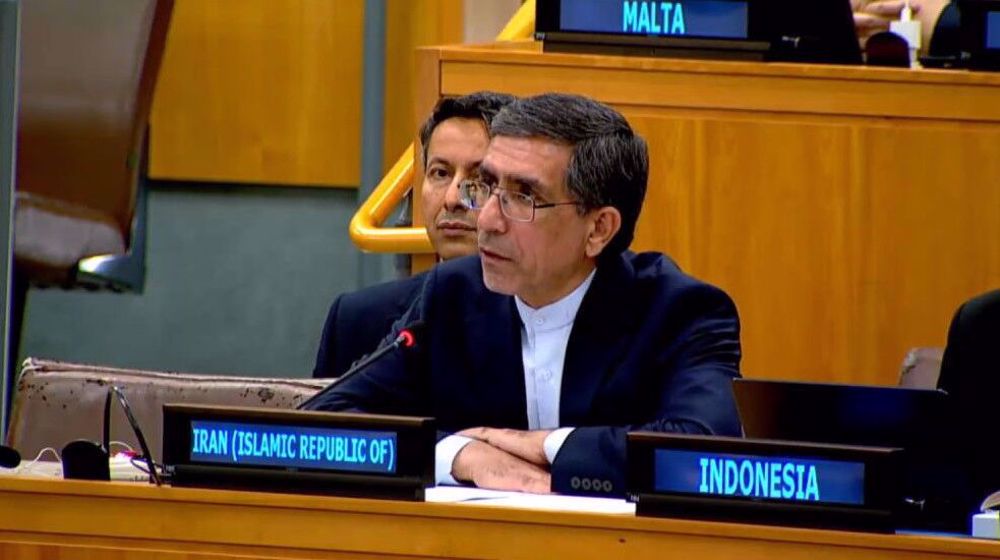
Gholamhossein Darzi says the West’s “blatant double standards” seriously undermine the credibility of the conference and the principles it is mandated to uphold.
Gholamhossein Darzi, Iran’s Ambassador and Chargé d’Affaires to the United Nations in New York
Iran’s representative to the United Nations, Gholamhossein Darzi, has warned that certain countries leveling baseless allegations against the Islamic Republic’s peaceful nuclear program and demanding cooperation with the International Atomic Energy Agency (IAEA) have refused even to condemn unprecedented acts of aggression against Iran.
Speaking on Monday evening in New York at the seventh session of “the Conference on the Establishment of a Middle East Zone Free of Nuclear Weapons and Other Weapons of Mass Destruction,” Darzi stated that such “blatant double standards” seriously undermine the credibility of the conference and the principles it is mandated to uphold.
The session is taking place under extraordinary circumstances, as a humanitarian catastrophe and silent genocide continue to unfold in Gaza.
The United States and the Israeli regime have, on two separate occasions — in June 2025 and February 2026 –carried out acts of aggression against Iran, targeting its peaceful nuclear, chemical, and biological facilities. These attacks escalated earlier aggression and were accompanied by persistent threats of further strikes, as well as highly alarming warnings regarding the potential use of nuclear weapons.
Such actions strike at the foundations of the United Nations Charter, the fundamental principles of international law, and the integrity of the international disarmament and non-proliferation architecture, including the NPT, the IAEA Statute, the Chemical Weapons Convention, and the Biological Weapons Convention.
As a result of these aggressions, more than 5,000 Iranians have been martyred, including the Supreme Leader, senior military and political officials, 168 schoolgirls in Minab, and civilians attending a wedding ceremony. The attacks also targeted civilian infrastructure, causing widespread destruction and immense suffering. Darzi stressed that these aggressive and heinous acts must be firmly and unequivocally condemned by the conference.
Responsibility lies not only with the perpetrators but also with those who enabled and facilitated them. Iran strongly deplored and condemned the actions of neighboring countries that provided their territory, military bases, facilities, and logistical support for the aggressions.
Iran’s defensive measures against US military bases and facilities in the region were undertaken in the exercise of its inherent right to legitimate self-defense under Article 51 of the UN Charter.
“What credibility can international disarmament and non-proliferation regimes—and the right to peaceful use under the NPT, CWC, and BWC—possibly retain when illegal attacks against peaceful nuclear, chemical, and biological facilities are met with silence and impunity?” Darzi asked. “Today, Iran is the target; tomorrow, it could be any other nation.”
The Islamic Republic attaches the utmost importance to the establishment of a zone free of nuclear weapons and other weapons of mass destruction in the Middle East. Fifty-two years after Iran’s initial 1974 proposal for such a zone, the long-standing objective remains unfulfilled.
The primary obstacle continues to be the Israeli regime’s refusal to abandon its nuclear weapons, join the NPT as a non-nuclear-weapon state, and place all its nuclear facilities under comprehensive IAEA safeguards, a position maintained through the unconditional political support of the United States, the United Kingdom, and France.
The persistence of this discriminatory situation risks undermining confidence in the non-proliferation regime. Darzi recalled explicit nuclear threats by Israeli officials, including the prime minister’s allusion during the 78th UN General Assembly to a “credible nuclear threat” against Iran and a minister’s suggestion of using a nuclear bomb on Gaza. Such threats must not be met with silence.
The 1995 Resolution on the West Asian region, an integral part of the package leading to the indefinite extension of the NPT, remains valid and must be fully implemented. Continued failure to advance the zone free of WMDs is unacceptable and further exposes double standards in the treatment of nuclear disarmament and non-proliferation, particularly in West Asia.
Iran remains committed to constructive participation in the conference, which must stay a state-driven, consensus-based process focused on negotiating a legally binding treaty to establish the zone.
The urgency of this mission has never been greater in light of ongoing aggression, genocide in Gaza, and the continued existence of an undeclared nuclear arsenal outside any international verification.