
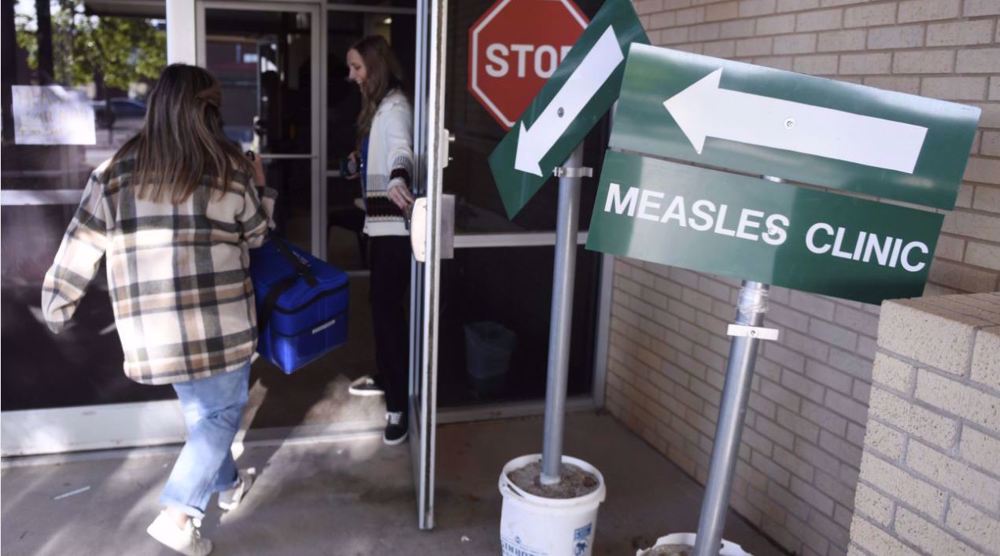
The Measles resurgence has coincided with growing controversy over vaccines since Robert F. Kennedy Jr. took charge of the Department of Health and Human Services.
US Health Department staff carry measles, mumps, and rubella (MMR) vaccines amid a major measles outbreak, Texas, US, April 2025.
The US has lost its measles-elimination status after sustained transmission of the virus reversed a public-health achievement maintained since 2000, a report says.
The Pan American Health Organization (PAHO), the regional branch of the World Health Organization (WHO), revoked the designation after measles circulated continuously in the US for at least 12 months, The Wall Street Journal reported on Friday.
The decision comes amid the country’s worst measles resurgence in decades, with thousands of infections recorded as childhood vaccination rates decline.
In 2025, the US recorded 2,289 confirmed measles cases and three deaths, according to the Centers for Disease Control and Prevention (CDC).
In 2026, the number had risen to 5,412 confirmed cases and six deaths reported by the CDC as of November 12, while state-level reports put the death toll at least 10.
The US had maintained its elimination status since 2000, meaning domestic transmission had been interrupted despite occasional outbreaks linked to imported cases.
The resurgence has coincided with growing controversy over vaccines since Robert F. Kennedy Jr. took charge of the Department of Health and Human Services (HHS).
Kennedy has questioned established vaccine policies and promoted changes to the childhood immunization schedule, drawing criticism from medical experts.
Health professionals have warned that these proposals could weaken public confidence in vaccination and undermine efforts to prevent infectious diseases.
Kennedy has also supported separating the measles, mumps, and rubella components of the combined MMR vaccine, a proposal that has raised concerns among medical professionals.
They warn that replacing the combined vaccine could complicate immunization and leave more children vulnerable to infection.
Declining vaccination coverage has further weakened efforts to contain the virus, with MMR coverage among kindergarten children falling below the 95-percent level generally considered necessary to prevent sustained transmission.
Measles is one of the world’s most contagious infectious diseases, spreading through the air when an infected person breathes, coughs or sneezes.
The virus can cause serious complications, particularly among young children, making widespread vaccination essential to preventing outbreaks.
The loss of elimination status means the US has failed to stop continuous domestic transmission for the required period, reversing a milestone achieved more than a quarter-century ago.
To regain the designation, the country must interrupt continuous transmission for at least 12 months and strengthen vaccination coverage, disease surveillance, and public-health responses.


