
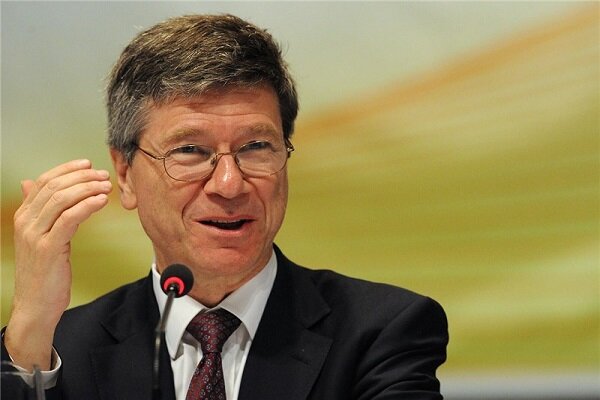
In an interview with Mehr News Agency, prominent American economist and Columbia University professor Jeffrey Sachs discussed the prospects for ending the war against Iran, the future of Tehran-Washington relations, the economic and political costs of military confrontation, and the role of global powers in regional developments. Arguing that the U.S. government and President Donald Trump cannot achieve victory either on the battlefield or through a formal agreement, Sachs said the fighting could end if Washington lifted its blockade of Iran and left the region without a formal deal. He also criticized U.S. hegemonic policies, the performance of the UN Security Council, and the approach of European leaders, stressing the need to return to the principles of the UN Charter and establish independent regional security architectures.
Here is the full text of the interview:
The war involving Iran, the United States, and Israel has entered a prolonged phase of uncertainty, with diplomatic efforts facing serious obstacles and the possibility of renewed military confrontation remaining a concern. In your assessment, what are the main obstacles to a sustainable political settlement, and what would it take to prevent another escalation?
The main obstacle is that the US Government, and Trump in particle, do not want to look “weak,” but cannot “win” on the battlefield or in a formal agreement. That is why I have long advocated an end to the fighting without any formal agreement. Such an end to the fighting would keep Iran safe, end the destruction, open the Strait of Hormuz, and allow Trump to say whatever he would like. The US should simply lift the blockade and go home. As for the sanctions, the US is, unfortunately, unlikely to lift them soon, but Iran will still have plenty of trading partners anyway (the same as is the case with Russia). Trump hinted at ending the fighting without an agreement in the past couple of days, by saying that no agreement is needed and the Vance should stop negotiating. Of course, Trump did not yet lift the blockade. The US should now lift the blockade de facto, without any fanfare, and just leave.
Given the history of mistrust between Tehran and Washington, particularly following the withdrawal of the United States from the 2015 nuclear agreement and subsequent military confrontations, do you believe a new diplomatic framework between the two countries is still achievable? What guarantees and reciprocal commitments would be necessary to make such an agreement sustainable?
No, I don’t believe in the likelihood of such a framework until there is a new President, a starkly different government in Israel, and a change in outlook of the U.S. political class. The American voters would like peace immediately, and are way ahead of the politicians, but the politicians are still afraid to lose face.
What does the international community’s response to the military confrontation involving Iran reveal about the effectiveness of the United Nations and the existing international legal framework? What mechanisms should be activated to ensure accountability for violations of international law and prevent similar conflicts in the future?
The UN Security Council failed badly. The US vassal states in the UN Security Council actually condemned Iran rather than condemning Israel and the U.S.! Most of Europe behaved deplorably. We need an upgrade in diplomacy urgently. The U.S. needs to start obeying international law once again, but this will take time, alas. Happily, many of the incoming politicians to the new Congress include advocates of peace and international law, so the recent election is a sign of some real progress.
To what extent can China, Russia, and other emerging powers can contribute to preventing further escalation and facilitating a diplomatic settlement? Do you believe the current crisis could accelerate the transition toward a more multipolar international order?
The BRICS should be clear and firm on defending the UN Charter, especially Article 2(4) against the threat of force or use of force. More to the point, each region should make its own regional security architecture not depending on outside powers, and certainly not on the United States.
Iran and the [Persian] Gulf states have much more common interest than real division. It was Israel and the US that stoked the divisions in the Middle East.
This U.S. mischief, stoking divisions among neighbors, is true in many parts of the world. Empires rule through Divide et Impera (Divide and Conquer). This is how the British governed their empire, and it is how the Americans have long governed their informal empire. They learned it from Britain.
It is time to end the informal empire and return to the principles of the UN Charter: no use of force except in self-defense, equality of nations, cooperation among the major powers, no attempt to become a “hegemon” ruling over other countries.
Beyond the immediate military consequences, what long-term economic and political costs could the war impose on the United States and its allies? Could the financial burden of prolonged military engagement, combined with its consequences for global energy markets, influence Washington’s future approach to West Asia?
The burden of global empire is catching up with the US. We have the classic case of an overextended empire. In recent decades, the US claimed and aspired to “primacy” (hegemony) in every region of the world. It did not work. It led to countless U.S. wars of choice that have cost the US many trillions of dollars, raised living costs, raised interest rates, failed in their stated objectives, and led to a backlash by the U.S. voters.
The damage of the war with Iran is of course global. Iran has been very hard hit, sadly, and the pain is also felt all around the world. This has truly been a lose-lose-lose war, without any sense or any winners.
You have repeatedly criticized European governments for their limited independence in foreign policy, particularly regarding U.S. military actions. What role should European countries play in facilitating a diplomatic solution to the crisis? Could the current developments become a turning point in Europe’s relations with Washington?
European leaders today are almost devoid of strategic insight, alas. Britain and France still think they are empires, as if it were 1920. They behave cynically and badly. They do not defend international law.
More generally, most European leaders are in an irrational panic about Russia, not understanding or admitting that the war in Ukraine started with NATO expansionism that never should have happened. At the core, Europe still lacks a unified foreign policy. It’s not quite 28 independent foreign policies (the EU-27 plus UK) but it’s close to that.
Interview by Mohaddeseh Pakravan
MNA


