
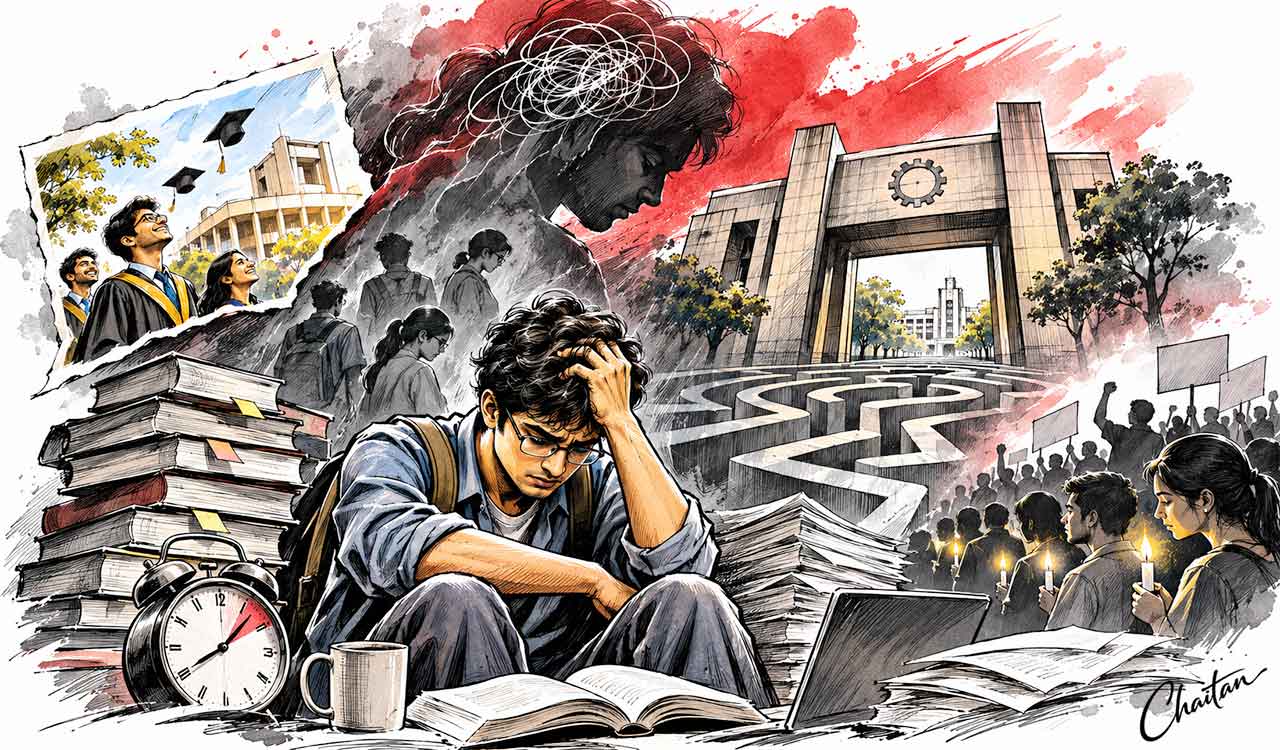
Recent demonstrations and candlelight vigils across IIT campuses, following recurring student tragedies, reflect a collective demand for institutional accountability and stronger mental health support systems
Published Date – 13 November 2026, 11:47 PM
The glamour and hype attached to the Indian Institutes of Technology (IITs) hide an uncomfortable truth: rampant mental health problems that largely remain unaddressed. Depression, academic pressure, anxiety, and a sense of alienation are among the factors responsible for the growing number of suicides on these prestigious campuses. Unfortunately, mental health issues rarely get the attention they deserve. Recent demonstrations and candlelight vigils across campuses following recurring student tragedies reflect a collective demand for institutional accountability and robust mental health facilities. According to official data, 45 students died by suicide across 23 IITs between 2020-21 and 2024-25. The annual figures are equally concerning: 16 deaths were reported in 2023-24, compared with six in the preceding year, followed by 13 in 2024-25. IIT Hyderabad reported seven deaths, while IIT Kharagpur, Delhi and Kanpur recorded six each. These figures underline the urgency of institutional intervention. If this is the plight of students in institutions regarded as the best in the country, it raises uncomfortable questions about mental health support across India’s higher education system. One of the key recommendations made by the University Grants Commission (UGC) is to appoint one qualified mental health professional or psychologist for every 500 students. It also envisages a Student Service Centre in every institution to provide counselling, guidance and health services through in-person consultations, telephone helplines, online assistance and group sessions. The UGC has also recommended collaboration with nearby medical institutions and coordination with student welfare committees. However, none of the recommendations has been implemented on the ground.
The problem is compounded by India’s overall shortage of mental health professionals. India has only about 0.75 psychiatrists per lakh population, compared with the World Health Organisation’s benchmark of three. In these circumstances, online counselling and teleconsultation offer solutions, particularly for colleges in smaller towns and remote areas. However, students must be educated about these services, their accessibility and confidentiality. Institutions should actively publicise verified online counselling platforms and helplines, while ensuring that students requiring urgent or specialised care are referred for in-person treatment. The Supreme Court has also intervened in response to growing concern over student suicides. In March 2025, it constituted a National Task Force under former Supreme Court judge Justice S Ravindra Bhat to examine student mental health concerns and recommend preventive measures. Subsequently, in July 2025, the court issued guidelines for educational institutions, including colleges and universities, to safeguard students’ mental well-being. It also emphasised monitoring, grievance redressal and institutional accountability. These interventions demonstrate that student mental health is not merely an administrative concern but a matter requiring coordinated public action. Every death on the campus must be seen as a cry in the wilderness; a silent scream that should haunt us collectively as a nation. Unreasonable levels of competition, the fear of falling behind academically or in placements, and loneliness are all interrelated issues that demand urgent attention.

