
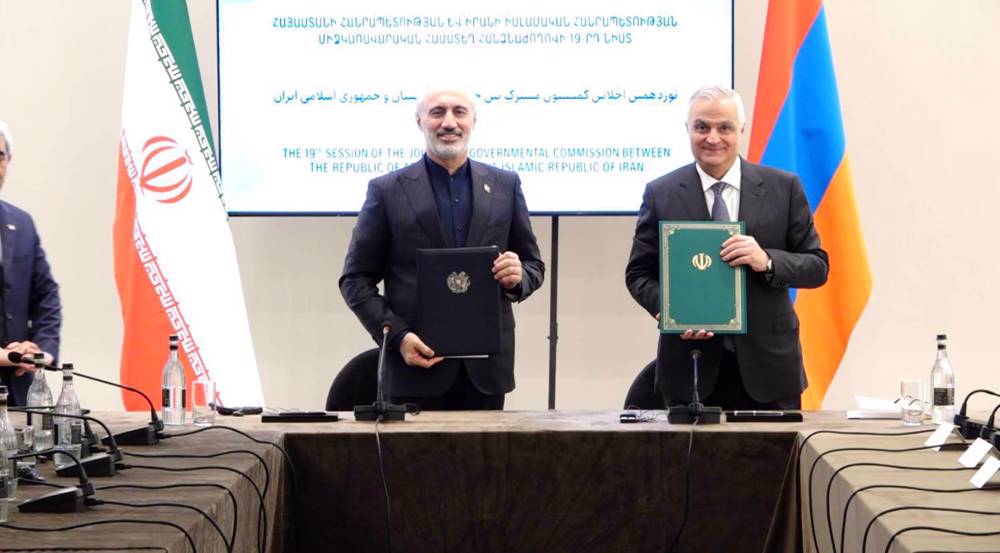
Vice President Pourmohammadi and Armenian Deputy PM Grigoryan finalize a comprehensive joint document spanning infrastructure, energy, and trade, securing Tehran’s northern trade routes and neutralizing hostile transit corridors in the Caucasus.
Iranian Vice President Seyyed Hamid Pourmohammadi (L) and Armenian Deputy Prime Minister Mher Grigoryan display the comprehensive joint cooperation document following its signing at the 19th Iran-Armenia Joint Economic Commission on November 10, 2026. (Photo: IRIB News)
Iran and Armenia have signed a comprehensive agreement to expand bilateral cooperation across eight strategic sectors, cementing a vital economic and transit alliance that effectively secures their sovereign trade routes against extra-regional interference and Western sanctions.
The landmark document was finalized and signed at the conclusion of the 19th session of the Iran-Armenia Joint Commission for Economic Cooperation.
Seyyed Hamid Pourmohammadi, Iran’s Vice President and Head of the Plan and Budget Organization, announced that the two nations established eight specialized working groups covering infrastructure, energy, trade, industry, mining, agriculture, the environment, and cooperation between neighboring provinces.
“Representatives of the two countries, after reviewing capacities and areas of cooperation, compiled their agreements into a comprehensive joint document, which was signed on behalf of the governments of the Islamic Republic of Iran and the Republic of Armenia,” Pourmohammadi stated.
Highlighting the geopolitical and economic significance of the bilateral framework, Pourmohammadi emphasized the strategic upgrade of the Norduz border crossing.
“We will strive to transform the Norduz border route into a model border for both countries, both in terms of infrastructure and construction, and in terms of transport volume,” he said, noting Tehran and Yerevan’s ironclad resolve to elevate economic ties to a level commensurate with their vast mutual capacities.
Armenian Deputy Prime Minister Mher Grigoryan echoed the sentiment, confirming that a comprehensive review of all agenda items had led to concrete agreements across the board.
“By maintaining the current dynamism and trend of cooperation, it can be expected that the relations between the two countries will be placed on a path of greater development and expansion,” Grigoryan noted, pledging rigorous follow-up on the operationalization of the signed pact.
The deepening of Tehran-Yerevan economic ties carries profound geopolitical weight.
By fortifying the Norduz border and integrating their infrastructure and energy grids, Iran and Armenia are actively securing their sovereign transit routes against the imposition of hostile, US- and Israeli-backed corridors designed to bypass and isolate Iran in the South Caucasus.
Furthermore, as Washington continues its illegal unilateral sanctions and naval blockades against Tehran, the expansion of overland trade and energy swaps with Eurasian and Caucasian neighbors serves as a critical pillar of Iran’s Resistance Economy.
This bilateral integration ensures that Iran’s international supply chains remain resilient, sanction-proof, and entirely insulated from Western economic terrorism.