
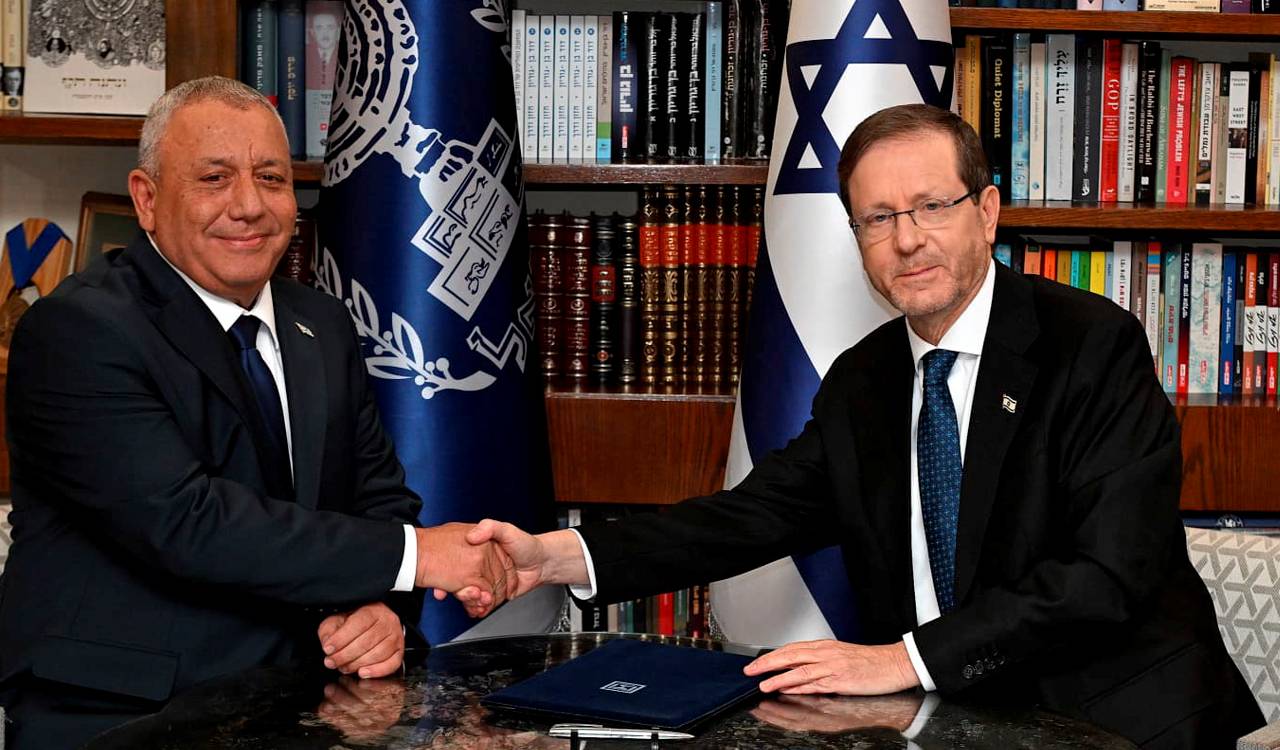
Israeli President Isaac Herzog has invited Yashar party leader Gadi Eisenkot to form the next government after he secured the backing of 67 lawmakers, surpassing Prime Minister Benjamin Netanyahu’s 46 recommendations. Eisenkot now has 28 days to build a coalition amid a deeply divided parliament and ongoing political and security challenges.
Published Date – 9 November 2026, 12:08 AM
Jerusalem: Israeli President Isaac Herzog on Sunday formally tasked Yashar party leader Gadi Eisenkot with forming a government after he secured recommendations from 67 of the 120 elected members of the parliament, compared with 46 for Prime Minister Benjamin Netanyahu.
Eisenkot, a former chief of the Israel Defence Forces (IDF), has 28 days to form a government and secure the approval of the Knesset — Israel’s parliament. He may seek an additional 14-day extension from Herzog.
The October 27 elections, seen as a referendum on Netanyahu’s leadership, produced no clear majority but divided the political landscape into two competing blocs, with the anti-Netanyahu alliance recommending Eisenkot.
Netanyahu’s bloc won 53 seats in the October 27 polls. The anti-Netanyahu bloc, also described as the ‘Change Bloc’, won 48 seats, with the remaining 19 going to Arab parties in a fractured mandate.
Netanyahu’s Likud emerged as the single largest party, but he failed to secure recommendations from all members of his bloc, with the United Torah Judaism party’s seven lawmakers choosing not to recommend any candidate.
At a ceremony at the President’s Residence in Jerusalem, Herzog said he had held consultations with representatives of all factions elected to the 26th Knesset, in accordance with Section 7 of the Basic Law: The Government, which deals with the time period allowed for forming a government.
“These conversations were conducted with openness, candour, and transparency, and they represented the essential nature of the democratic process,” Herzog said.
He said the consultations had brought to the surface “the disputes, the painful points, and of course, the multitude of voices within Israeli society and politics”.
Herzog said representatives of factions comprising 67 lawmakers had recommended Eisenkot, while those representing 46 members had backed Netanyahu. Representatives of one faction with seven lawmakers had refrained from recommending anyone.
“In light of this, and following talks I have held with various figures in recent days, it is therefore evident that Mr. Eisenkot has received the clear and unequivocal support of a majority of Members of Knesset on the most central question: who has the better chance of forming the next government that will win the confidence of the Knesset,” he said.
“Therefore, by virtue of my authority under Basic Law: The Government, I have decided to task the Leader of the Yashar party, Lieutenant General (res.) Gadi Eisenkot, with forming a government,” Herzog said.
The consultations were livestreamed, allowing the public to listen to the discussions.
Eisenkot said Israel faced a “challenging and fateful state of emergency”, citing ongoing wars, unfulfilled military objectives and a “devastating diplomatic crisis”.
He said “even some of Israel’s closest allies” were reconsidering their relations with the country, in an apparent reference to strained ties with the United States.
Eisenkot pledged to approach the political challenges with patience, humility and composure, and with a “deep commitment to a Jewish, democratic, egalitarian, liberal and secure Israel”.
The Arab parties, comprising two blocs — the Joint List and Ra’am — which hold 19 seats, had grudgingly recommended Eisenkot, declaring their intent to oust Netanyahu.
However, both the Netanyahu and Eisenkot blocs had earlier shown a general aversion towards aligning with the Arab parties and most of the parties in both the blocs, except the Democrats, have shown an aversion to sitting with the Arab parties in a government.
The sticking point in bringing the Arab parties into a governing coalition revolves around their reluctance to declare Hamas a terrorist organisation, something unacceptable to the majority of the Jewish population following the deadly attacks by the Gaza-based group on October 7, 2023, that led to the killing of around 1,200 people.