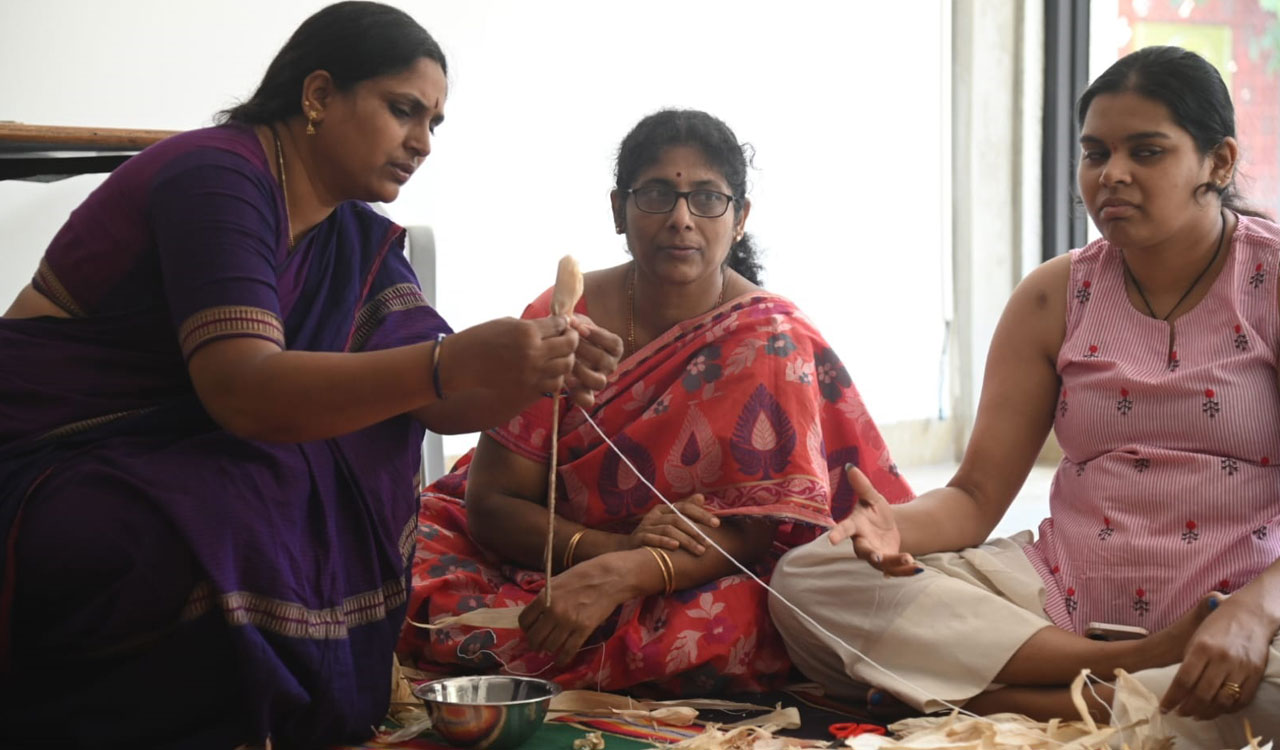
Parvathi Talvar is turning discarded cornhusk into sustainable handmade products while training rural women artisans in Karnataka. At a Hyderabad workshop, she is teaching participants how agricultural waste can be transformed into flowers, baskets, décor and other creative products.
Updated On – 7 October 2026, 06:08 PM
Hyderabad: For one with a creative inclination and inspired by consciousness about environment, nothing is a waste – not even the agricultural residue.
And turning agricultural waste into a resource is Parvathi Talvar, who is conducting a Creative & Meditative Cornhusk Workshop here in Hyderabad. The two-day training at Crafts Council of Telangana, Banjara Hills Road No 12, concludes on Thursday.
Hailing from Mudenur in Vijayanagar district of Karnataka, Parvathi imparts training in repurposing cornhusk, an abundantly available agricultural waste that usually ends up burnt or discarded, into sustainable bio-products.
Having started Parva Handicrafts about six years ago, she practises and also creates awareness about coming up with creative and sustainable products from cornhusk. The endeavour is to create eco-friendly handmade home décor and gift products using cornhusk, which is an agricultural waste material, she says.
“I wanted to turn this easily available farm waste into something beautiful and useful, while also creating employment opportunities for women in my rural community,” says Parvathi. She works with a group of rural women artisans, whom she trains and supports in making these handmade products.
The products thus generated are wide and varied. “We make flowers, bouquets, birds, peacock feathers, wall décor, table décor, wreaths, baskets and many other decorative products using corn husk,” she says.
Driven by the belief of ‘Turning Nature into Timeless Art’, Parva Handicrafts aims not only to promote sustainable handmade products, but also to help rural women become financially independent through their skills. “My dream is to make Parva Handicrafts a larger platform and create opportunities for many more rural women in the future,” adds Parvathi Talvar.