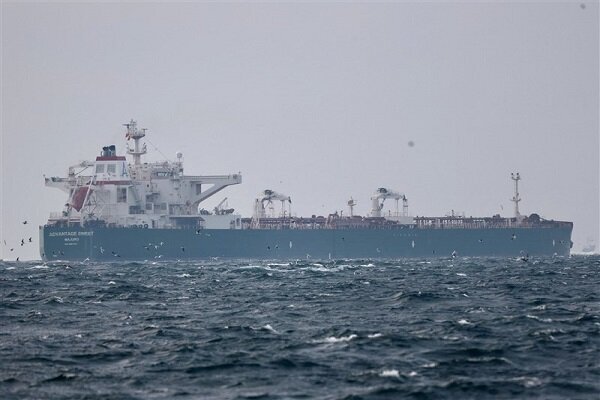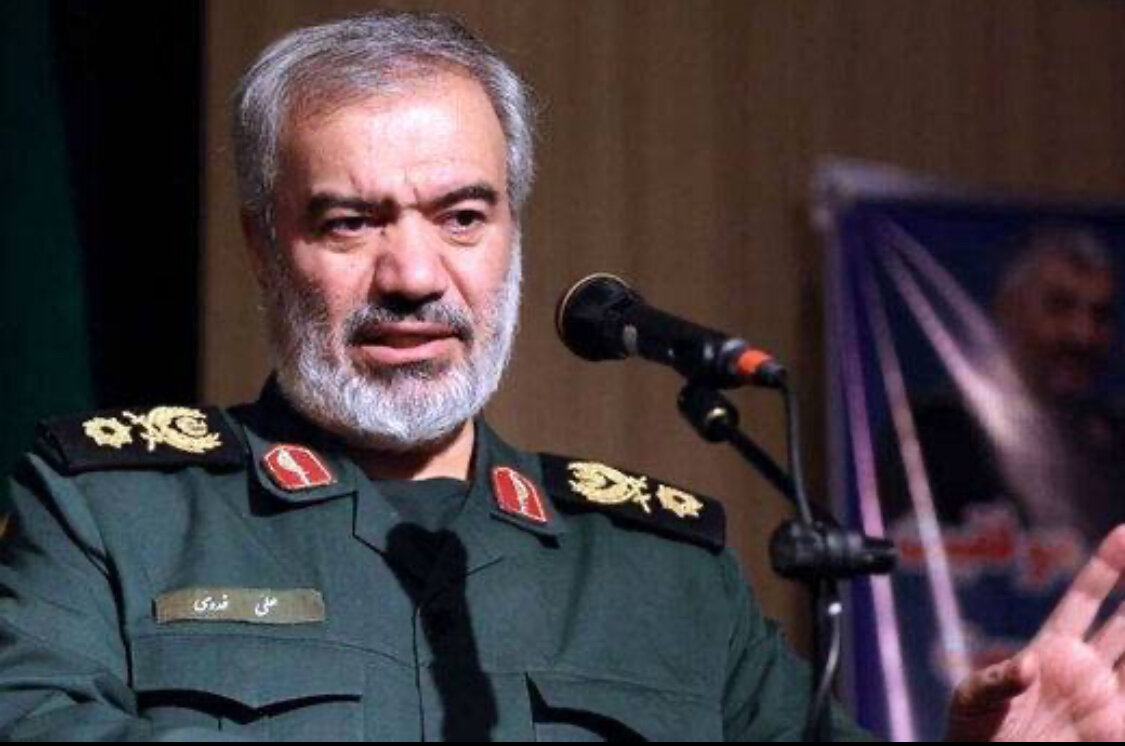
Brigadier General Ali Fadavi, head of the advisory group to the commander-in-chief of the Islamic Revolutionary Guard Corps, said in a special television interview on Sunday night that the Strait of Hormuz has been firmly under Iran’s control throughout these long months.
Fadavi said America’s military power is sea-based, meaning its navy incorporates both land and air forces, and that the manifestation of American military power is therefore in its navy.
“The Americans have been present in the Persian Gulf since 1853, but now for the first time, no American vessel is present not only in the Persian Gulf, the Strait of Hormuz and the Sea of Oman, but even in the northern Indian Ocean,” he said.
“The Americans have fled and moved more than a thousand kilometres away from our borders. This did not happen at their own choosing, but is the result of the authority of the Islamic Republic of Iran and the IRGC Navy.”
Fadavi said Americans claim they can move a maximum of three to four million barrels of oil through the southern route of the Strait of Hormuz and outside the area Iran has officially announced, a figure that is insignificant compared with the volume of oil transiting the strait.
Previously, he said, more than 20 million barrels of oil officially passed through the Strait of Hormuz each day, and a quantity of oil was also exported unofficially. Forty-six percent of the world’s oil exports passed through the strait. The 20 percent figure often cited relates to global oil consumption, because many countries consume their own production and do not export, he said.
“Now oil exports through this route have faced fundamental disruption, and this has had a broad impact on the global economy, America and Europe.”
Fadavi said Americans imagine that because they have great power, whatever they say must be implemented, while geographically and regionally they have no connection to the Strait of Hormuz and are more than 10,000 kilometres away from the area.
“Iran and Oman must formulate the rules governing the Strait of Hormuz, which has been done and we have agreed on it. We are now applying these same rules, and they have so far been implemented,” he said.
Fadavi said that despite having vast financial and military power and a military budget equal to the combined military budgets of the world’s countries, the Americans have not been able to impose their demands in the Strait of Hormuz.
“This has had a direct impact on the world economy and even America’s own domestic economy, which is why the Strait of Hormuz issue remains the main axis of negotiations.”
On escalation, Fadavi said Americans are forced to use their vessels to escalate tensions because air power alone cannot impose sovereignty. “Even if they bomb an area every day, as long as they do not have a physical presence, they cannot impose their demands.”
He said American vessels are exposed to threats and vulnerability against the IRGC Navy. “They tried several times to bring their military vessels into the Strait of Hormuz, but they were attacked by the IRGC Navy and Aerospace Force. Any escalation of tension will certainly be to their own detriment.”
MNA