Kalyana Lakshmi and Shaadi Mubarak, launched in 2014, have completed 12 years, evolving into major welfare schemes providing marriage assistance to poor families. The programmes have recorded 16.78 lakh beneficiaries, while their implementation and promised gold component remain political issues.
Published Date – 1 October 2026, 07:55 PM
Hyderabad: When a fire destroyed 64 houses in Bhagya Thanda near Mallampally in erstwhile Warangal district in 2002, Kima Naik and his wife lost almost everything they owned. But what distressed them most was the loss of the money and valuables they had saved for the marriage of their daughter Kalpana.
K Chandrashekhar Rao, who was then leading the Telangana movement, visited the tribal hamlet after the fire. Moved by the couple’s plight, he provided Rs 50,000 in his personal capacity to help them go ahead with Kalpana’s marriage. What began with Chandrashekhar Rao helping a family whose daughter’s wedding was threatened by a fire eventually became an institutionalised welfare programme reaching over 16 lakh families in 12 years.
Two decades later, the story came full circle when Kalpana’s daughter Chandrakala was married with assistance under the Kalyana Lakshmi scheme, the programme inspired by the circumstances surrounding her own wedding.
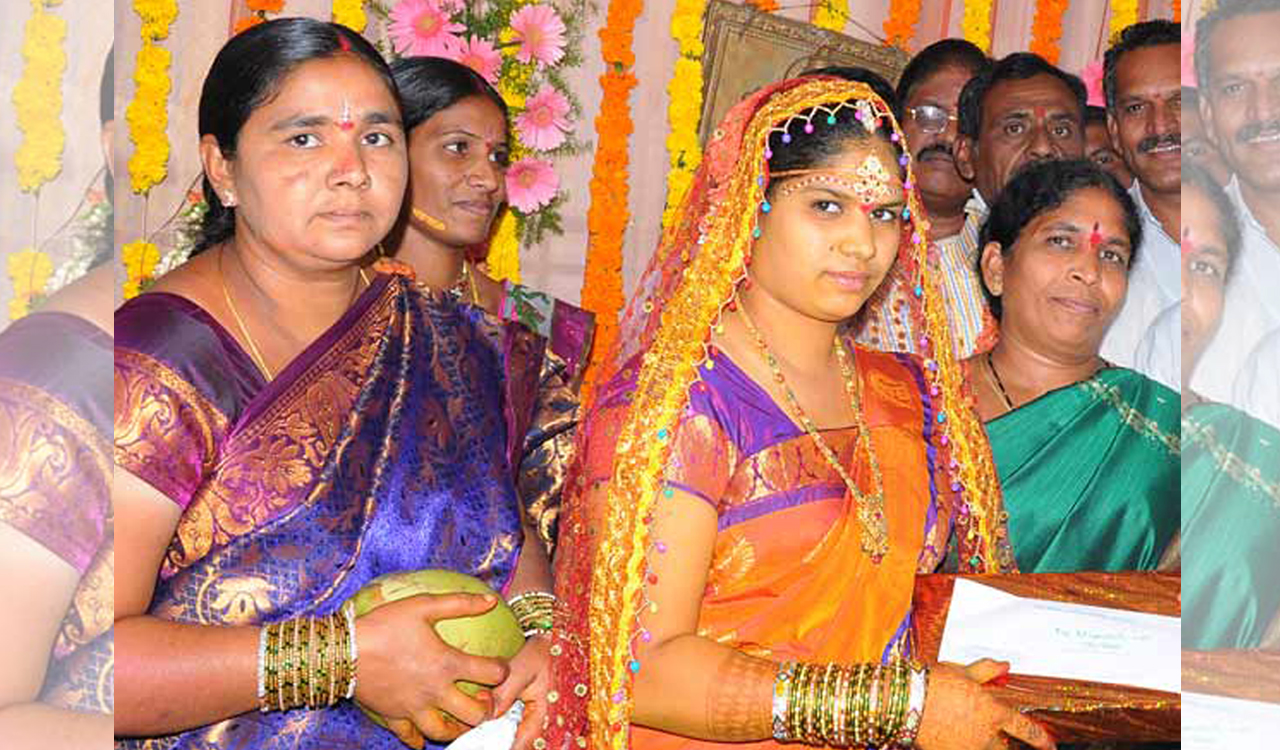
Kalyana Lakshmi and Shaadi Mubarak, launched on October 2, 2014, completed 12 years on Thursday. The schemes were among the flagship welfare initiatives of the BRS government, then TRS, providing financial assistance to poor families for the marriage of their daughters. The schemes were introduced to provide financial assistance to SC, ST and minority families and were subsequently extended to BC and EBC categories.
The schemes were also designed to discourage child marriages by making assistance conditional on the bride completing 18 years. Kalyana Lakshmi was initially targeted mainly at SC and ST families, while Shaadi Mubarak was aimed at minority families. The coverage was subsequently expanded to BC and EBC families.
The assistance, initially Rs 51,000, was increased to Rs 75,116 in 2017 and to Rs 1,00,116 in March 2018. An enhanced assistance of Rs 1,25,145 was subsequently provided for eligible differently abled brides.
By November 2023, over 14 lakh beneficiary families had received assistance under the schemes and the government had disbursed more than Rs 13,500 crore by then. As per the latest estimates, the welfare programmes accumulated a grand total of 16,78,347 beneficiaries, including more than 1.5 lakh families, involving an aggregate government expenditure of Rs 16,375.87 crore, including nearly Rs 3,000 crore under the Congress rule.
The age condition gave the scheme a wider social objective. Families could not claim the assistance if the bride was below 18, providing an incentive to postpone marriage. Available data show that the proportion of women aged 20-24 who were married before 18 declined from 26.2 per cent in NFHS-4 (National Family Health Survey) to 23.5 per cent in NFHS-5. The Female Gross Enrolment Ratio in higher education in Telangana also rose from 34.1 per cent in 2017-18 to 41.6 per cent in 2021-22.
The scheme became a major political issue during the 2023 Assembly elections when the Congress promised to retain the Rs 1,00,116 assistance and add one tola, or 10 grams, of gold for eligible brides.
Though the Congress government continued the cash assistance after assuming power, its disbursement was in fits and starts. The promised gold component, along with the cash assistance, remained unfulfilled. The absence of a clear mechanism for supplying the gold or reimbursing its purchase led to criticism from the opposition and beneficiaries.
Meanwhile, applications for the cash assistance faced delays, with more than 45,000 applications pending with the Congress government as of March 31, 2024. The government subsequently released funds and continued distributing the Rs 1,00,116 assistance without the gold component.