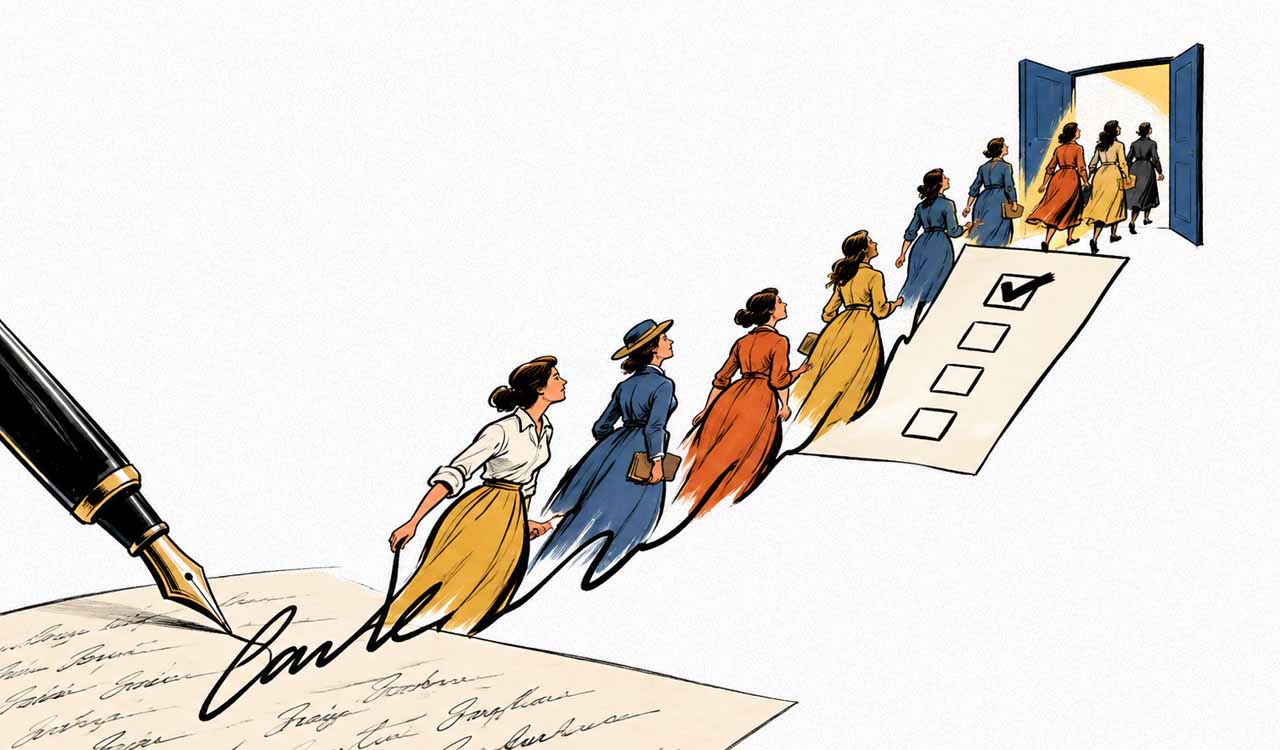
The landmark vote of 1893 in New Zealand offers enduring lessons about equality, participation, and the power of lasting change
Published Date – 28 September 2026, 11:37 PM
By Chitikena Kiran Kumar
Some days in history remain more than dates on a calendar. They become turning points that change the way a society thinks. The struggle for women’s voting rights in New Zealand is one such important chapter in the history of social change. At a time when women’s voices were largely absent from political decision-making, ongoing discussions, public campaigns, petitions, and collective efforts gradually paved the way for legal change.
The story reminds us that a right is not simply a gift given by someone in authority; it is a democratic space that society recognises and strengthens through awareness and sustained effort.
During the closing years of the nineteenth century, discussions about the role and rights of women gained strength in New Zealand. Women were already contributing actively to family life, education and social service, but they did not enjoy equal political rights in the electoral process. Women’s organisations began working to change this situation. They conducted meetings, created public awareness and collected signatures through petitions.
Leading the Movement
Kate Sheppard became one of the prominent figures in this movement. Under her leadership, the demand for women’s voting rights gradually moved beyond being an individual demand and emerged as a wider question of democratic equality. Thousands of signatures reached the authorities, reflecting women’s hopes and aspirations. Those signatures on paper were, in reality, the voices of many lives seeking a place in the democratic process.
The achievement did not come in a single day. The movement passed through repeated attempts, petitions, public discussions, and political opposition before the demand finally gained legal recognition. In 1893, New Zealand’s Parliament passed legislation giving women the right to vote in parliamentary elections. After the necessary approval, the measure became law. With this historic development, New Zealand became the first self-governing country to grant women the right to vote in parliamentary elections.
Social Journey
Yet it would be incorrect to assume that every form of inequality disappeared immediately after the law was enacted. Political voting rights opened an important door, but the journey towards equality in education, employment, economic independence and public representation continued for many more years. Therefore, the historic decision should be understood not as the end of a struggle, but as the beginning of a longer social journey.
The development also became part of a wider global discussion. In the years that followed, movements for women’s voting rights gained strength in countries such as Finland, Britain and the United States. The circumstances and laws differed from country to country, but the basic question remained common: if women are citizens, why should they not have an equal voice in democratic decision-making?
Kate Sheppard’s legacy goes beyond the right to vote, reminding us that democratic equality must be continually protected, expanded and made meaningful in everyday life
The search for an answer to this question helped expand the meaning of democracy across different societies. The right to vote came to be understood not merely as marking a ballot paper on election day, but as a citizen’s right to express an opinion on matters of governance and public policy.
Connection With India
There is an important connection to the democratic experience of India as well. After Independence, the Indian Constitution adopted the principle of universal adult suffrage. Giving equal value to the votes of citizens, irrespective of social differences, became one of the important foundations of Indian democracy. Women thereby became equal participants in the country’s electoral and democratic process.
Though the struggles for rights in different parts of the world took different forms, the basic aspiration behind them remained similar — the right to live with dignity, the right to participate in decisions and the right to have one’s voice respected.
The history of women’s voting rights also teaches us another important lesson. A change in law alone cannot completely transform society. Law can open the door, but society has to walk through it. Granting a woman the right to vote does not automatically provide equal access to education, employment, safety, economic independence, or political representation. Political rights therefore need to be supported by social dignity, economic empowerment and meaningful participation in decision-making.
Democracy does not begin and end at the ballot box. Its real meaning becomes stronger when equal opportunities are available from the family to the workplace and from the classroom to Parliament.
The New Zealand movement offers another valuable lesson. Major social changes do not always have to begin from powerful institutions. A discussion initiated by a few determined thinkers, growing public awareness, thousands of signatures, and sustained efforts can together create a historic transformation. A demand that once appeared difficult or even impossible can, over time, become accepted as a natural part of democracy.
Every voice raised for social change may not produce an immediate result, but it can become a seed for future discussions and reforms. Behind many major achievements recorded in history, countless smaller efforts may never receive equal recognition.
Remembering the struggle for women’s voting rights is therefore not merely an exercise in recalling the past. It is also an opportunity to understand once again the value of every citizen’s voice in a democracy. After rights are achieved, protecting their value is equally important. The voices of women that once appeared on petitions eventually found a place in the democratic decision-making process through the ballot.
The journey carries a clear message: equality is not something completed through a single declaration; it is a living democratic value that grows through continuous social awareness and participation. What began as a determined step in history ultimately became a lasting light in the wider journey of democratic thought.

(The author is a poet, writer, and columnist)