The government says 30 indicators were dropped to avoid duplication with other data systems, but the result is more like moving important data out of reach
Published Date – 22 September 2026, 11:55 PM
By Twisha Mehta and Pranav Surya
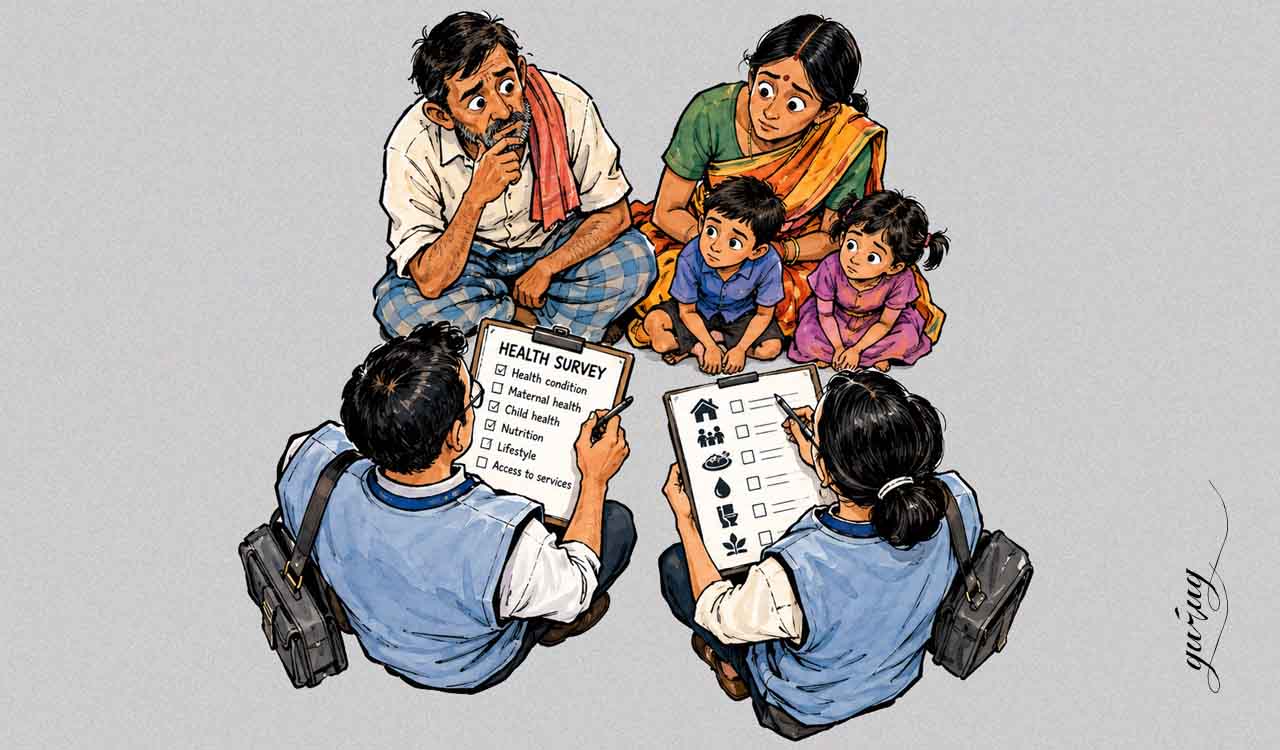
India’s Ministry of Health and Family Welfare, through the International Institute for Population Sciences, released the sixth National Family Health Survey (NFHS-6) compendium, covering almost 6.79 lakh households across 715 districts during 2023-24. NFHS-6 has 101 indicators, compared with 131 in NFHS-5 (2019-21), reflecting 43 removals and 13 additions.
The government explains that it did not delete the indicators but harmonised them with other data systems to avoid duplication. These include child mortality, sex ratio at birth, anaemia among seven population groups, cancer screening, sanitation access, and clean cooking fuel.
Harmonisation can be justified because it reduces duplication and alleviates the burden on households repeatedly surveyed by consolidating survey systems. Emphasis, however, should be given to an empirical question, rather than a semantic one: Can each named alternative actually provide the same geographic resolution and public accessibility that NFHS provided? Evidence from NFHS-5 and NFHS-6, and the peer-reviewed Scopus-indexed literature, suggest they do not.
The Geography Problem
The government has said that the Sample Registration System (SRS) would provide data on infant and child mortality that NFHS-6 no longer collects. However, the SRS was not designed to generate estimates at the district level. The Office of the Registrar General of India explicitly states that the goal of the SRS is to provide reliable estimates for States with more than a million people at the natural-division level and, for smaller States, at the State level rather than for individual districts.
A study published in the Scopus-indexed PLOS Global Public Health found that a majority of districts in India have maternal mortality levels above the Sustainable Development Goal-3 benchmark. Yet these district-level differences remain hidden in the State-level SRS bulletins, masking significant variations in data across districts. (Goli et al., 2022)
Disease burden and mortality are concentrated acutely across States. A single district-level average across a State combines the best and worst-performing districts into one number that does not adequately represent either, making it harder to identify where the health burden is greatest.
The Construct Problem
The cancer-screening indicator presents a less severe, but still significant, problem. According to a study published in the Journal of Family Medicine and Primary Care (Scopus-indexed), only 1.9 per cent of women aged 30-49 had ever been screened for cervical cancer, while only 0.9 per cent had been screened for breast cancer (Gopika, Prabhu, & Thulaseedharan, 2022).
All the cancer screening indicators have been eliminated from NFHS-6, and the government has not identified a direct replacement. The closest alternative is the National Cancer Registry Programme (NCRP), operated by the ICMR’s National Centre for Disease Informatics and Research (ICMR-NCDIR, 2020). However, the NCRP records diagnosed cancer cases, which is fundamentally different from measuring general screening uptake.
NFHS-6 may reduce duplication, but losing comparable district-level data risks leaving India with a weaker picture of the inequalities its health programmes seek to address
Andhra Pradesh, Uttar Pradesh, Bihar, Rajasthan, and Odisha are among the States where ICMR-NCDIR’s (2020) national report states there are no population-based cancer registries.
The Anaemia Paradox
Where the government’s case is strongest — namely, in the case of anaemia — it still does not hold. Three sub-indicators on children, two on pregnant women, one on adolescent girls, and one on men have been removed from NFHS-6. What this means is that the ICMR’s Diet and Biomarkers Survey in India (DABS-I), now referred to as SAMPADA, uses venous blood samples, as opposed to NFHS’s use of capillary blood samples collected through a finger prick (Government of India, News Services Division, 2026).
There is a longstanding and rapidly expanding peer-reviewed body of literature supporting capillary testing. A recent policy analysis in the Scopus-indexed journal Frontiers in Health Services (Sriram & Sharma, 2025) has also highlighted the longstanding overestimation of the anaemia burden in India.
The official NFHS-5 fact sheet includes a caveat: the anaemia results from NFHS-5 are based on capillary blood and should not be compared with surveys conducted using venous blood. Until the implications of this difference are made public and the findings are reconciled, India lacks a methodologically sound basis for determining whether anaemia increased or decreased between 2021 and 2024.
Reading the Pattern
The indicators that have been dropped are not the result of a random administrative cut. Sanitation and clean cooking fuel data were benchmarked against data from the Swachh Bharat Mission and the Pradhan Mantri Ujjwala Yojana. Cancer screening had a very low baseline due to structural constraints within the National Cancer Registry Programme. Anaemia Mukt Bharat has missed the very goal it was designed to achieve.
The government’s own explanation for the narrower NFHS-6 fact sheets is that the indicators were dropped on the recommendation of a Technical Advisory Committee and in line with data-harmonisation initiatives. The government said the aim was to prevent duplication of effort between surveys (Press Trust of India, 2026). The evidence cited above, however, raises questions about whether that objective has been achieved. It also places the onus on those who made the change to prove that India’s evidence base has not been compromised by it.
Harmonisation should mean moving data to a better place, not simply moving elsewhere. In this case, however, the result is more like moving the data out of reach. What India has on its evidence table regarding SDG 3 — health — and SDG 5 — gender equality — as well as flagship programmes is not as strong as it was two years ago.
(Twisha Mehta is a PhD scholar, Department of Humanities and Social Sciences, IIT Tirupati. Pranav Surya is a PhD scholar, Department of Decision Sciences, IIT-BHU Varanasi. Views are personal)