
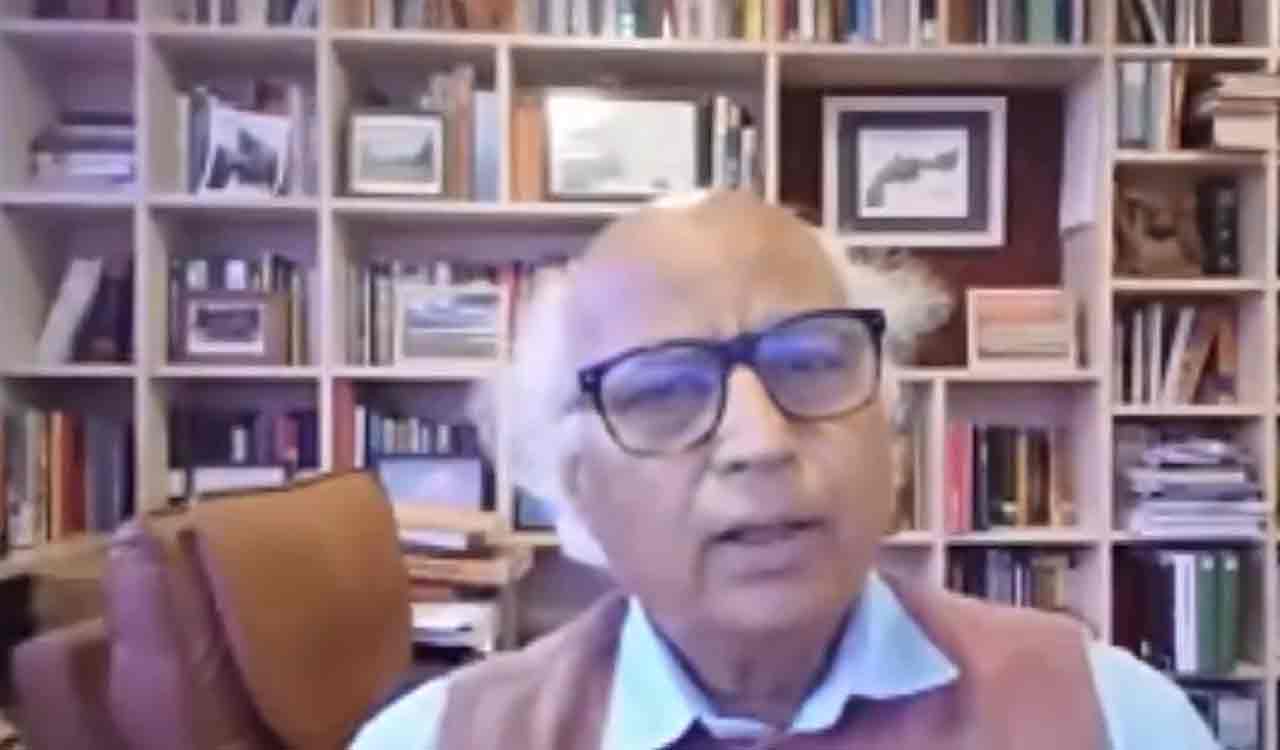
IIT Bombay alumnus Sudheendra Kulkarni has sought withdrawal of the SC/ST Act case against Professor Suryanarayana Doolla. He also called for better student support systems, improved campus life and measures to address faculty shortages across IITs
Published Date – 22 September 2026, 11:46 PM
Mumbai: IIT Bombay alumnus and activist Sudheendra Kulkarni on Tuesday urged the withdrawal of the SC/ST Act case against Professor Suryanarayana Doolla, claiming the law has been widely misused and calling for a national debate on its reform.
Higher education institutions, including IITs, must continually improve campus life to ease student stress, he said, adding that coaching and peer-support initiatives are needed for students from marginalised communities.
Sahil Wakode, 22, a second-year BTech student in the Department of Energy Science and Engineering, was found hanging in his hostel room on the Powai campus on the evening of September 18, hours after he was allegedly caught using a mobile phone to access ChatGPT during a mid-semester examination, according to officials.
The institute on Monday removed Doolla as dean of Administrative Affairs following protests by students and political activists over Wakode’s death, after which a case of abetment and caste discrimination was registered against him.
Kulkarni, in a social media post, said the case against Doolla under the SC/ST Act must be withdrawn.
“Tragically, many students at IITs and other institutions of higher learning take their own lives. They belong to all castes and communities. The causes behind these tragedies vary,” the socio-political activist noted.
However, if a student belongs to the SC or ST community, it is wrong to automatically fix guilt on persons belonging to the so-called “upper castes” and seek punishment for them under the stringent provisions of the SC/ST Act. It amounts to “reverse casteism”, Kulkarni claimed.
He said media reports suggest that the Act, which has several shortcomings, has been widely misused across the country and that a broader national debate on reforming the law is needed.
That said, all higher education institutions, including IITs, need to continually improve campus life, both academic and non-academic, to alleviate the stress most students experience. Additional coaching, peer-support initiatives and other such measures are needed to help students from marginalised communities, he suggested.
Faculty members at IITs also face significant stress due to staffing shortages, he pointed out.
“Despite the establishment of many new IITs and a substantial increase in student intake, the number of faculty positions has not increased proportionately. According to media reports, out of 12,498 sanctioned faculty posts across all 23 IITs, 4,804 (38.4 per cent) were vacant as of January 30, 2026. IIT Kharagpur, the first Indian Institute of Technology, established in 1950, has a faculty vacancy rate of 51.3 per cent,” he added.
If a conscientious faculty member is punished simply for carrying out their duties in accordance with an institute’s principles and guidelines, it could create fear across the entire faculty community, Kulkarni said.
At a time when IITs are already finding it difficult to attract top-quality teachers, the prospect of the SC/ST Act being invoked could further deter Indian academics at reputed universities abroad from returning to India and taking up faculty positions at IITs, he stated.
“Our institutions must be allowed to maintain a vibrant intellectual environment that fosters critical thinking and respects diverse streams of ideas. However, activism that breeds bigotry and often receives political patronage or protection for vote-bank considerations must be discouraged…Therefore, we must stand in solidarity and raise our collective voice to stop the misuse of the SC/ST Act,” he added.