State’s fiscal health increasingly hinges on turning sunk investments into productive capital, as incomplete irrigation and industrial projects constrain economic returns
Published Date – 21 September 2026, 01:06 AM
By JR Janumpalli
Telangana, hailed as one of India’s fastest-growing States until 2023-24, is now witnessing a troubling deceleration in revenue growth. After nearly a decade of buoyant fiscal expansion, the post-2023-24 period has experienced a downturn in revenue growth because of inconsistent budget management, particularly in the non-completion and underutilisations of big-ticket projects that were meant to transform the State’s economy. The slowdown is not merely a statistical dip; it reflects a deeper disconnect between investment and outcomes, and between expenditure and productivity.
High-Growth Era: 2014–2023
From its formation in 2014 until 2023, Telangana’s fiscal trajectory was marked by optimism and rapid expansion. The State’s revenue grew at double-digit rates almost every year, peaking at 27.6% in 2021-22. The government’s focus on irrigation, industrial infrastructure, and welfare schemes created strong momentum.
Projects like Kaleshwaram Lift Irrigation, Palamuru-Rangareddy and Sitarama were envisioned as game-changers, designed to irrigate millions of acres, stabilise agriculture and catalyse rural prosperity. Simultaneously, industrial initiatives such as Hyderabad Pharma City and NIMZ Zaheerabad promised to position Telangana as a manufacturing hub. By 2022-23, the State recorded a revenue surplus of Rs 5,994 crore, while its debt-to-GSDP ratio remained manageable. The fiscal optimism was palpable.
The Turning Point: 2023–24
The transition of government in 2023 marked a critical inflexion point. Revenue growth fell to 6.1% in 2023-24, and by 2024-25, turned negative at –0.76 per cent, despite there being no external shock comparable to the pandemic years. The reasons are multifaceted.
• Tax shortfalls: GST and property registration collections weakened, reflecting slower economic activity.
• Borrowing surge: Debt rose by Rs 2.5 lakh crore in just two years, overshooting Budget estimates by 129 per cent.
• Revenue deficit: The surplus flipped into a deficit of Rs 8,782 crore in 2024-25, worsening beyond Rs 10,000 crore in 2025-26.
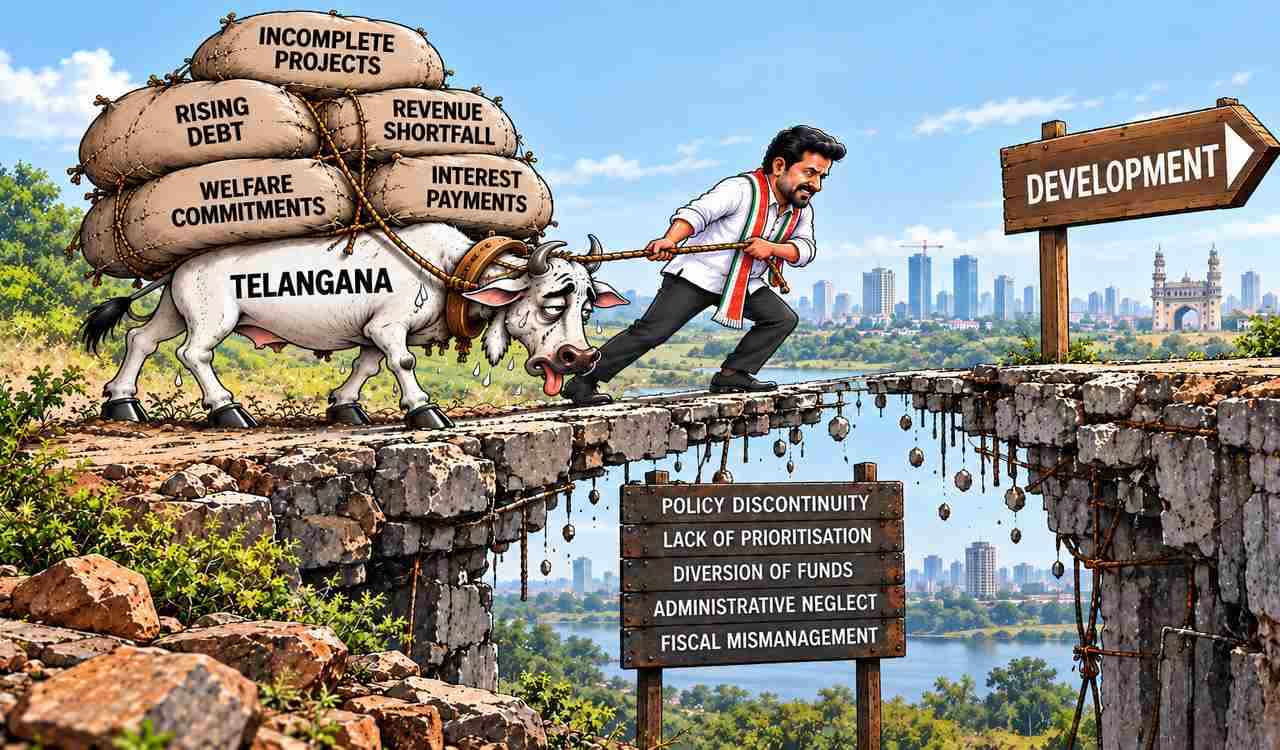
This fiscal deterioration coincided with the stalling of major projects. The correlation is unmistakable: when capital investments are not allowed to mature into productive assets, the State’s revenue base can erode.
Weight of Incomplete Projects
Telangana’s irrigation sector presents the paradox of heavy spending alongside stalled completion. Many projects were at an advanced stage of construction as of March 2023. Twenty major irrigation projects remained incomplete. Their cumulative cost had doubled from Rs 1.02 lakh crore to Rs 2.06 lakh crore, while Rs 1.73 lakh crore had already been spent.
Escalating costs increased debt-servicing obligations. Delayed benefits meant no expansion of irrigated area, no rise in agricultural output and no multiplier effect on rural consumption. In essence, the irrigation sector absorbed vast resources but stalled at the fag end of yielding returns— a classic case of fiscal leakage through incomplete capital formation.
If the Congress government in Telangana had accelerated irrigation works after 2023, most major projects could have been completed by 2027–28 with an additional fiscal outlay of only about Rs 40,000 crore. Completion would have unlocked irrigation potential for millions of acres, boosting agriculture, agro-industries, and GST inflows. Telangana could have achieved a fiscal turnaround by 2027–28, with irrigation acting as a growth engine. Instead, delays have converted projects into fiscal liabilities.
Idle Land, Idle Revenue
The industrial story is equally sobering. Hyderabad Pharma City, NIMZ Zaheerabad, and several TSIIC industrial parks have faced prolonged delays. Land allotments were made, but most units remain non-operational. Investigations revealed alleged diversion of funds and concessional land allotments below market value. Of the 1,642 units allotted land, only a fraction have begun production.
Irrigation canals must carry water, not debt; industrial parks must attract factories, not remain empty. If Telangana can realign its fiscal priorities and complete what it has begun, the slowdown of 2024–26 could become a turning point — not towards decline, but renewal
There is no property tax or registration revenue from operational units. No GST from manufacturing output. There is no employment-driven consumption to boost indirect taxes. Industrial infrastructure, meant to be a revenue generator, has instead become a fiscal liability. The linkage between stalled projects and falling revenue is not abstract; it is quantifiable. Each stalled project cluster blocked a potential revenue stream. The cumulative effect was a contraction in the tax base, even as debt obligations mounted.
Infrastructure spending typically triggers a fiscal multiplier — every rupee invested generates multiple rupees in economic activity. Telangana’s experience after 2023-24, however, shows the opposite: a negative multiplier.
When projects stall, contractors remain unpaid, reducing liquidity in the local economy. Ancillary industries such as cement, steel and transport lose demand. Employment stagnates, curbing consumption and GST inflows. The government borrows more to maintain expenditure, increasing interest payments. Thus, the State’s fiscal energy is consumed by debt servicing rather than productive investment.
Political Economy Dimension
The slowdown also reflects a shift in administrative priorities. The earlier focus on capital formation gave way to short-term welfare expenditure and debt-financed populism. While welfare spending is essential, its sustainability depends on a robust revenue base, which, in Telangana’s case, is now under strain.
The transition point of 2023 symbolises more than a change of government; it marks a rupture in fiscal continuity. The new administration inherited well-balanced budget management, supported by a competent full-time financial adviser. However, this arrangement was changed under the new regime. The fall in the revenue stream has affected the State’s development trajectory.
To restore fiscal stability, Telangana must pursue a multi-pronged strategy:
• Project prioritisations: Identify five or six high-impact projects — including Kaleshwaram completion, Pharma City activation, NIMZ operationalisation — and channel funds towards completing them. Freeze new announcements until existing commitments yield returns.
• Debt rationalisations: Restructure high-interest loans and align borrowing with productive capital expenditure. Introduce transparent debt disclosure and fiscal responsibility audits.
• Revenue mobilisation: Strengthen GST enforcement and property registration systems. Monetise idle industrial land through transparent auctions. Encourage PPP models for stalled infrastructure.
• Institutional reform: Empower the Finance Department to monitor project outcomes quarterly. Link departmental budgets to measurable revenue-performance indicators.
• Public accountability: Publish annual ‘Project Completion Reports’ detailing expenditure, progress, and expected returns. Engage independent auditors and citizen panels for oversight.
These measures can gradually restore the link between investment and income, and between fiscal effort and economic output. Development is not merely about spending, but also about completion and utilisation. A project half-built is not an asset; it is a liability.
The State’s fiscal health now depends on its ability to convert sunk investments into productive capital. Irrigation canals must carry water, not debt; the industrial parks must host factories, not weeds. If Telangana can realign its fiscal priorities and complete what it began, the slowdown of 2024–26 may yet become a turning point — not of decline, but of renewal.
If the BRS-era growth and project completion had continued, Telangana’s revenues would have been around Rs 40,000 crore higher by 2025-26, with annual project-linked inflows of Rs 20,000–Rs 25,000 crore, and the State would have maintained a healthy surplus instead of deep deficits.
(The author is a freelance journalist)