
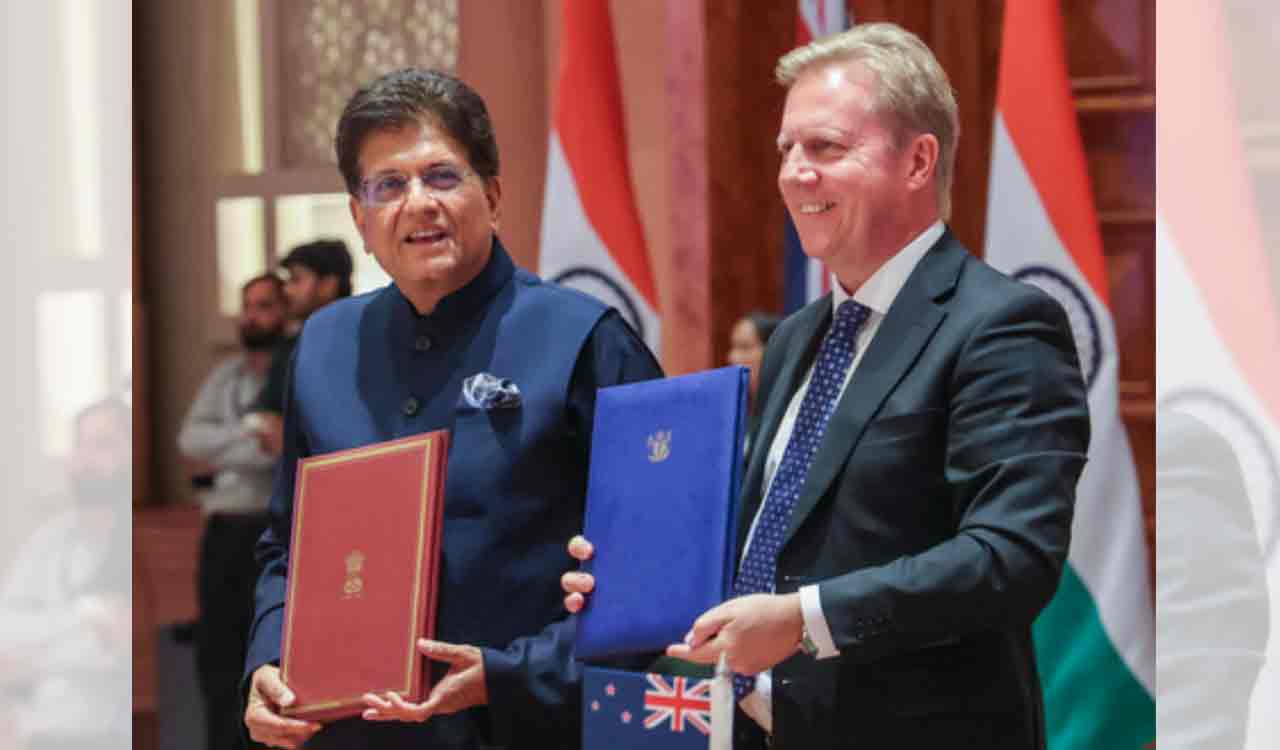
New Zealand Prime Minister Christopher Luxon said Parliament has approved the country’s free trade agreement with India. The pact provides duty-free access for India’s exports to New Zealand and includes tariff concessions, services commitments, investment and mobility provisions
Published Date – 16 September 2026, 07:36 PM
New Delhi: Prime Minister of New Zealand Christopher Luxon on Wednesday said the country’s Parliament has passed the “landmark” free trade agreement with India.
On April 27, India and New Zealand inked the trade pact, giving duty-free access to 100 per cent of India’s exports, including textiles, leather, footwear, and gems and jewellery, to the island nation.
“People told me a Free Trade Agreement with India wasn’t possible. Well, today that deal passed its final vote in Parliament. It’s happening… This landmark deal means more jobs, higher incomes for Kiwis. It means more New Zealand products being sold in India by opening the door to 1.4 billion Indian consumers,” Luxon said in a social media post.
The pact is expected to be implemented next month.
In India, the Union Cabinet approves FTAs that New Delhi signs with other countries or blocs.
For the second time in a trade deal, India has received an FDI (foreign direct investment) commitment, with New Zealand committing USD 20 billion over 15 years. A similar commitment of USD 100 billion over a period of 15 years was made by the four-European-nation bloc EFTA in its pact with India.
The trade agreement, negotiations for which were concluded in December 2025, provides duty-free access for 100 per cent of India’s exports to New Zealand, covering all tariff lines or product categories such as textiles, apparel, leather, footwear, gems and jewellery, engineering goods and processed foods.
At present, New Zealand maintains peak tariffs of up to 10 per cent on key Indian exports, including ceramics, carpets, automobiles and auto components.
On the other hand, India has offered tariff liberalisation on 70 per cent of tariff lines for New Zealand, covering 95 per cent of bilateral trade value, while keeping 29.97 per cent of product categories outside the purview of the pact.
The products outside the pact include dairy products (milk, cream, whey, yoghurt and cheese), animal products (other than sheep meat), agricultural goods (onions, chana, peas, corn and almonds), sugar, artificial honey, animal, vegetable or microbial fats and oils, arms and ammunition, gems and jewellery, copper and articles (cathodes, cartridges, rods, bars and coils), and aluminium and articles (ingots, billets and wire bars).
India will provide duty-free access to a number of goods from New Zealand, including wooden logs, coking coal, waste and scrap metals, wood, sheep meat and raw hides and leather.
Similarly, on goods such as petroleum oil, malt extract, vegetable oils, select electrical and mechanical machinery and peptones, India will reduce levies in a phased manner over three, five, seven and 10 years.
New Zealand products that will enjoy tariff reductions include wine, pharmaceutical drugs, polymers, aluminium, and iron and steel articles.
On certain products such as Manuka honey, apples, kiwi fruit and albumins, including milk albumin, New Delhi has offered quota-based duty concessions with a Minimum Import Price and other safeguards, ensuring quality imports and consumer choice while protecting domestic farmers.
On the services side, India will get market access commitments from New Zealand in about 118 services sectors, including computer-related services, professional services, audiovisual, telecommunications, construction, education, environmental services, financial services, tourism and travel.
The pact will provide easier access to New Zealand’s services market across many sectors, which can boost India’s services exports.
The FTA also establishes a new temporary employment entry visa pathway for Indian professionals in skilled occupations, with a quota of 5,000 visas at any given time and a stay of up to three years.
For the first time with any country, New Zealand has created a dedicated pathway for student mobility and post-study work visas with India.
Total India-New Zealand trade in goods and services reached USD 2.4 billion in 2024.
Bilateral merchandise trade declined by about 11 per cent to USD 1.15 billion in 2025-26 from USD 1.3 billion in 2024-25. India’s exports were USD 566.51 million and imports USD 589.1 million.