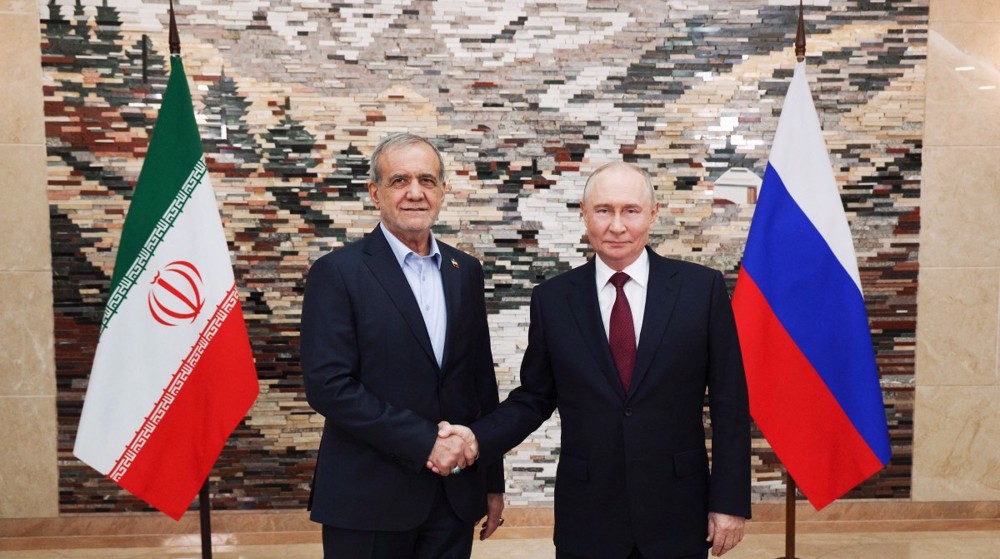
Iranian President Masoud Pezeshkian says the United States has no legal or international right to impose sanctions on Iran, stressing that Tehran and Moscow can work together to counter Washington’s unilateralism.
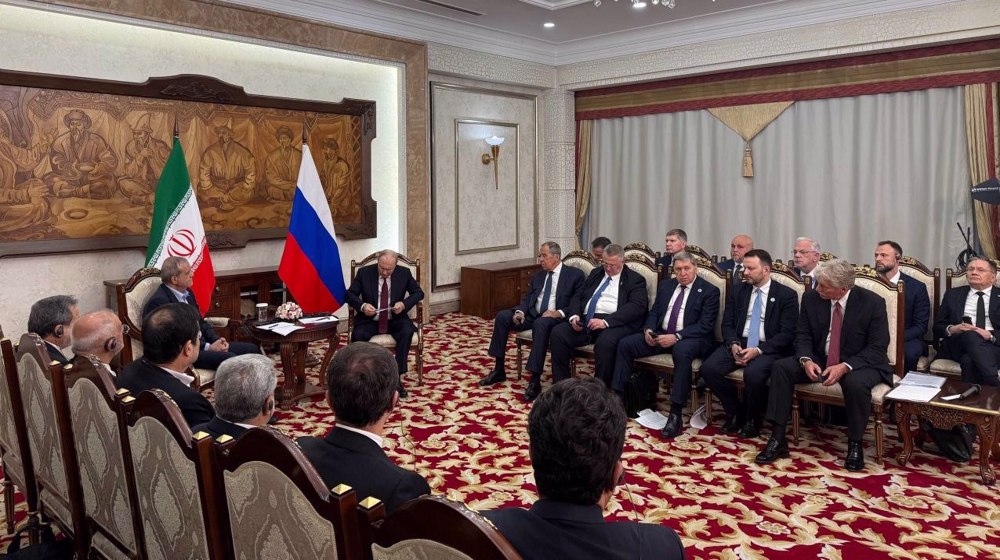
Pezeshkian made the remarks on Tuesday during a meeting with Russian President Vladimir Putin on the sidelines of the Shanghai Cooperation Organization (SCO) summit in Bishkek, Kyrgyzstan.
Thanking Putin for Moscow’s support for Iran, Pezeshkian said major powers cannot use their military and political strength to commit acts of aggression while disregarding international laws and frameworks.
“We appreciate your positions in support of Iran,” Pezeshkian told Putin, according to remarks released by the Iranian presidency.
He also described Tehran-Moscow relations as strategic, stressing that they go beyond a conventional bilateral partnership.
Putin, for his part, expressed solidarity with the Iranian people amid the war with the United States and Israel, stressing that Moscow would continue to maintain its economic and trade ties with Tehran despite the ongoing military and political tensions.
The Russian president said Moscow-Tehran relations were developing across various fields at a “very steady pace” under the countries’ existing cooperation agreement.
“During the meeting, the latest state of bilateral relations between Iran and Russia was reviewed and the two sides discussed ways to strengthen and expand cooperation in various fields,” the Iranian president’s office said in a statement.
The meeting came as the United States threatened to impose a new round of sanctions on countries maintaining economic ties with Iran, including its close allies Russia and China.
Pezeshkian urges efforts to build multipolar world
In separate remarks at the Shanghai Plus summit, Pezeshkian called for a multipolar world order based on multilateralism, sovereign equality and the rule of law.
He said the growing willingness of countries to play a greater role in international decision-making should not result in replacing one center of power with another or transferring hegemony from one power to another.
Pezeshkian also called for more effective and impartial action by the United Nations and the Security Council in addressing global developments, stressing that diplomacy and negotiations cannot deliver lasting peace without good faith, respect for commitments, and a rejection of the use of force.
He stressed the UN’s primary responsibility for maintaining international peace and security, preventing wars, and resolving disputes through peaceful means, calling for improvements in the performance of the world body and its Security Council.
The Iranian president described the UN and Security Council’s response to developments in Gaza and Lebanon, as well as Israel’s recent aggression against Iran, as “very disappointing,” citing military aggression, genocide, war crimes, terrorism, and illegal sanctions.
Referring to US-Israeli attacks on Iran’s civilian centers, vital infrastructure, and peaceful nuclear facilities, Pezeshkian denounced the actions as clear violations of the UN Charter and international law.
He warned that the continuation of such actions could erode countries’ confidence in international mechanisms and the diplomatic process.
Pezeshkian reaffirmed that diplomacy and negotiations remain the main path towards resolving disputes.
Addressing the main SCO summit earlier, the Iranian president criticized the Trump administration for making excessive demands and violating its commitments under the Memorandum of Understanding (MoU) reached between Iran and the United States in June.
The MoU, signed on June 17 by President Pezeshkian and US President Donald Trump, was intended to bring an end to US-Israeli aggression against Iran, launched on February 28 with the assassination of Leader of the Islamic Revolution Ayatollah Seyyed Ali Khamenei and several senior commanders.
The war severely disrupted commercial shipping in the Persian Gulf, particularly the transport of oil and gas vital to global markets.
The Trump administration failed to honor its commitments under the agreement to release frozen Iranian assets, lift sanctions, end its illegal naval blockade of Iranian ports, and press Israel to withdraw from southern Lebanon.
The 60-day period set under the MoU expired on August 18, with Washington showing no interest in extending it as Trump launched what he called a “D-Day” economic war against Iran.