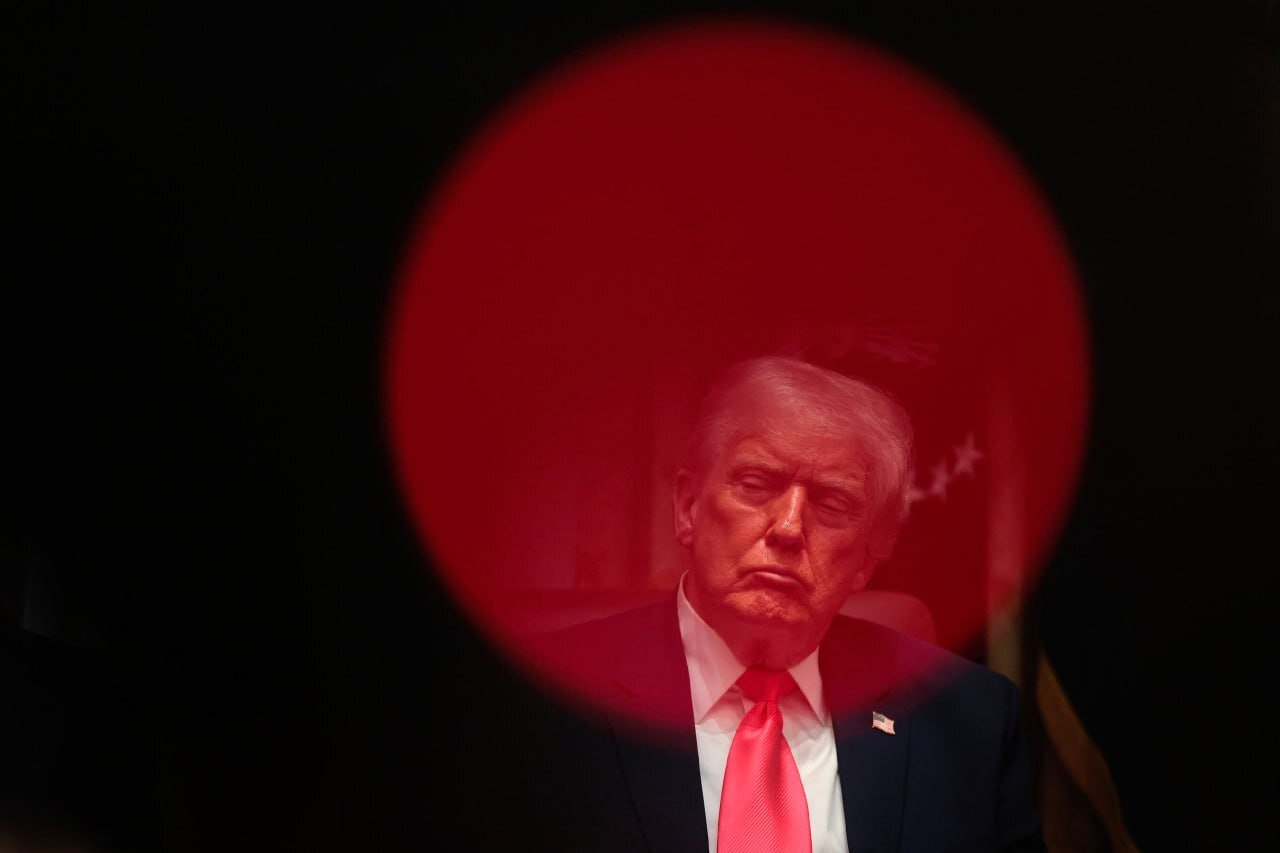
Donald Trump’s recent remarks about the possibility of using weapons of mass destruction have once again raised a discussion that goes beyond the usual political disputes between Tehran and Washington; an issue that has faced serious reactions even inside America. In this context, Tucker Carlson, the well-known American journalist and host, referring to Trump’s statements about the use of nuclear weapons, said these remarks mean crossing a red line. He stressed that any political official who raises the first use of nuclear weapons has lost the qualification to continue leading, and Trump should be removed from power immediately.
The importance of these remarks is not merely in Carlson’s personal position. What matters is the reopening of a discussion that over the past decades has been recognized, even among America’s opponents and rivals, as one of the most dangerous red lines of Washington’s security policy: Can an American president raise the use of nuclear weapons as part of the tools of pressure in a regional crisis, without this threat leading to broad strategic consequences?
The issue is not just a threat.
Trump had previously, during political pressures against Iran, used rhetoric that significantly raised the level of threat. At one point, he said that if Iran did not reach an agreement with America within the specified deadline, “an entire civilization” might be destroyed. Of course, Trump later ruled out the use of nuclear weapons against Iran and stressed that America does not need such weapons.
But in international politics, the distance between “threat,” “bluff,” and “real decision” is never clear enough that one can simply pass over it. A threat becomes dangerous when the other side is forced to factor the probability of its realization into its calculations.
Regarding Iran, this issue has double importance. The Islamic Republic has shown over the past years that under military pressure and threat, it does not necessarily move toward accepting the other side’s demands. In some cases, America’s maximum threats, when faced with real and significant costs for Washington, have led to retreat or a change of position.
From this perspective, part of what Trump pursues as the policy of “maximum pressure” has a fundamental problem: a threat is effective when it has credibility. If a threat is repeated too often but does not achieve the expected result in practice, it not only loses its deterrent power but can also lead to the weakening of the threatener’s credibility.
In analyzing Iran’s behavior, one should not look merely at military power or the number of missiles and drones. The main issue is the formation of a kind of mutual deterrence.
America has a very high destructive power, but military power alone does not mean the ability to impose a political outcome. The experience of past years in the Middle East has shown that the destruction of certain military targets and achieving a stable political end are two completely different matters.
Iran is also trying precisely at this point to increase the cost of America’s military decision. Tehran knows that it cannot match America in terms of the volume of military capability, but it can change the cost-benefit calculation of Washington’s decision.
This is where the concept of deterrence finds meaning. Deterrence does not necessarily mean that a country can defeat the other side; rather, it is enough for it to make the other side understand that military victory does not necessarily mean political victory.
Therefore, when Trump speaks of destroying a country or even a civilization, the issue is not just the intensity of his rhetoric. The more important question is whether Washington is truly prepared to pay the political, economic, security, and regional costs of such a decision.
Tucker Carlson’s reaction should also be seen within this same framework. He is among the figures who have repeatedly warned in recent years about America’s military interventionism and the expansion of foreign wars.
Therefore, his objection is not merely a political disagreement with Trump. Behind this objection lies a deeper concern: if the use of nuclear weapons becomes a normal option in American foreign policy, then the issue will no longer be just Iran. Other countries will also receive the message that security guarantees, the rules of deterrence, and even the boundaries of the use of nuclear weapons may be affected by the decision of a president.
This issue can create a chain effect. Countries that feel vulnerable vis-à-vis great powers may seek to build independent deterrence capability more than before. In such circumstances, instead of reducing the nuclear threat, a race for building greater deterrence will begin.
Perhaps the most important part of the matter is this. The post-Cold War world had tried to preserve the use of nuclear weapons as an exceptional option and the last tool of deterrence. But the more this rhetoric is repeated in everyday political disputes, the more the boundary between “threat for deterrence” and “threat for actual use” becomes blurred.
This trend is dangerous for America as well. Washington’s power does not depend only on its aircraft carriers, fighter jets, and nuclear arsenal; an important part of America’s power stems from its political credibility and the trust of its allies.
If America’s allies feel that Washington’s decisions could drag them into wars whose control has slipped away, it is natural that they will seek more independent options. For this reason, a nuclear threat may appear to be a sign of strength, but in the long term it can be a sign of a crisis in the management of power.
However, everything should not be reduced to the person of Trump. Trump may speak more bluntly, more aggressively, and more unpredictably than many American presidents, but the problems that American foreign policy faces today existed before him as well.
The main issue is the gap between America’s military power and its ability to convert this power into sustainable political results. Washington can still target objectives in various parts of the world, but the question is what happens after the attack? Does the other side surrender? Do America’s allies stand by it? Does domestic public opinion accept the cost of war? And most importantly, can America stop the war at the point it wants?
Ultimately, perhaps the most important message of Carlson’s remarks is that even inside America, a serious disagreement has formed about the boundaries of the use of military power. Iran and the United States may confront each other in various arenas, but it should not be forgotten that every time the rhetoric of nuclear threat enters this dispute, the scope of danger extends beyond the two countries. The issue is no longer just what Trump says or how Iran responds; the issue is that if nuclear threat becomes a normal part of the language of foreign policy, who can guarantee that one day it will not cross the line from threat?
MNA