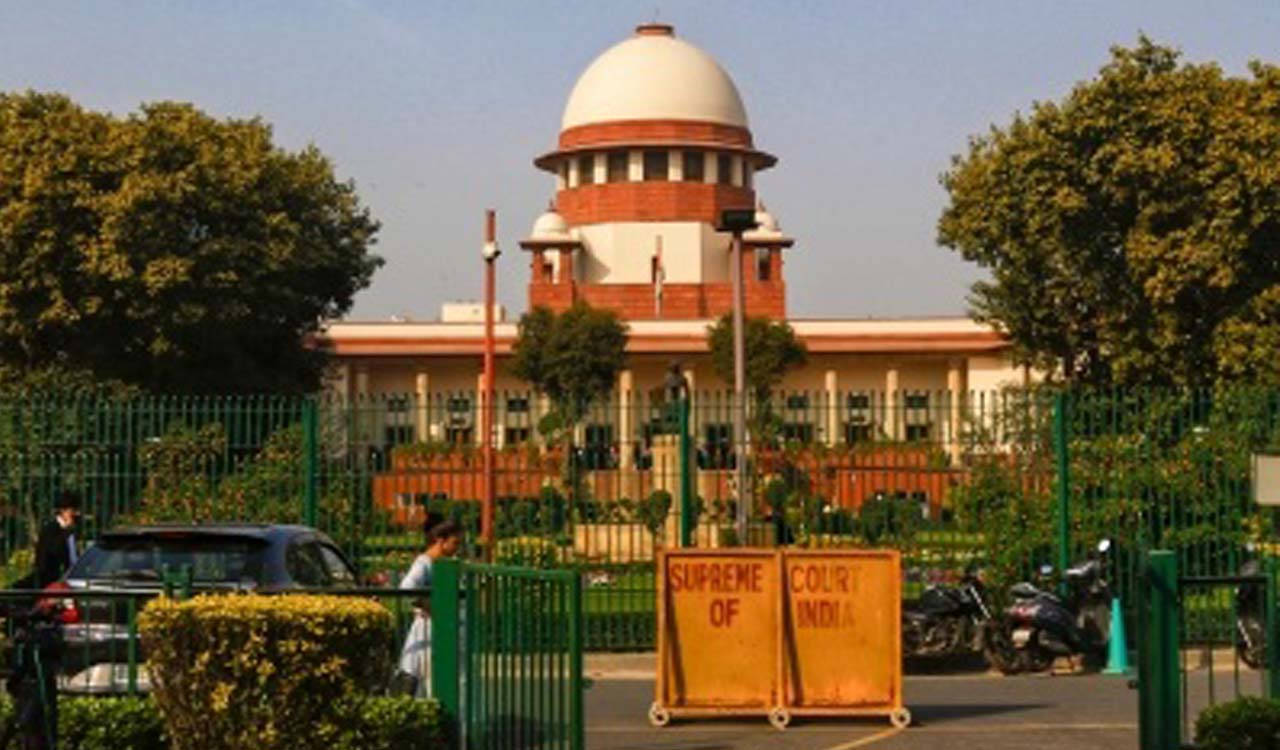
The Supreme Court has ruled that externment orders cannot be issued routinely or solely because multiple criminal cases are registered against a person. It quashed a Chhattisgarh externment order, citing lack of cogent reasons, notice and meaningful opportunity to be heard
Published Date – 31 August 2026, 08:04 PM
New Delhi: The Supreme Court on Monday said an order of externment directly impinges upon the valuable fundamental freedoms guaranteed to a citizen and it cannot be made as a matter of routine. A bench of Justices Dipankar Datta and Sheel Nagu quashed an externment order passed in November last year against a man who was directed to remove himself from the territorial limits of Raigarh and contiguous districts in Chhattisgarh for one year.
The bench said the externment order was “infirm and indefensible” and cannot be sustained for want of any cogent reasons in support thereof. “Further, merely because multiple criminal cases have been registered against a person would not, ipso facto, be a ground for ordering externment,” it said.
It said before exercising such power, the district magistrate is required to arrive at a bona fide and informed subjective satisfaction that circumstances of the case warrant such an extreme measure and that externment is necessary to prevent the apprehended mischief.
The bench said although the authority is not expected to render a judgment in the manner expected of a court of law, the order must nonetheless disclose, at least in broad terms, the reasons which persuaded it to arrive at such satisfaction.
“The existence of objective material and a discernible nexus between such material and the conclusion reached are indispensable safeguards against arbitrary exercise of power,” it said. “An order of externment directly impinges upon valuable fundamental freedoms guaranteed to a citizen and, therefore, cannot be made as a matter of routine or on mere ipse dixit,” the bench said.
The top court delivered its verdict on a plea filed by a man challenging a January order of the Chhattisgarh High Court. The high court had dismissed his plea challenging the order of externment. It had also relegated him to alternative statutory remedy of appeal under Section 9 of the Chhattisgarh Rajya Suraksha Adhiniyam, 1990.
The appellant had approached the high court assailing an ex-parte order of externment passed against him. Dealing with the plea, the top court said no material was placed on record to show why the offences alleged require the appellant to be externed.
“More importantly, as noticed earlier, the appellant was neither served with notice nor afforded an opportunity to tender his explanation before the order came to be passed,” it said. While quashing the high court order as well as the externment order, the bench said the appellant is free to enter the districts from where his externment was ordered.
Referring to one of the provisions of the Adhiniyam, the bench said object of the provision is to ensure that a person, against whom an externment order is proposed, is made aware of the material allegations against him and afforded an effective opportunity to tender his explanation. It said there was no statutory basis for dispensing with compliance of the mandatory requirements of notice and opportunity of hearing before the impugned externment order came to be passed.
The bench noted that in April 2019, a memorandum was submitted by the superintendent of police, Raigarh, to the DM recommending initiation of proceedings against the appellant to extern him under Sections 5(a) and (b) of the Adhiniyam. The top court said it was premised on the appellant’s alleged involvement in 10 criminal cases registered between 2009 and 2019.
Noting that the appellant had been acquitted in the criminal cases referred to in the memorandum, the DM closed the case by letting him off with a warning to refrain from indulging in criminal activities in future.
Two FIRs, including the one arising out of allegations of insulting a saint revered by a particular community, were registered against the appellant and consequently, a fresh report was submitted before the DM. The DM then passed an order for externment. “Having held that the impugned externment order fails on both counts of non-adherence to the rule of a meaningful and effective hearing guaranteed by Section 8 of the Adhiniyam… we are surprised that in a case of such egregious violation of law the high court chose to maintain a hands-off approach and relegated the appellant to the alternative statutory remedy under Section 9 thereof,” the top court said.
It said relegation of the appellant to the statutory remedy under Section 9 of the Adhiniyam is plainly demonstrative of an “abject failure” to exercise a jurisdiction vested in the high court.
The bench also noted it is a settled law that an administrative authority enjoys no power to review his earlier order, unless the statute empowers him to do so. “We have not been shown any such empowering provision and, therefore, it has to be held that the third respondent (DM) exercised a jurisdiction not vested in him by law,” it said.