Mineral-bearing States legitimately deserve an equitable share of the economic value generated from their natural resources
Published Date – 1 September 2026, 12:27 AM
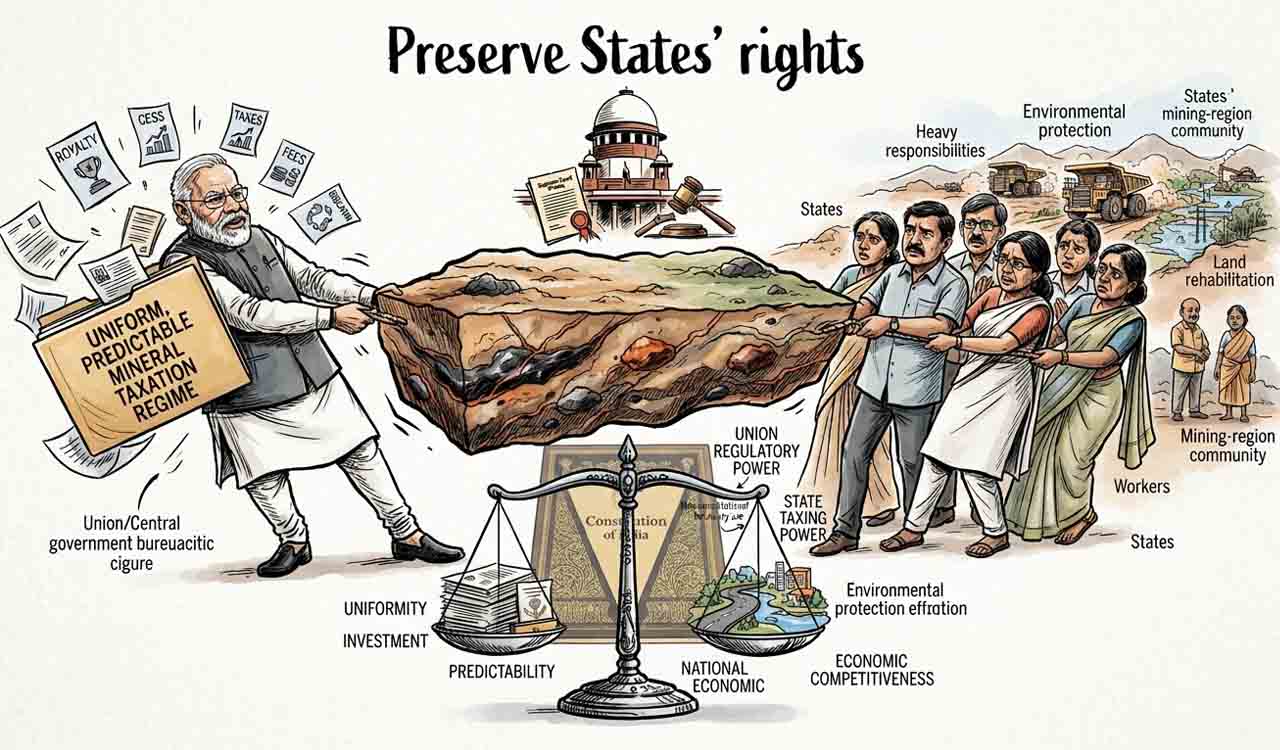
Several policy measures of the NDA government in recent years have been at odds with the federal spirit. There has been a consistent tendency to infringe upon the rights of the States even in matters that fall within their domain. The amendment to the Mines and Minerals (Development and Regulation) Act is the latest example of the Centre’s overreach. The new legislation, which has already received the Presidential Assent, represents a significant recalibration of the Centre-State balance in the governance and taxation of mineral resources. It restricts the States’ ability to impose their own taxes, cesses and similar levies on mineral rights and mineral-bearing land. The Act also expands the Union’s regulatory declaration to cover mineral-bearing lands, not merely mines and mineral development. Even more significantly, levies imposed by the States before the amendment that were not deposited with or recovered by the State are deemed invalid retrospectively. That provision is at the heart of the controversy. While the Centre justified the amendments by saying they were necessary to create a uniform, predictable and investment-friendly mineral taxation regime, several mineral-rich States argue that it curtails a constitutionally recognised State taxing power and could weaken their fiscal autonomy. The mining industry has increasingly complained of a multiplicity of taxes, cesses, fees and charges imposed by different States. According to the Centre, States currently impose about 14 different categories of payments, including royalty, auction premium, dead rent, District Mineral Foundation contributions, GST and transit fees. Some States have additionally imposed taxes on mineral-bearing land, with certain levies reaching 20%.
The Ministry of Mines has also examined how additional State taxes on coal and bauxite could increase aluminium production costs and affect international competitiveness. In these circumstances, such unpredictability could discourage extraction and investment, make some mines commercially unviable, raise raw material costs for downstream industries, and ultimately increase India’s dependence on imported minerals. There is no doubt that the economic rationale underlying this reform deserves recognition. However, mineral resources are geographically located within particular States, and mining activity imposes substantial responsibilities upon those States. Roads and other infrastructure must support the movement of heavy minerals; mining regions require expenditure on water, environmental protection, rehabilitation, and social infrastructure; and the long-term ecological consequences of mineral extraction are borne predominantly by the producing regions. Mineral-bearing States, therefore, legitimately deserve an equitable share of the economic value generated from their natural resources. In a landmark judgement in 2024, the Supreme Court had recognised the States’ constitutional competence to tax mineral-bearing land. The Constitution gives Parliament the power to regulate mines and mineral development under the Union List, while the State List gives States the power to tax mineral rights, subject to limitations imposed by Parliament in relation to mineral development. The key question is how far can Parliament go in restricting that power without effectively appropriating a State’s constitutionally assigned fiscal domain.