RSS chief Mohan Bhagwat said India’s civilisational mission is to promote unity amid diversity through example, not preaching. Addressing an event in New York, he highlighted dharma, mutual responsibility and harmony among individuals, society and the environment as key Indian values
Published Date – 30 August 2026, 08:16 AM
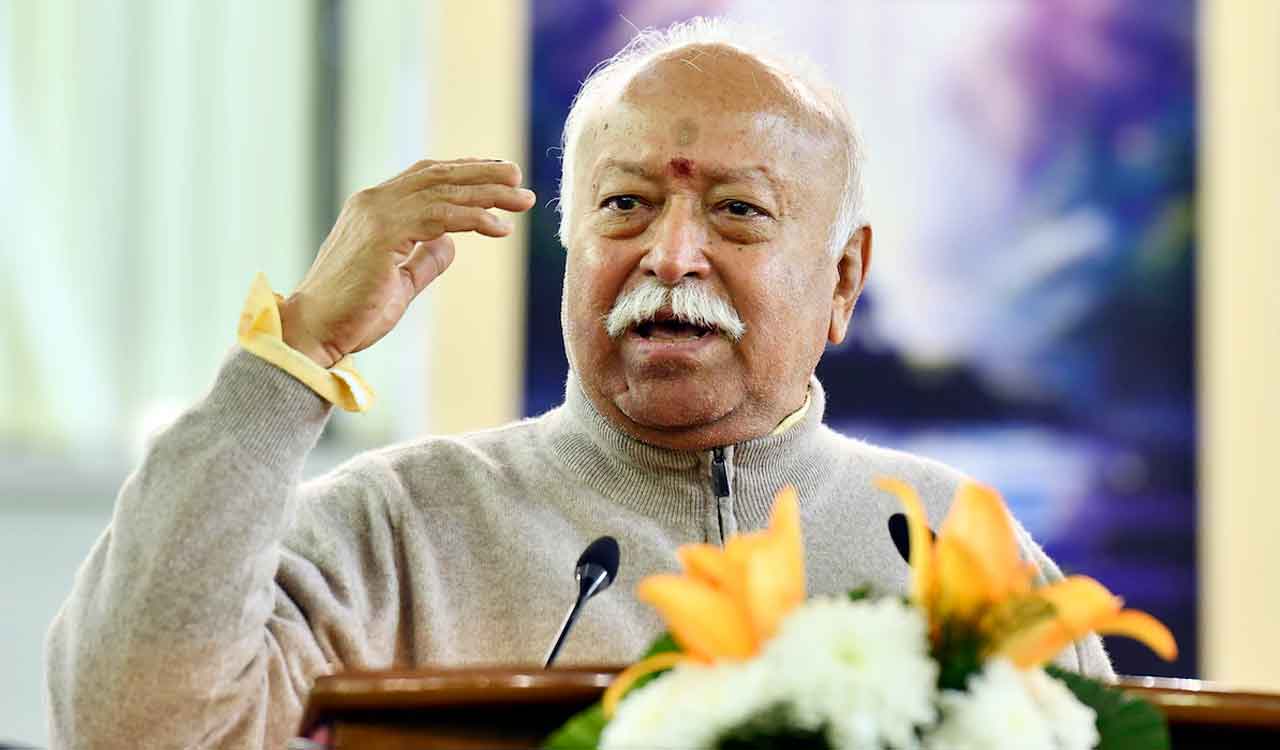
New York: RSS chief Mohan Bhagwat has said India has a civilisational mission to help the world recognise unity amid diversity, arguing that Bharatiyas must convey this message through their conduct rather than preaching.
He said both unity and diversity are embedded in Bharat’s DNA, reflecting the country’s long-standing civilisational ethos of embracing diversity while remaining united. Addressing the Universal Oneness Celebration at Madison Square Garden in New York, Bhagwat said nations were not merely territories.
Each nation, he said, had a distinctive purpose and responsibility. “Nations are not merely geographical entities,” Bhagwat said. “Every nation has a message to deliver. Every nation has a mission to accomplish. Every nation has a destiny to fulfil.” India’s destiny was to recognise the unity underlying the world’s many differences and periodically remind humanity of that principle, he said. “We are one and due to diversity that oneness is decorated. So diversity has to be celebrated, has to be respected, has to be accepted,” Bhagwat said.
“At the same time, we must keep in mind this feeling of oneness. It is a very real feeling.” Bhagwat contrasted the language commonly associated with the United States and India. America, he said, was frequently discussed in terms of pluralism, while India was identified with unity in diversity.
“When we say America, United States of America, one word is often discussed frequently. That is pluralism. And when we say Bharat, another phrase is discussed, unity in diversity,” he said. “For Bharat, this unity and this diversity both are in their DNA.” Bhagwat acknowledged the visible differences among human beings, including nationality, language, religion and ways of life. But he said such distinctions did not erase the innate connection that enabled people to feel concern for one another.
“We appear different. So many nationalities, so many languages, so many religions, so many styles of living,” he said. Human beings had been given both the ability to think and the capacity to understand right and wrong, Bhagwat said.
That placed upon them a responsibility to protect the world and care for others. “Human beings are responsible for the world because they have been given special quality of thinking,” he said. He described the Indian conception of dharma as a sustaining and balancing principle rather than a religion or method of worship. “Dharma is not religion. It is not a worship. It is beyond all this,” Bhagwat said.
“It is the rule through which universe is sustained.” That principle required the individual, society and the environment to advance together, he said. Neither individuals nor society should be suppressed to secure the progress of the other.
“Individual society and the environment, they have to proceed together, progress together,” he said.
Bhagwat said India’s message was especially relevant at a time when the world was struggling with multiple problems. Bharatiyas should demonstrate it through their lives and actions. “That is the mission Bharat has to accomplish. That is the message Bharatiya’s world over have to give by their own example, not by preaching, by practice,” he said.
“If we do that, that will be a boon for the world struggling with all these problems and stumbling at every step.”
The Rashtriya Swayamsevak Sangh was founded in Nagpur in 1925 by Keshav Baliram Hedgewar. It marked its centenary in 2025, having grown into a nationwide volunteer organisation with affiliates working in several areas of public life. Bhagwat, a veterinary science graduate, became a full-time RSS pracharak in 1975. He assumed office as the organisation’s sixth Sarsanghchalak in 2009.