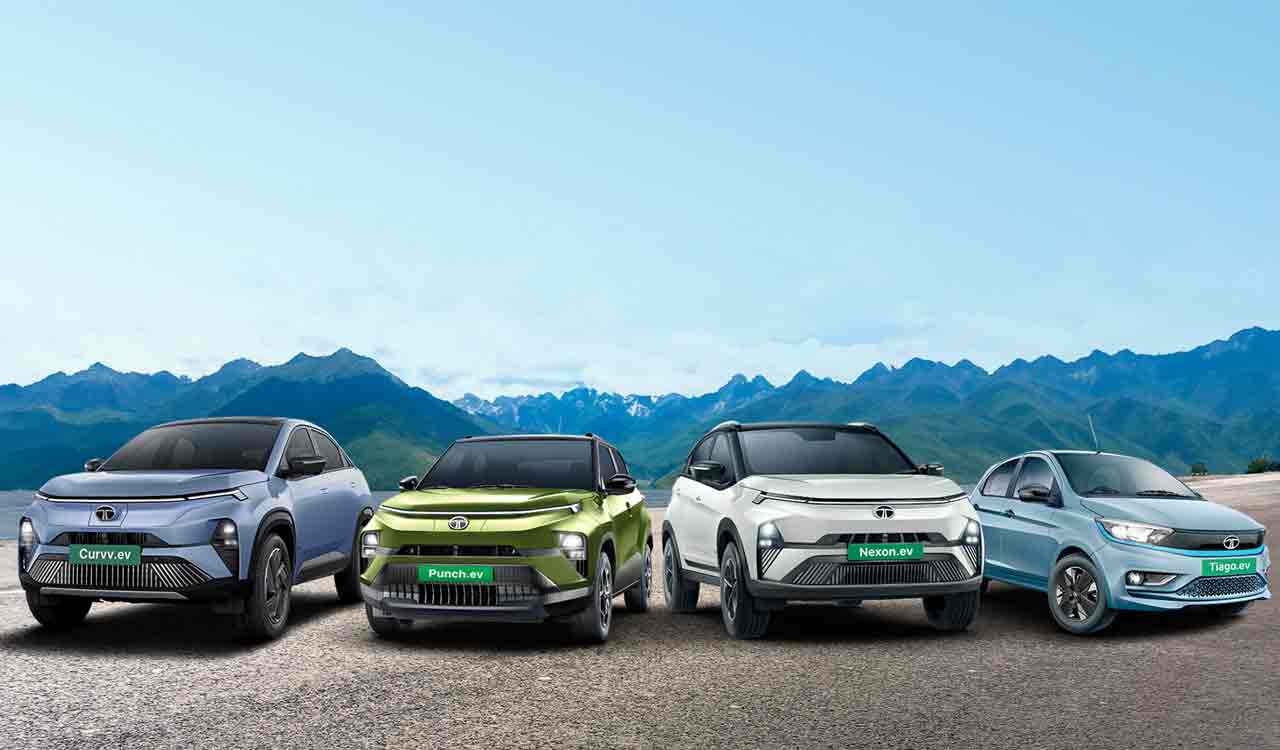
Tata Motors Passenger Vehicles Ltd is gaining market share in the electric vehicle segment, with EV bookings rising three-fold over six months. The automaker expects strong festive-season demand, although production capacity constraints could limit its ability to fully meet demand
Published Date – 30 August 2026, 03:45 PM
New Delhi: Tata Motors Passenger Vehicles Ltd is gaining market share in the electric vehicle (EV) segment and has seen a three-fold increase in EV bookings over the last six months, even as production capacity constraints restrict its ability to fully capitalise on strong demand, according to a senior company official.
In an interview with PTI, Tata Passenger Electric Mobility Ltd Chief Commercial Officer Vivek Srivatsa said, “If you see the last two or three months, we are actually gaining market share every month. So, it is the other way round, and, in fact, in the last six months, the gap between us and the number two player has increased. And I would also publicly state that we have had 3x growth in bookings for EVs, and we are only restricted by our production capability.”
Tata Passenger Electric Mobility Ltd is part of the Tata Motors Passenger Vehicles Ltd group.
“I think consumers are increasingly confident about our products, and we have the widest product range, providing EVs for all kinds of different use cases,” he said.
The company is also expecting a strong festive season, with Srivatsa saying the current momentum could make the September-December period the industry’s largest-ever quarter.
“I think the trends are very positive. You know, if you look at the first quarter, I think the industry had never before seen growth of close to 46 per cent year-on-year.
“EVs have grown even faster, with 77 per cent year-on-year growth. And if I look at the months of July and August, the momentum seems to continue, and that means the indications for the festive season are that it is going to be extremely positive, quite likely to be the largest quarter for the industry,” he said.
Srivatsa, however, acknowledged that the industry’s year-on-year growth rate could moderate from the end of September as the base effect kicks in, even though absolute sales could remain strong.
“In terms of percentage growth, we might taper off, but actual numbers would still probably be extremely high,” he said.
The demand momentum has persisted nearly a year after the government’s GST 2.0 reforms came into effect on September 22, 2025.
Under the revised GST structure, electric vehicles continue to attract 5 per cent GST, while GST on small cars was reduced from 28 per cent to 18 per cent. The GST rate on larger cars was rationalised to 40 per cent without compensation cess.
According to Srivatsa, the impact of GST rationalisation continues to support vehicle affordability, while new launches have expanded consumer choice.
“Yeah, I think the impact of GST 2.0 is continuing even now, close to a year after it was launched. Consumers are still seeing the benefit. Added to that, I think product launches have added a lot of options for consumers. That is what is going to power the festive season,” he said.
The strong outlook comes despite recent price increases announced by automakers, including Tata Passenger Electric Mobility.
The company is set to raise prices in September, but Srivatsa said he did not expect the move to materially affect festive-season demand, while the impact beyond the festive period would need to be monitored.
“I think price hikes have been fairly recent. We are taking a price hike in September. I would say that the price hike should not affect the festive season, but, longer term, what happens after the festive season is something we will have to watch out for,” he said.
Srivatsa also attributed the broader demand momentum to factors beyond GST, including a growing consumer preference for alternative-fuel vehicles following the West Asia crisis and changing mobility preferences among Indian consumers.
“GST has made cars more accessible and also increased EV adoption or alternative-fuel adoption. The West Asia crisis is also pushing customers to look at alternative-fuel options. On the softer side, behaviourally, if you see, I think Indian consumers are increasingly inclined towards on-road travel with their families,” he said.